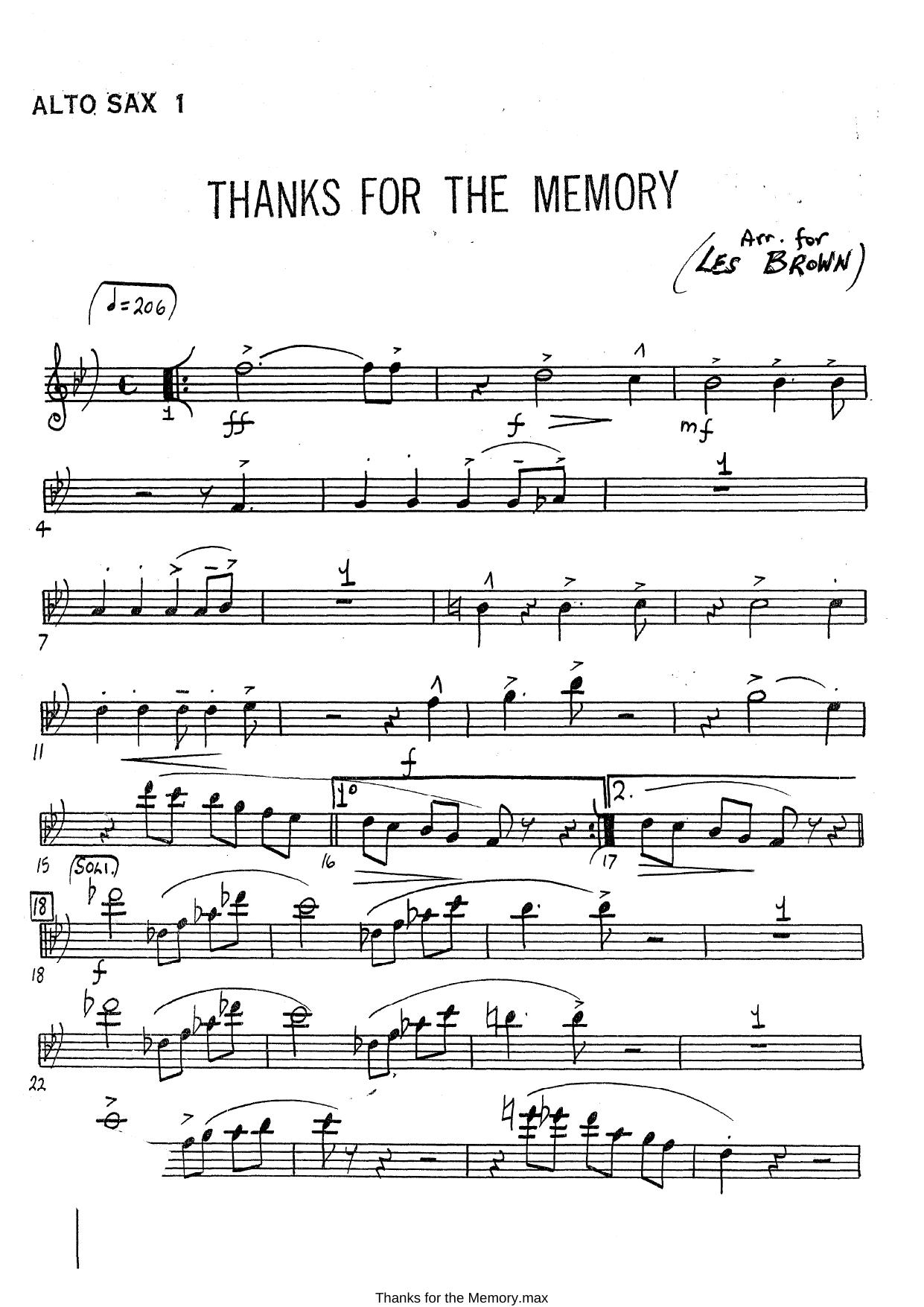
Thanks For The Memory (L.Brown)
Composed by Ralph Rainger
Arranged by Les Brown
- Ensemble: Big Band
- Pages: 51
- Instruments (17): Alto Sax 1, Alto Sax 2, Tenor Sax 1, Tenor Sax 2, Baritone Sax, Trumpet 1, Trumpet 2, Trumpet 3, Trumpet 4, Trombone 1, Trombone 2, Trombone 3, Trombone 4, Piano, Bass, Drums, Guitar
- Difficulty: advanced
- Content: Individual Parts
- Format: PDF Download (Instant)
- Price: $24.99
Ralph Rainger and Leo Robin originally penned "Thanks for the Memory" for the 1938 musical comedy film *The Broadcast of 1938*, where it was famously introduced by Bob Hope and Shirley Ross. The tune quickly transcended its cinematic origins to become Bob Hope’s lifelong theme song and an enduring American jazz standard. Recorded by countless vocal and instrumental icons throughout the swing era and beyond, its bittersweet, nostalgic melody offers a masterclass in harmonic storytelling. Within the vast landscape of big band literature, few interpretations hold as much historical weight as those tailored for the masters of swing, bridging the gap between lush cinematic balladry and sophisticated dance orchestration. Les Brown’s masterful treatment of this classic standard balances bittersweet nostalgia with the crisp, highly polished swing precision that defined the "Band of Renown." Opening with a reflective, atmospheric introduction, the arrangement quickly settles into a sophisticated medium-swing groove driven by a subtle, pulsing rhythm section. The mood shifts effortlessly between lush, harmonically rich ensemble passages and swinging, driving interjections. Brown’s signature voicings utilize tight, sophisticated chord clusters in the saxophones and warm, harmon-muted brass textures that evoke the sophisticated nightlife of the late 1930s and 1940s, capturing both the melancholy of the lyric and the irrepressible optimism of the swing era. The 51-page manuscript is meticulously scored for a compact 9-instrument big band instrumentation, featuring Alto Saxophone, Tenor Saxophone, Baritone Saxophone, Trumpet, Trombone, and a robust rhythm section foundation. The melodic weight is shared gracefully across the horn section, featuring evocative saxophone solis that highlight section blend and intonation, alongside crisp brass counter-melodies. Featured solo space allows individual horn players to stretch out over changes that honor the sophisticated chord progression. Technical demands center less on breakneck speed and more on breath control, stylistic uniformity, dynamic nuance, and maintaining an effortless, laid-back swing feel at a moderate tempo. Advanced high school, collegiate, and professional community big bands will find this arrangement an exceptionally rewarding addition to their repertoire. Because it relies heavily on stylistic maturity, dynamic contrast, and precise articulation rather than sheer technical velocity, it serves as an ideal vehicle for teaching stylistic authenticity. Directors will appreciate how the rich harmonic textures and iconic Les Brown stylistic markers engage the audience, making it a standout selection for formal concert programming, festival adjudications, or vintage-themed dance sets. Executing this chart successfully requires a deep commitment to the polished, driving swing style championed by Les Brown. The tempo should remain a comfortable, confident medium swing; pushing the tempo too hard destroys the relaxed, sophisticated groove essential to the chart's charm. The rhythm section must lock into a steady, unhurried quarter-note pulse, with the bassist keeping a walking line that breathes and the drummer utilizing a crisp, feathered bass drum and light ride cymbal sizzle. Technically, the primary challenges lie in blend, balance, and intonation within the 9-instrument texture. Because the horn section is streamlined, every player must project their part with absolute clarity. Pay close attention to dynamic markings: the contrast between lush, whispered passages and punchy, accented shout moments defines the arrangement's architectural arc. Brass players should master standard swing articulations—dach notes on upbeats and well-supported tenuto marks on downbeats—while ensuring that mutes are handled with precise timing. Rehearsal should begin slowly, isolating the saxophone soli sections to lock in phrasing and vibrato before integrating the rhythm section's harmonic support. Q: What instruments and parts are included in this arrangement? A: This arrangement is scored for a 9-instrument big band lineup, comprising Alto Saxophone, Tenor Saxophone, Baritone Saxophone, Trumpet, Trombone, and a full rhythm section (piano, bass, drums, and guitar). Q: What is the difficulty level of this chart? A: It is suited for advanced high school, collegiate, and professional community big bands, requiring strong ensemble listening skills, precise swing articulation, and stylistic maturity rather than extreme technical speed. Q: What is the historical and stylistic context of the piece? A: Originally composed by Ralph Rainger in 1938 as Bob Hope's signature tune, this arrangement filters the classic jazz standard through the sophisticated, polished swing aesthetic characteristic of Les Brown and his Band of Renown. Q: What makes this specific Les Brown arrangement unique? A: It stands out for its clever 9-instrument voicing that achieves the harmonic fullness of a 17-piece orchestra, combining lush, tightly-voiced saxophone solis with warm brass textures and a relaxed, driving medium-swing groove. Q: What is the recommended performance tempo and duration? A: The arrangement is set in a comfortable, confident medium-swing tempo (approximately 112 to 120 beats per minute) and typically runs around 3 to 4 minutes in performance duration, depending on solo extensions.
Questions and answers
- What is included in the Thanks For The Memory (L.Brown) PDF?
- The verified current file contains individual parts across 51 pages.
- How many instruments or parts are listed for Thanks For The Memory (L.Brown)?
- The verified instrumentation list contains 17 entries for this Big Band arrangement.
- Who is credited for Thanks For The Memory (L.Brown)?
- Composer: Ralph Rainger. Arranger: Les Brown.
- What difficulty is listed for Thanks For The Memory (L.Brown)?
- The verified difficulty level is advanced.
- Can I preview Thanks For The Memory (L.Brown) before buying?
- Yes. The product page provides a preview generated from the current PDF file.
- How is Thanks For The Memory (L.Brown) delivered?
- After successful payment, the digital PDF is made available for download. The displayed price is $24.99.
Musicians Also Search For
Thanks For The Memory Les Brown PDF • Thanks For The Memory Les Brown sheet music • Thanks For The Memory arranged by Les Brown • Les Brown big band charts • Les Brown jazz arrangements PDF • Thanks For The Memory Ralph Rainger sheet music • Thanks For The Memory Ralph Rainger big band arrangements • Ralph Rainger big band charts • Thanks For The Memory big band arrangements • Thanks For The Memory big band PDF download • Thanks For The Memory jazz sheet music • big band sheet music download • Thanks For The Memory individual parts download • Thanks For The Memory sheet music PDF • buy Thanks For The Memory sheet music • download Thanks For The Memory PDF • Thanks For The Memory jazz charts • best Les Brown big band arrangements • Ralph Rainger arranged by Les Brown • Thanks For The Memory printable sheet music • big band repertoire PDF