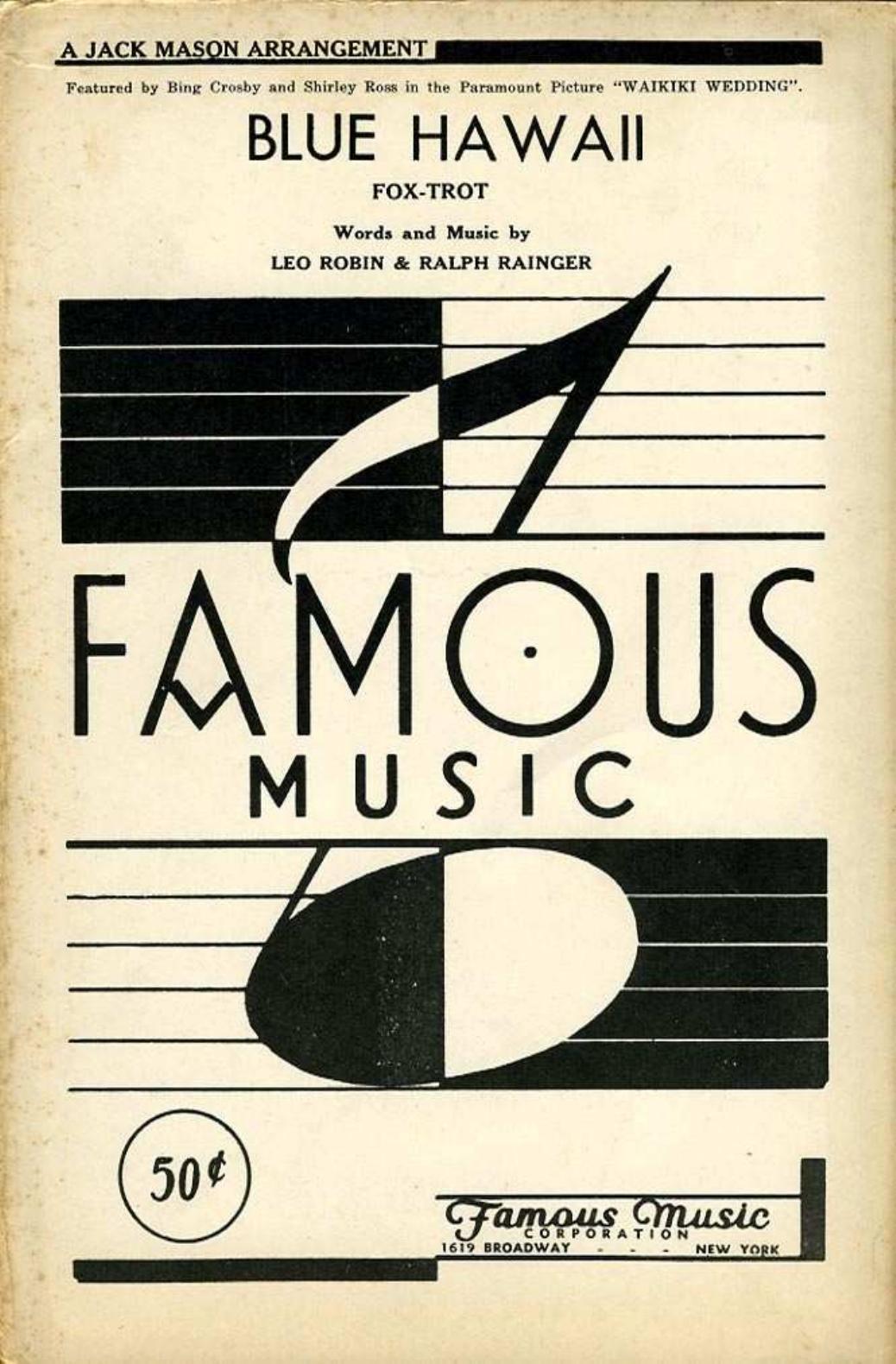
Blue Hawaii (J.Mason)
Composed by Ralph Rainger
Arranged by Jack Mason
- Ensemble: Big Band
- Pages: 30
- Instruments (15): 1st Sax. Eb Alto, 2nd Sax. Bb Tenor, 3rd Sax. Eb Alto, 4th Sax. Eb Baritone, 1st Trombone, 2nd Trombone, 1st Trumpet in Bb, 2nd Trumpet in Bb, 3rd Trumpet in Bb, Piano, Guitar or Banjo, Bass, Drums, Violin A-B, Violin C
- Difficulty: medium
- Content: Individual Parts
- Format: PDF Download (Instant)
- Price: $24.99
Ralph Rainger and Leo Robin originally penned "Blue Hawaii" for the 1937 Paramount musical *Waikiki Wedding*, where it was famously introduced by Bing Crosby, cementing its place in the American songbook before later undergoing a mid-century cultural resurgence through Elvis Presley's iconic 1961 soundtrack work. This timeless melody bridges the gap between pre-war popular song architecture and tropical exotica, offering a remarkably malleable framework for jazz interpretation. Transported from its cinematic island origins into the rich palette of a contemporary jazz ensemble, the composition thrives under the weight of swinging syncopation and lush harmonic extensions, transforming a familiar film tune into a sophisticated vehicle for ensemble interaction. Jack Mason’s arrangement reimagines the classic tune with a sophisticated medium-swing groove that balances relaxed tropical warmth with driving, hard-swing momentum. Operating in a comfortable, resonant key center, the arrangement establishes a laid-back yet infectious pocket right from the outset, driven by a crisp rhythm section foundation. The mood shifts fluidly between breezy, harmonized horn lines that evoke gentle ocean breezes and gutsy, blues-inflected countermelodies. Mason avoids cliché novelty effects in favor of rich, block-chord voicings and subtle chromatic passing tones, imbuing the nostalgic melody with a mature, sophisticated jazz sensibility that feels both fresh and respectful of its origins. The 30-page score is meticulously crafted for a flexible 7-instrument ensemble—featuring Alto Saxophone, Tenor Saxophone, Trumpet, Trombone, and a robust rhythm section including Piano—allowing smaller horn sections to achieve a surprisingly full, big-band-style acoustic footprint. The melody is shared fluidly across the frontline horns, utilizing tight sax solis and punchy brass interjections that create dynamic contrast. Improvisational opportunities are integrated naturally into the form, providing designated solo space over accessible chord changes that invite players to stretch out without feeling overwhelmed. Technical demands remain judiciously managed, focusing instead on blend, intonation, swing articulation, and stylistic cohesiveness rather than blazing technical virtuosities. Advanced high school ensembles, collegiate combos, and professional community big bands will find this chart to be an exceptionally rewarding addition to their repertoire. It serves as an ideal concert programmer, offering audiences an instantly recognizable melody while giving discerning musicians enough harmonic depth and stylistic challenge to sink their teeth into. The careful pacing, intelligent scoring, and balanced distribution of melodic material ensure that every player on the stage remains actively engaged from the first downbeat to the final chord. Achieving the authentic groove of this arrangement requires strict attention to a relaxed, behind-the-beat medium swing feel. Avoid rushing the quarter-note pulse; the momentum should come from the natural forward push of the eighth-note triplet subdivision rather than sheer velocity. Horn players must master uniform articulation, ensuring that all short notes are cleanly clipped and accented notes receive a warm, vocal-like weight. The rhythm section acts as the primary engine: the pianist should lean into sparse, comping shell voicings that leave plenty of room for the horns, while the bassist maintains a walking quarter-note line with strong emphasis on beats two and four. Balance is crucial given the compact 7-instrument configuration—players must listen across sections to ensure the inner voice harmonies project clearly beneath the primary melody. Pay close attention to dynamic markings during the transition into the solo sections, allowing the soloist ample acoustic room to breathe without sacrificing the underlying groove. Q: What instruments and parts are included in this arrangement? A: This chart is scored for a 7-instrument configuration featuring Alto Saxophone, Tenor Saxophone, Trumpet, Trombone, and a full rhythm section anchored by Piano, making it ideal for smaller big bands and expanded jazz combos. Q: What is the difficulty level of this Jack Mason arrangement? A: It is graded as medium difficulty, making it well-suited for advanced high school musicians, collegiate ensembles, and professional groups looking for an accessible yet musically rich chart. Q: What is the musical style and historical context of "Blue Hawaii"? A: Originally written by Ralph Rainger for the 1937 film *Waikiki Wedding* and famously popularized by Bing Crosby, this arrangement reimagines the classic tune in a sophisticated, medium-swing jazz style. Q: What makes this specific arrangement by Jack Mason unique? A: Mason’s treatment distills the sonic breadth of a traditional big band into a tightly voiced 7-instrument format, utilizing lush block chords, smart counterpoint, and flexible solo sections without losing the piece's iconic warmth. Q: What is the recommended performance duration and tempo for this piece? A: The arrangement runs approximately 3 to 4 minutes and is best performed at a relaxed medium-swing tempo that prioritizes pocket, groove, and clean articulation over speed.
Questions and answers
- What is included in the Blue Hawaii (J.Mason) PDF?
- The verified current file contains individual parts across 30 pages.
- How many instruments or parts are listed for Blue Hawaii (J.Mason)?
- The verified instrumentation list contains 15 entries for this Big Band arrangement.
- Who is credited for Blue Hawaii (J.Mason)?
- Composer: Ralph Rainger. Arranger: Jack Mason.
- What difficulty is listed for Blue Hawaii (J.Mason)?
- The verified difficulty level is medium.
- Can I preview Blue Hawaii (J.Mason) before buying?
- Yes. The product page provides a preview generated from the current PDF file.
- How is Blue Hawaii (J.Mason) delivered?
- After successful payment, the digital PDF is made available for download. The displayed price is $24.99.
Musicians Also Search For
Blue Hawaii Jack Mason PDF • Blue Hawaii Jack Mason sheet music • Blue Hawaii arranged by Jack Mason • Jack Mason big band charts • Jack Mason jazz arrangements PDF • Blue Hawaii Ralph Rainger sheet music • Blue Hawaii Ralph Rainger big band arrangements • Ralph Rainger big band charts • Blue Hawaii big band arrangements • Blue Hawaii big band PDF download • Blue Hawaii jazz sheet music • big band sheet music download • Blue Hawaii individual parts download • Blue Hawaii sheet music PDF • buy Blue Hawaii sheet music • download Blue Hawaii PDF • Blue Hawaii jazz charts • best Jack Mason big band arrangements • Ralph Rainger arranged by Jack Mason • Blue Hawaii printable sheet music • big band repertoire PDF