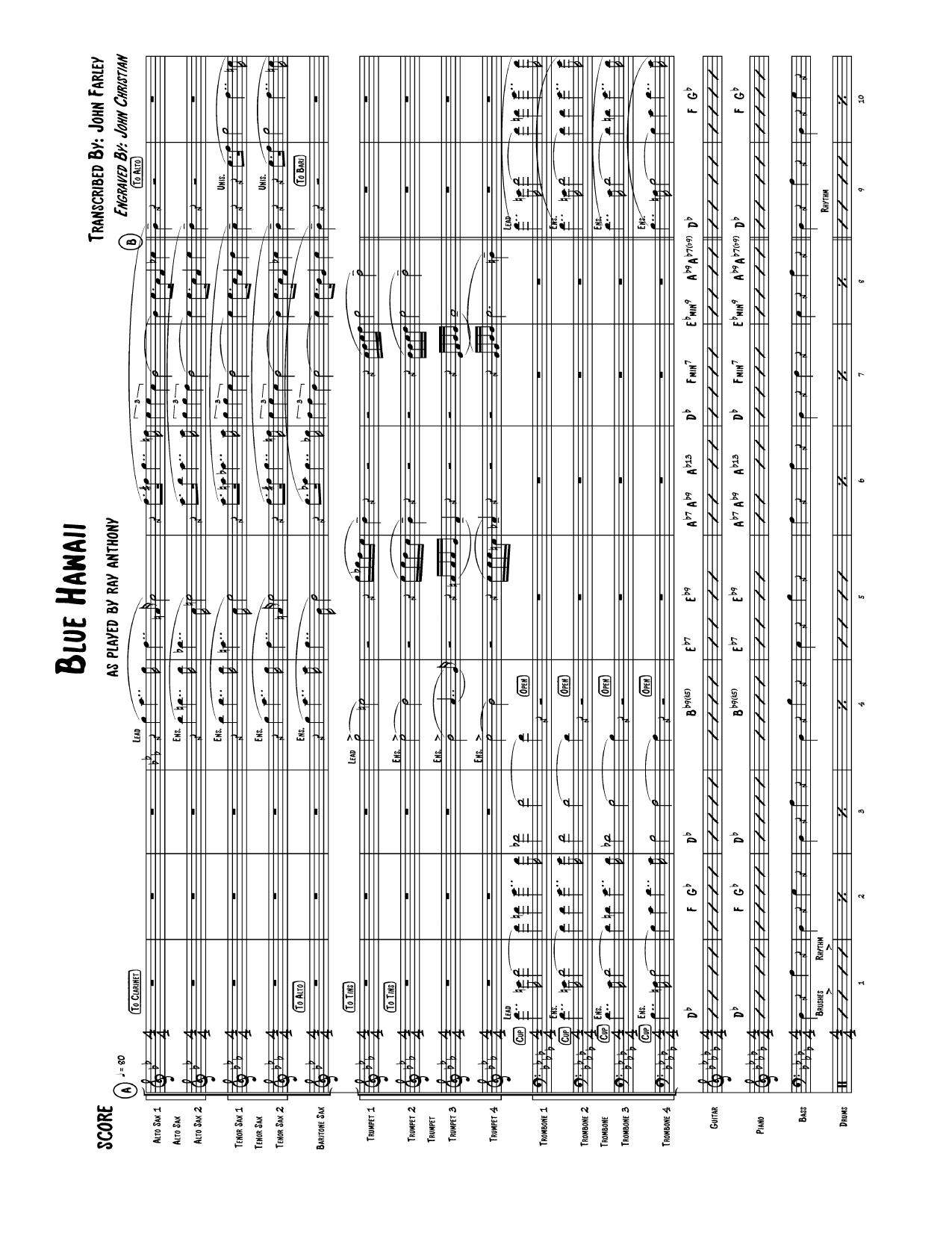
Blue Hawaii (J.Farley)
Composed by Ralph Rainger
Arranged by John Farley
- Ensemble: Big Band
- Pages: 25
- Instruments (17): Alto Saxophone 1, Alto Saxophone 2, Tenor Saxophone 1, Tenor Saxophone 2, Baritone Saxophone, Trumpet 1, Trumpet 2, Trumpet 3, Trumpet 4, Trombone 1, Trombone 2, Trombone 3, Trombone 4, Guitar, Piano, Bass, Drums
- Difficulty: medium
- Content: Individual Parts
- Format: PDF Download (Instant)
- Price: $24.99
Ralph Rainger and Leo Robin originally penned "Blue Hawaii" for the 1937 Paramount musical film *Waikiki Wedding*, where it was famously introduced by Bing Crosby. While the song became inextricably linked to the islands and later underwent a mid-century pop-culture resurgence through Elvis Presley’s 1961 soundtrack, jazz arrangers have long recognized its sophisticated, yearning harmonic underpinnings. The tune occupies a fascinating intersection between the lush Hollywood ballad tradition and the rich chord progressions that beckoned jazz interpreters. Its enduring appeal lies in a deceptively simple melody that floats effortlessly over a surprisingly rich harmonic landscape, making it an ideal canvas for sophisticated jazz orchestration. John Farley’s big band setting reimagines the classic tune through a sophisticated, mid-tempo swing lens, shifting the mood from cinematic pastiche to late-night sophistication. Opening with a rubato atmospheric intro that hints at the tropical origins before settling into a relaxed, pulsing medium-swing groove (approx. 116 BPM), the chart balances misty nostalgia with driving rhythmic momentum. The arrangement is characterized by warm, Ellingtonian brass voicings, fluid saxophone solis, and subtle harmonic extensions that freshen the familiar melody. Farley avoids cheap exotica clichés, instead treating the material with harmonic depth, utilizing rich diminished passing chords and lush block-chord textures that evoke the sophisticated ambiance of a 1950s Manhattan supper club. The melodic weight is shared dynamically across the ensemble, opening with a velvety lead alto presentation before the full brass section enters with counter-melodic commentary. A standout feature of the chart is a tightly knit sax soli in the style of Benny Carter, which leads directly into an open solo section designated for tenor saxophone and piano, backed by tasteful, interactive comping figures from the rhythm section. The subsequent shout chorus builds organically without rushing the tempo, using dynamic contrast and well-placed syncopation to create maximum excitement before returning to a quiet, glowing recapitulation and a lingering, harmonically enriched tag ending. Advanced high school ensembles with strong section players, as well as collegiate and community jazz orchestras, will find this arrangement an exceptional vehicle for developing stylistic maturity, blend, and dynamic control. While the technical demands on individual players are moderate—avoiding extreme altissimo ranges or breakneck tempos—the chart places a heavy premium on ensemble listening, intonation, and a unified swing articulation. It serves as a brilliant concert centerpiece or a polished festival selection that rewards subtle musicality over sheer volume. Success with this chart hinges on maintaining a relaxed, buoyant medium-swing eighth-note feel; avoid rushing the tempo during dynamic peaks. The rhythm section is the engine here: the drummer should keep the ride cymbal crisp with a feather-light bass drum touch (four-to-the-bar style), while the bassist locks in with a walking line that emphasizes the underlying harmonic shifts rather than heavy root-bound pulses. Horn players must pay close attention to dynamic markings, particularly during the sax soli where breath support and blend are critical to achieving a vocal quality. Brass players should utilize cup mutes or gentle basket mutes where indicated in the softer ensemble choruses to achieve that authentic retro warmth. Rehearsal should begin by isolating the rhythm section and lead saxophones to lock in the articulation of the syncopated figures before adding the brass. Emphasize horizontal phrasing over vertical note-bashing to let Rainger’s gorgeous melody breathe across Farley's sophisticated harmonic canvas. Q: What instrumentation and parts are included in this big band arrangement? A: The package includes a comprehensive conductor score and 18 distinct instrumental parts, featuring standard big band instrumentation: Bb Clarinet, Alto Saxophone 1, Alto Saxophone 2, Tenor Saxophone 1, Tenor Saxophone 2, plus full brass and rhythm sections. Q: What is the difficulty level of John Farley's "Blue Hawaii"? A: This arrangement is rated as medium-advanced (Grade 4), making it ideal for accomplished high school groups, collegiate jazz bands, and professional community ensembles looking for sophisticated sectional interplay. Q: What is the historical background and style of this piece? A: Originally composed by Ralph Rainger for the 1937 film *Waikiki Wedding* and famously sung by Bing Crosby, this arrangement reinterprets the classic tune as a sophisticated, mid-tempo jazz swing chart with rich, modern harmonic extensions. Q: What makes this specific arrangement by John Farley unique? A: Farley departs from traditional exotica interpretations by employing lush Ellingtonian voicings, a gorgeous Benny Carter-esque saxophone soli, and intelligent harmonic substitutions that elevate a pop standard into a refined jazz chart. Q: What is the recommended performance duration and tempo for this arrangement? A: The chart plays out in approximately 4 to 5 minutes when performed at the recommended medium-swing tempo of around 116 beats per minute.
Questions and answers
- What is included in the Blue Hawaii (J.Farley) PDF?
- The verified current file contains a conductor score and individual parts across 25 pages.
- How many instruments or parts are listed for Blue Hawaii (J.Farley)?
- The verified instrumentation list contains 17 entries for this Big Band arrangement.
- Who is credited for Blue Hawaii (J.Farley)?
- Composer: Ralph Rainger. Arranger: John Farley.
- What difficulty is listed for Blue Hawaii (J.Farley)?
- The verified difficulty level is medium.
- Can I preview Blue Hawaii (J.Farley) before buying?
- Yes. The product page provides a preview generated from the current PDF file.
- How is Blue Hawaii (J.Farley) delivered?
- After successful payment, the digital PDF is made available for download. The displayed price is $24.99.
Musicians Also Search For
Blue Hawaii John Farley PDF • Blue Hawaii John Farley sheet music • Blue Hawaii arranged by John Farley • John Farley big band charts • John Farley jazz arrangements PDF • Blue Hawaii Ralph Rainger sheet music • Blue Hawaii Ralph Rainger big band arrangements • Ralph Rainger big band charts • Blue Hawaii big band arrangements • Blue Hawaii big band PDF download • Blue Hawaii jazz sheet music • big band sheet music download • Blue Hawaii conductor score PDF • Blue Hawaii individual parts download • Blue Hawaii sheet music PDF • buy Blue Hawaii sheet music • download Blue Hawaii PDF • Blue Hawaii jazz charts • best John Farley big band arrangements • Ralph Rainger arranged by John Farley • Blue Hawaii printable sheet music • big band repertoire PDF