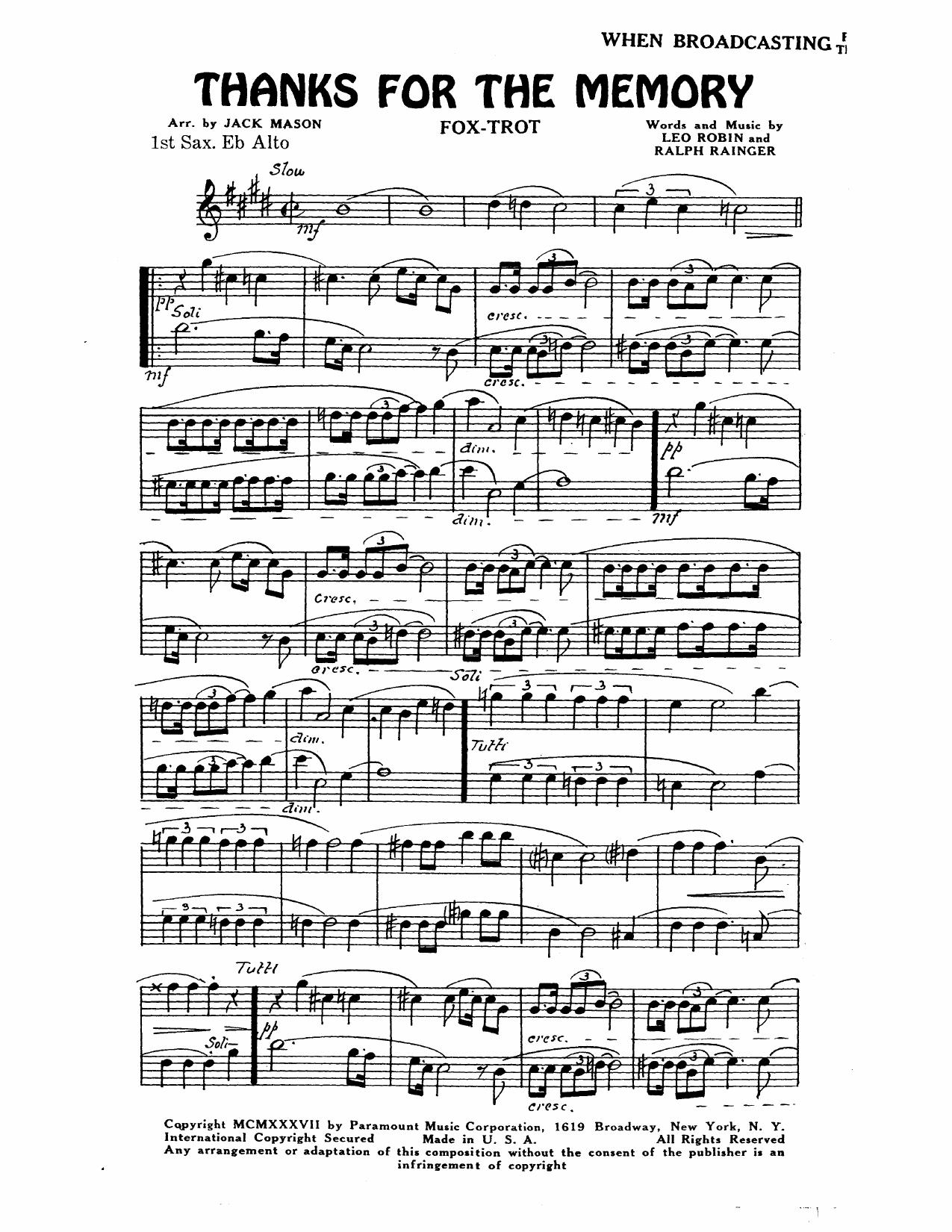
Thanks For The Memory (J.Mason) sheet music preview

Thanks For The Memory (J.Mason)

Composed by Ralph Rainger

Arranged by Jack Mason

  • Ensemble: Big Band
  • Pages: 24
  • Instruments (12): 1st Sax. Eb Alto, 2nd Sax. Bb Tenor, 3rd Sax. Eb Alto, 4th Sax. Eb Baritone, 1st Trumpet in Bb, 2nd Trumpet in Bb, 3rd Trumpet in Bb, 1st Trombone, 2nd Trombone, Piano, Bass, Drums
  • Difficulty: medium
  • Content: Individual Parts
  • Format: PDF Download (Instant)
  • Price: $24.99

Ralph Rainger and Leo Robin’s immortal standard "Thanks for the Memory" occupies a revered place in the Great American Songbook, forever linked to the inimitable wit and nostalgic charm of Bob Hope, who introduced it in the 1938 musical comedy film *The Big Broadcast of 1938*. Evolving rapidly from its cinematic origins into an essential jazz and pop vehicle, the tune has been interpreted by everyone from classic vocalists to instrumental modernists like Chet Baker and Art Pepper. Its bittersweet harmonic progression and unforgettable lyrical hook lend themselves naturally to jazz reharmonization, making it a brilliant canvas for mid-century and contemporary big band arranging. Jack Mason’s sophisticated big band interpretation transforms this melancholy classic into an evocative, beautifully textured medium-swing ballad. The arrangement balances a warm, sepia-toned nostalgia with rich, expanded jazz harmonies that give the ensemble a lush, cinematic depth. Shifting effortlessly between intimate, exposed horn writing and sweeping, full-ensemble dynamic swells, the chart captures a reflective yet deeply swinging mood. The emotional core oscillates between tender reminiscence and buoyant, understated rhythmic drive, offering a masterclass in how a mature big band can extract maximum expression from a familiar melody without overcomplicating its narrative arc. Mason’s arranging hand is immediately recognizable in the clever distribution of lines across the standard 12-instrument instrumentation, ensuring that a leaner big band setup still achieves a robust, room-filling acoustic footprint. The woodwind section—configured with two altos, tenor, and baritone—frequently deploys close-position voicing that creates a velvety, sax-soli texture reminiscent of classic Johnny Richards or Billy May writing. Brass integration is seamless, utilizing muted trumpets for a smoky, vintage atmosphere in the head before opening up into warm, harmonically rich ensemble passages. Rather than relying on a traditional, explosive shout chorus, Mason builds tension through subtle chromatic mediant modulations and shifting dynamic plateaus that force the band to listen closely and lock in their intonation. Melody distribution is shared thoughtfully across the ensemble, giving the woodwinds ample opportunity to state the iconic theme before brass counters with answering motives. While structured to highlight the collective ensemble blend, the chart leaves strategic space for an expressive improvised solo—ideally suited for tenor saxophone or trumpet—backed by tasteful, sparse rhythm section comping that maintains the underlying medium-swing pulse. Technical demands center less on raw velocity and more on breath control, blend, balance, and stylistic unity, particularly during sustained chordal passages where slight pitch deviations will compromise the rich extended voicings. Advanced high school ensembles with strong section leaders, as well as college and accomplished community big bands, will find this arrangement an ideal vehicle for developing stylistic maturity, phrasing nuance, and dynamic control. Because it avoids punishing technical extremes while demanding high-level musicianship, it serves as an exceptional festival showcase piece or a sophisticated anchor for any standard jazz concert program. Conductors should approach this chart with a relaxed, driving medium-swing feel (approx. quarter note = 112–116 BPM), ensuring the rhythm section lays down a deep, unhurried pocket that anchors the wind sections. The primary technical challenge lies in maintaining pristine intonation and consistent blend during the lush, multi-horn chord clusters, particularly in the saxophone soli and muted brass interludes. Saxophones must balance their subtones carefully to let the baritone anchor the bottom of the chord without masking the inner voices. Trumpets and trombones should utilize cup or harmon mutes where indicated to achieve that authentic, breathy vintage warmth, paying close attention to smooth dynamic contours rather than abrupt shifts. Rehearsal time should be heavily invested in achieving uniform articulation—short accents must be crisp and dry, while the lyrical bridge demands a legato, vocal phrasing approach that honors the original lyric's sentiment. Q: What instruments and parts are included in this 12-instrument big band arrangement? A: The instrumentation features a 12-piece lineup comprising three saxophones (Alto 1, Tenor 2, Alto 3), Baritone Saxophone 4, Trumpet 1, and standard rhythm and supporting horn parts designed to provide a full, balanced big band sound without requiring a massive ensemble. Q: What is the difficulty level of Jack Mason's arrangement of "Thanks For The Memory"? A: This chart is graded as medium-advanced, making it an excellent fit for accomplished high school jazz ensembles, college bands, and community big bands looking to refine their ballad playing, blend, and subtle swing phrasing. Q: What is the historical style and musical context of this piece? A: Originally penned by Ralph Rainger and Leo Robin as a nostalgic 1938 film theme, this arrangement reframes the composition in a sophisticated medium-swing jazz style that emphasizes rich harmonies and a bittersweet, reflective mood. Q: What makes Jack Mason's arrangement unique compared to other big band versions? A: Mason’s treatment stands out for its clever 12-instrument voicing that maximizes ensemble density, its lush sax-soli textures, and its avoidance of a loud, standard shout chorus in favor of subtle harmonic modulations and dynamic building. Q: What is the recommended performance duration and tempo for this arrangement? A: The piece is set at a comfortable medium-swing tempo (around 112–116 beats per minute) and typically runs approximately 3.5 to 4 minutes in performance duration, depending on the length of the open improvised solo section.

Questions and answers

What is included in the Thanks For The Memory (J.Mason) PDF?
The verified current file contains individual parts across 24 pages.
How many instruments or parts are listed for Thanks For The Memory (J.Mason)?
The verified instrumentation list contains 12 entries for this Big Band arrangement.
Who is credited for Thanks For The Memory (J.Mason)?
Composer: Ralph Rainger. Arranger: Jack Mason.
What difficulty is listed for Thanks For The Memory (J.Mason)?
The verified difficulty level is medium.
Can I preview Thanks For The Memory (J.Mason) before buying?
Yes. The product page provides a preview generated from the current PDF file.
How is Thanks For The Memory (J.Mason) delivered?
After successful payment, the digital PDF is made available for download. The displayed price is $24.99.

Musicians Also Search For

Thanks For The Memory Jack Mason PDFThanks For The Memory Jack Mason sheet musicThanks For The Memory arranged by Jack MasonJack Mason big band chartsJack Mason jazz arrangements PDFThanks For The Memory Ralph Rainger sheet musicThanks For The Memory Ralph Rainger big band arrangementsRalph Rainger big band chartsThanks For The Memory big band arrangementsThanks For The Memory big band PDF downloadThanks For The Memory jazz sheet musicbig band sheet music downloadThanks For The Memory individual parts downloadThanks For The Memory sheet music PDFbuy Thanks For The Memory sheet musicdownload Thanks For The Memory PDFThanks For The Memory jazz chartsbest Jack Mason big band arrangementsRalph Rainger arranged by Jack MasonThanks For The Memory printable sheet musicbig band repertoire PDF

All arrangements by Jack Mason All Ralph Rainger sheet music