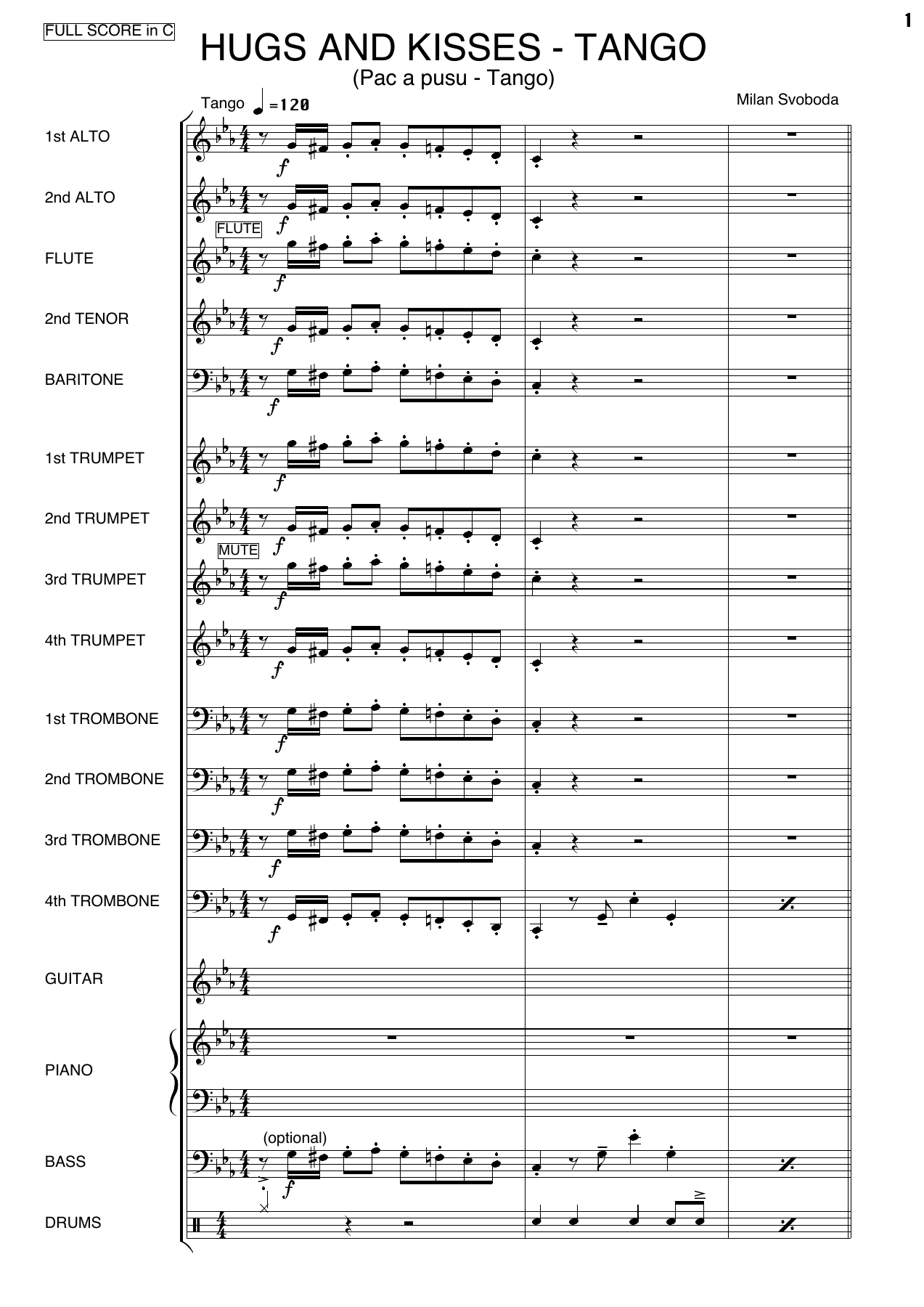
Tango (M.Svoboda)
Composed by M. Svoboda
Arranged by M. Svoboda
- Ensemble: Big Band Dance
- Style: Tango
- Pages: 17
- Instruments (17): 1st ALTO, 2nd ALTO, FLUTE, 2nd TENOR, BARITONE, 1st TRUMPET, 2nd TRUMPET, 3rd TRUMPET, 4th TRUMPET, 1st TROMBONE, 2nd TROMBONE, 3rd TROMBONE, 4th TROMBONE, GUITAR, PIANO, BASS, DRUMS
- Difficulty: easy
- Content: Individual Parts
- Format: PDF Download (Instant)
- Price: $24.99
M. Svoboda's original composition, "Tango," masterfully transports the big band idiom into the passionate and rhythmic world of Argentinian tango. While not a traditional jazz standard, this piece leverages the big band's dynamic capabilities to explore the rich harmonic and melodic language inherent in the tango style. Composed and arranged by Svoboda himself, it represents a contemporary interpretation rather than a historical recreation, offering a fresh perspective on a genre celebrated for its dramatic flair and intricate dance rhythms. The piece embraces the characteristic 2/4 or 4/4 meter with a strong emphasis on the syncopated, driving pulse that defines tango, evoking a mood that is at once melancholic, fiery, and deeply romantic. The musical character of "Tango (M.Svoboda)" is defined by its compelling Latin groove, maintaining a consistent, deliberate tempo that allows for both lyrical expression and rhythmic precision. The primary key signature provides a foundation for the piece's often dramatic harmonic shifts, which are a hallmark of Svoboda's writing. Expect rich, often dense voicings in the brass and saxophone sections, contributing to a full, resonant soundscape. The mood oscillates between moments of tender introspection, often carried by the woodwinds, and powerful, full-ensemble declarations that demand attention. The energy is sustained through careful dynamic contrasts and the relentless, yet nuanced, rhythmic drive, creating a captivating narrative arc throughout the performance. M. Svoboda's approach to this arrangement is distinctive for its sophisticated orchestration and harmonic ingenuity. While firmly rooted in the tango aesthetic, Svoboda employs extended harmonies and unexpected chord progressions that add a contemporary jazz sensibility without sacrificing the genre's authenticity. The arrangement features compelling soli sections for both saxophones and brass, showcasing the ensemble's blend and precision. There are also powerful tutti passages that build to climactic moments, often punctuated by sharp, accented figures characteristic of tango. Svoboda demonstrates a keen understanding of each section's capabilities, crafting lines that are both idiomatic and challenging, ensuring every instrument contributes to the piece's dramatic impact. Performance of "Tango (M.Svoboda)" demands both technical proficiency and a deep understanding of the tango idiom. The melody is often shared, weaving between the lead alto saxophone, trumpet, and trombone, requiring excellent intonation and blend across sections. While there aren't traditional improvised solo sections, the arrangement features highly expressive melodic lines that act as written solos, demanding a lyrical and nuanced approach from the featured players. Technical challenges include precise rhythmic execution, particularly in the syncopated figures, and maintaining dynamic control through wide ranges. The rewarding aspect lies in the piece's emotional depth and the opportunity for the ensemble to truly perform as a cohesive unit, bringing Svoboda's dramatic vision to life. This arrangement is ideally suited for advanced high school, college, community, and professional big bands seeking a sophisticated and engaging piece that explores the rich fusion of jazz orchestration with the passionate heart of tango. "Tango (M.Svoboda)" requires meticulous attention to rhythmic precision and dynamic contrast. The primary technical challenge lies in executing the characteristic tango syncopation with unwavering accuracy and a unified ensemble feel; emphasize a strong, grounded pulse from the rhythm section. Maintain a deliberate, medium-slow tempo, allowing the melodic lines to breathe while preserving the danceable quality. Articulation is paramount: differentiate clearly between legato phrases, sharp staccatos, and accented figures. Rehearsal should focus on balancing the dense voicings, ensuring inner voices are heard without overpowering the melody. Pay close attention to the conductor's cues for dramatic dynamic shifts and rubato sections, which enhance the piece's emotional depth. Q: What instruments are included in this arrangement? A: This arrangement is scored for a standard 17-piece big band dance ensemble, including Alto Saxophone 1 & 2, Tenor Saxophone 1 & 2, Baritone Saxophone, Trumpet 1-4, Trombone 1-4, Piano, Bass, Drums, and Guitar. A full conductor score is also included. Q: What is the difficulty level of "Tango (M.Svoboda)"? A: This arrangement is considered advanced, suitable for experienced high school, college, community, and professional big bands. It demands strong technical execution, sophisticated musicianship, and a nuanced understanding of the tango style. Q: What is the musical style and historical context of this piece? A: "Tango (M.Svoboda)" is an original composition by M. Svoboda, written in the tango style. It's a contemporary big band interpretation of the genre, blending traditional tango elements with modern jazz orchestration and harmonic language, rather than a historical piece or jazz standard. Q: What makes this arrangement unique compared to other big band pieces? A: Its uniqueness stems from M. Svoboda's original composition in the tango idiom, offering a sophisticated fusion of big band power with the dramatic flair and rhythmic intricacies of Argentinian tango. It features rich, often dense voicings and compelling soli sections that showcase the ensemble's precision. Q: What is the typical performance duration and tempo for "Tango (M.Svoboda)"? A: The typical performance duration is approximately 4-5 minutes, depending on interpretation. The piece should be played at a deliberate, medium-slow tempo, maintaining a consistent and authentic Latin/tango groove throughout.
Questions and answers
- What is included in the Tango (M.Svoboda) PDF?
- The verified current file contains a conductor score across 17 pages.
- How many instruments or parts are listed for Tango (M.Svoboda)?
- The verified instrumentation list contains 17 entries for this Big Band Dance arrangement.
- Who is credited for Tango (M.Svoboda)?
- Composer: M. Svoboda. Arranger: M. Svoboda.
- What difficulty is listed for Tango (M.Svoboda)?
- The verified difficulty level is easy.
- What style is listed for Tango (M.Svoboda)?
- The catalog lists the style as Tango.
- Can I preview Tango (M.Svoboda) before buying?
- Yes. The product page provides a preview generated from the current PDF file.
- How is Tango (M.Svoboda) delivered?
- After successful payment, the digital PDF is made available for download. The displayed price is $24.99.
Musicians Also Search For
Tango M. Svoboda PDF • Tango M. Svoboda sheet music • Tango arranged by M. Svoboda • M. Svoboda big band dance charts • M. Svoboda jazz arrangements PDF • Tango M. Svoboda big band dance arrangements • Tango big band dance arrangements • Tango big band dance PDF download • Tango jazz sheet music • big band dance sheet music download • Tango conductor score PDF • Tango sheet music PDF • Tango Tango charts • buy Tango sheet music • download Tango PDF • Tango jazz charts • best M. Svoboda big band dance arrangements • Tango printable sheet music • big band dance repertoire PDF