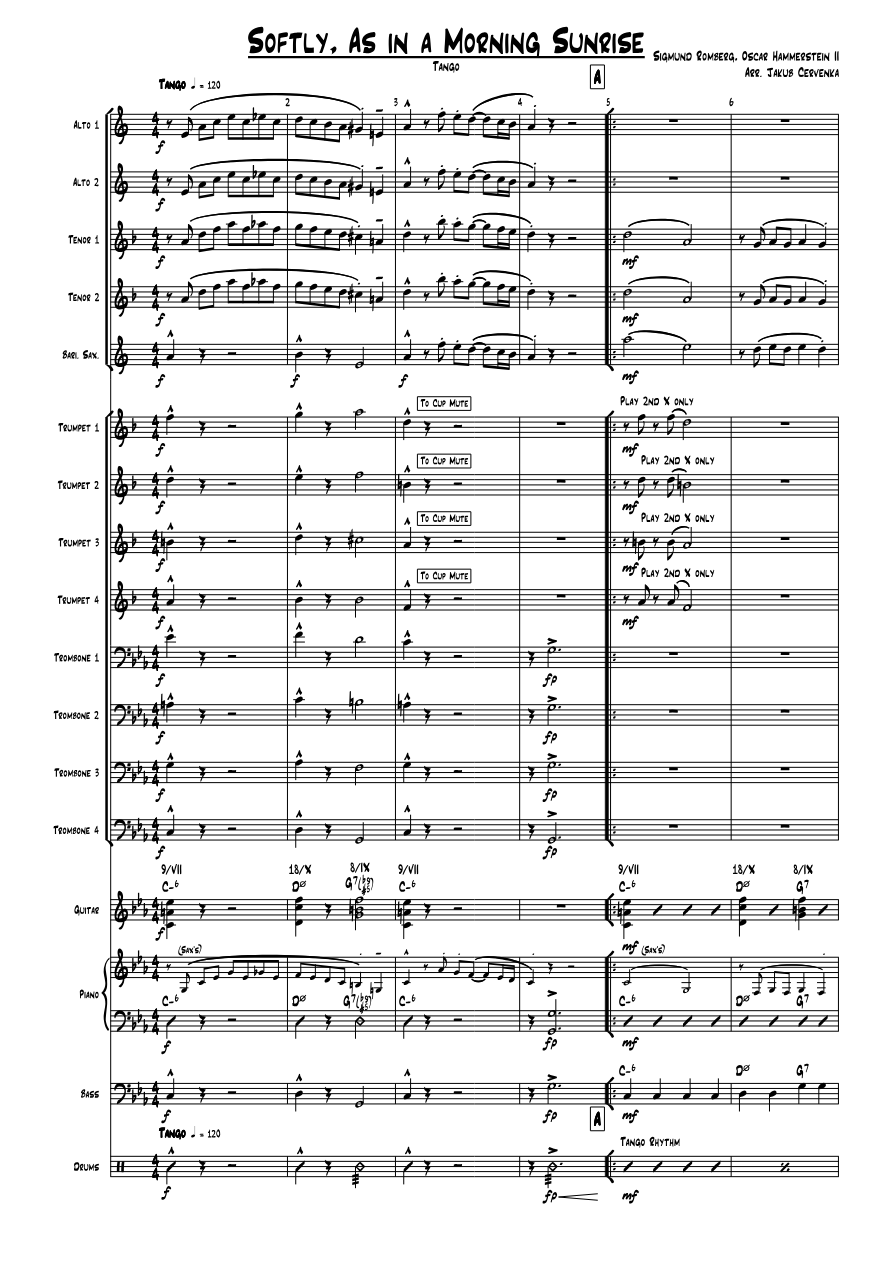
Softly As In A Morning Sunrise (J.Carvenka)
Composed by Sigmund Romberg
Arranged by J. Carvenka
- Ensemble: Big Band Dance
- Style: Tango
- Pages: 34
- Instruments (17): Alto Saxophone 1, Alto Saxophone 2, Tenor Saxophone 1, Tenor Saxophone 2, Baritone Saxophone, Trumpet 1, Trumpet 2, Trumpet 3, Trumpet 4, Trombone 1, Trombone 2, Trombone 3, Trombone 4, Guitar, Piano, Bass, Drums
- Difficulty: medium
- Content: Individual Parts
- Format: PDF Download (Instant)
- Price: $24.99
"Softly As In A Morning Sunrise," a timeless standard originally penned by Sigmund Romberg for the 1928 operetta *The New Moon*, transcends its Broadway origins to become a cornerstone of the jazz repertoire. While first introduced as a romantic ballad, its dramatic harmonic progression and minor-key intensity quickly captivated jazz musicians. John Coltrane's iconic 1957 recording on *New Jazz Conceptions* and Sonny Rollins's fiery 1957 rendition on *A Night at the Village Vanguard* cemented its status, showcasing its versatility for both lyrical interpretation and blistering improvisation. The piece's inherent tension and release, often navigating between a brooding minor theme and a contrasting major-key bridge, provide a rich canvas for exploration, making it a perennial favorite for its dramatic flair and improvisational potential. J. Carvenka’s arrangement of "Softly As In A Morning Sunrise" boldly re-imagines this classic as a captivating big band tango. Eschewing traditional swing rhythms, Carvenka crafts a sophisticated Latin-infused interpretation, maintaining the original's dramatic mood while infusing it with the characteristic rhythmic drive and elegant passion of the tango. The arrangement is set in the original key of C minor, allowing the inherent melancholy and intensity to shine through, but the rhythmic framework transforms its character entirely. Carvenka's signature approach to this style is evident in the intricate interplay between sections, particularly the brass and saxophones, which engage in a compelling dialogue of melodic fragments and rhythmic punctuations, rather than typical call-and-response. This arrangement opens with a brooding, almost cinematic introduction, establishing the tango feel with a distinct rhythmic pulse and rich, layered voicings. The melody is initially carried by the tenor saxophone section, offering a warm, expressive timbre that perfectly suits the tango's romantic undertones. As the piece progresses, the melody is passed between various sections, including a powerful soli section for the full saxophone ensemble, showcasing Carvenka's masterful command of ensemble voicing. A featured solo section is provided for Tenor Saxophone 1, offering ample space for improvisation over the familiar harmonic changes, now recontextualized within the tango rhythm. The arrangement builds to a dramatic climax with a full ensemble shout chorus that is both powerful and rhythmically precise, demanding a tight, unified attack from the brass and saxophones. The technical challenges lie in maintaining the precise tango rhythmic feel throughout, ensuring clean articulations, and executing the dynamic contrasts that are crucial to the genre's expressive power. This arrangement is ideally suited for advanced high school, college, community, or professional big bands seeking a fresh, challenging, and sophisticated addition to their repertoire. Its unique tango styling offers a valuable opportunity to explore Latin rhythms and expand the ensemble's stylistic versatility beyond traditional swing. The blend of familiar melody with an unexpected rhythmic treatment makes it an engaging piece for both performers and audiences, providing a rewarding experience that highlights musicality, precision, and expressive depth. Conductors should emphasize a consistent, authentic tango rhythmic feel from the outset, focusing on precise articulations and a slightly detached, yet flowing, brass sound. The tempo should be a deliberate, passionate tango, approximately quarter note = 108-116 BPM, allowing for expressive phrasing without rushing. Key technical challenges include maintaining rhythmic precision in the syncopated figures across all sections, particularly during the ensemble soli and shout chorus. Brass players should pay close attention to dynamic markings and release points to achieve the dramatic impact characteristic of tango. Rehearsal time should be dedicated to balancing the intricate voicings, ensuring that the melodic lines are always prominent while the accompanying rhythmic figures provide a solid foundation. Encourage the Tenor Saxophone 1 soloist to embrace the dramatic and lyrical possibilities of the tango style, perhaps drawing inspiration from bandoneon phrasing. Q: What instruments are included in this arrangement? A: This arrangement is scored for a standard 17-piece big band, including Alto Saxophone 1, Alto Saxophone 2, Tenor Saxophone 1, Tenor Saxophone 2, Baritone Saxophone, Trumpet 1, Trumpet 2, Trumpet 3, Trumpet 4, Trombone 1, Trombone 2, Trombone 3, Trombone 4, Piano, Bass, Drums, and Guitar. A conductor score is also included. Q: What is the difficulty level of J. Carvenka's "Softly As In A Morning Sunrise" (Tango)? A: This arrangement is considered advanced, suitable for college, community, or professional big bands. It requires strong rhythmic precision, advanced ensemble playing, and expressive musicality to capture the authentic tango style. Q: What is the musical style and historical context of this arrangement? A: This is a tango-style arrangement of "Softly As In A Morning Sunrise," originally a 1928 operetta tune by Sigmund Romberg that became a jazz standard. J. Carvenka re-imagines it with a Latin-infused, dramatic tango feel rather than its more common swing or ballad interpretations. Q: What makes J. Carvenka's arrangement of "Softly As In A Morning Sunrise" unique? A: Its distinctiveness lies in its complete transformation into a tango, departing from traditional jazz interpretations. Carvenka's approach features intricate sectional interplay, a strong rhythmic foundation characteristic of tango, and sophisticated voicings that highlight the dramatic potential of the original melody within this new stylistic context. Q: What is the approximate performance duration and recommended tempo for this piece? A: The approximate performance duration is 4:00-4:30 minutes, depending on the soloist. The recommended tempo is a deliberate tango, approximately quarter note = 108-116 BPM, emphasizing expressive phrasing and rhythmic precision.
Musicians Also Search For
Softly As In A Morning Sunrise J. Carvenka PDF • Softly As In A Morning Sunrise J. Carvenka sheet music • Softly As In A Morning Sunrise arranged by J. Carvenka • J. Carvenka big band dance charts • J. Carvenka jazz arrangements PDF • Softly As In A Morning Sunrise Sigmund Romberg sheet music • Softly As In A Morning Sunrise Sigmund Romberg big band dance arrangement • Sigmund Romberg big band dance charts • Softly As In A Morning Sunrise big band dance arrangement • Softly As In A Morning Sunrise big band dance PDF download • Softly As In A Morning Sunrise jazz ensemble sheet music • big band dance sheet music instant download • Softly As In A Morning Sunrise individual parts download • Softly As In A Morning Sunrise sheet music with parts • Softly As In A Morning Sunrise Tango chart • Tango big band dance arrangements • buy Softly As In A Morning Sunrise sheet music online • download Softly As In A Morning Sunrise PDF • Softly As In A Morning Sunrise jazz chart • best J. Carvenka big band dance arrangements • Sigmund Romberg songs arranged by J. Carvenka • Softly As In A Morning Sunrise printable sheet music • big band dance repertoire PDF