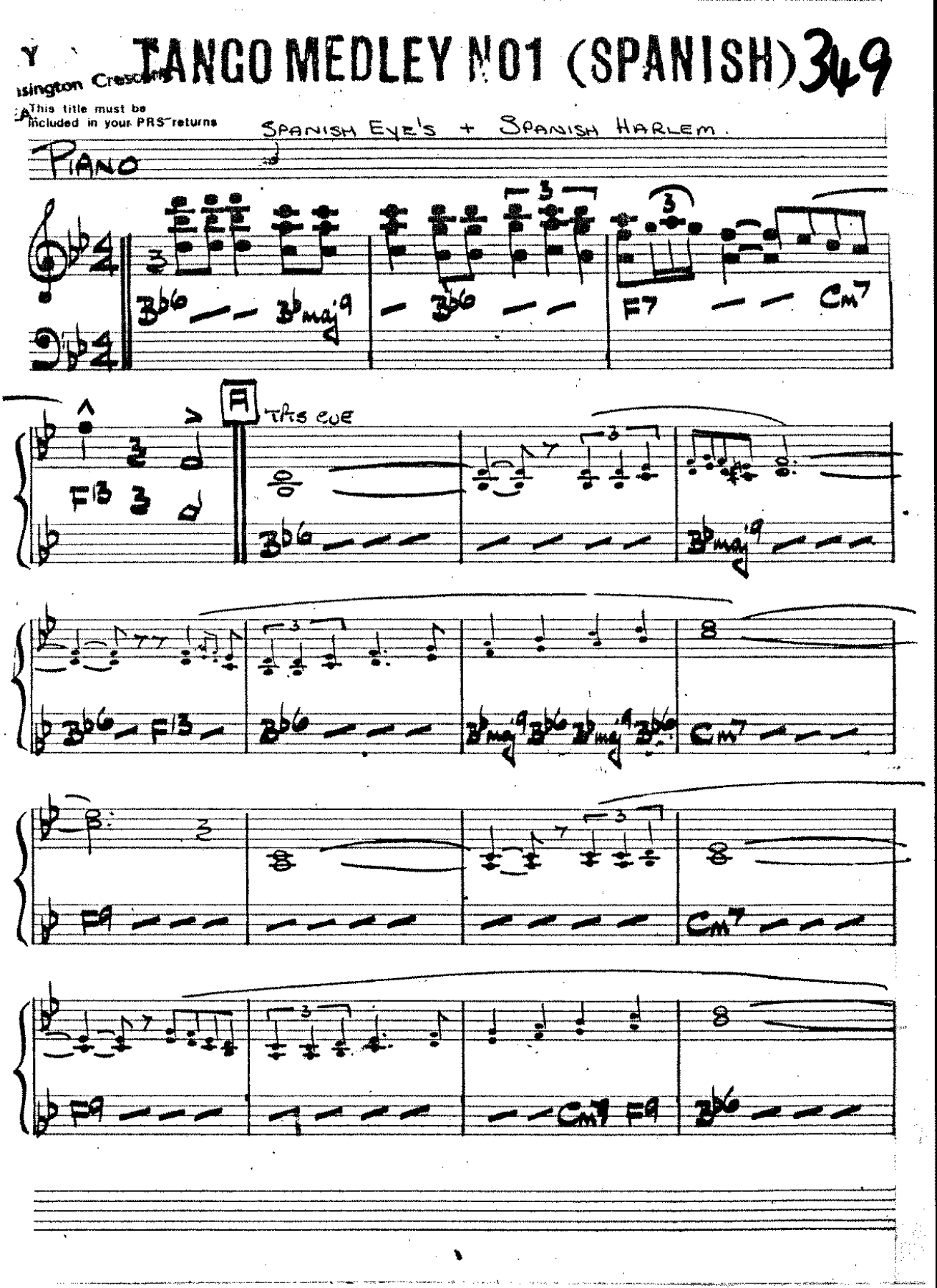
Tango Medley 1 (Spanich)
Composed by Various
Arranged by Spanich
- Ensemble: Big Band Dance
- Style: Tango
- Pages: 17
- Instruments (9): Flute / Tambourine, Alto Saxophone, Tenor Saxophone, Trumpet, Trombone, Piano, Guitar, Bass, Drums
- Difficulty: easy
- Content: Individual Parts
- Format: PDF Download (Instant)
- Price: $24.99
The vibrant and passionate world of tango finds a compelling new voice in Spanich's "Tango Medley 1," an arrangement that masterfully translates the genre's rich emotional landscape into the dynamic idiom of a big band dance ensemble. While the original compositions comprising this medley are drawn from various iconic tango composers, the style itself emerged in the late 19th century in the working-class districts of Buenos Aires and Montevideo, evolving through the "Golden Age" of the 1930s and 40s with legendary figures like Carlos Gardel and Astor Piazzolla later pushing its boundaries. This medley captures the essence of classic tango, evoking its characteristic blend of melancholic longing, dramatic flair, and fiery romance, making it a notable addition to any ensemble's repertoire that seeks to explore global musical traditions through a jazz lens. Spanich’s arrangement imbues the traditional tango form with a sophisticated big band sensibility. The medley typically unfolds with a medium-slow, deliberate tempo, emphasizing the genre's characteristic *marcato* articulation and rhythmic precision, often in a 4/4 time signature, though with an underlying *habanera* or *milonga* feel. The key often shifts to accommodate the dramatic tension and release inherent in tango, moving between minor and relative major tonalities to heighten the emotional impact. The mood oscillates between introspective melancholy and exhilarating passion, driven by the ensemble's collective push and pull. Expect lush, often close-voiced harmonies in the brass and saxophones, creating a rich sonic tapestry that supports the melodic lines. What distinguishes Spanich's approach is a keen understanding of both tango's authentic spirit and the big band's expressive capabilities. Rather than simply orchestrating existing tango pieces, Spanich reimagines them for the big band dance format, utilizing the full spectrum of the ensemble. Expect intricate soli sections where the saxophones or brass carry interwoven melodic fragments, building towards powerful shout choruses that punctuate the medley's dramatic arc. The arrangement often features a captivating interplay between the rhythm section—piano, guitar, bass, and drum set—which lays down the foundational rhythmic and harmonic groove, and the horn sections, which deliver the soaring melodies and counter-melodies. Spanich frequently employs extended harmonies and subtle reharmonizations that add a contemporary jazz sheen without sacrificing the tango's traditional character. Performance of "Tango Medley 1" is both challenging and immensely rewarding. The primary melody is often passed between sections, with the lead alto saxophone or lead trumpet frequently taking the initial statement, followed by full ensemble voicings. While this arrangement is primarily an ensemble showcase, there are often opportunities for featured soloists, typically the lead alto or tenor saxophone, to improvise over the rich harmonic progressions, adding a personal interpretive layer. Technical challenges include precise articulations, dynamic contrasts, and maintaining the characteristic tango rhythmic feel without rushing or dragging. The arrangement is well-suited for college-level big bands, advanced community ensembles, and professional dance orchestras looking for a sophisticated and engaging piece that offers both musical depth and audience appeal. The dramatic build-ups and passionate climaxes make for truly memorable musical moments. Conductors should emphasize a precise, yet flexible, rhythmic approach to "Tango Medley 1." The underlying pulse, while often in 4/4, requires a nuanced *marcato* articulation, particularly in the bass line and low brass, to convey the authentic tango feel without becoming stiff. Encourage the rhythm section—piano, guitar, bass, and drum set—to lock into a cohesive groove, focusing on the *habanera* or *milonga* rhythmic patterns that often underpin the melodies. Dynamics are crucial; dramatic swells and sudden diminuendos are integral to the emotional landscape of tango. Rehearsal time should be dedicated to achieving unified articulations across sections, especially in soli passages, and ensuring that the ensemble breathes together for maximum impact. Pay close attention to cut-offs and releases, which should be sharp and intentional. No special techniques like plunger mutes or falls are typically required, allowing the focus to remain on phrasing, dynamics, and rhythmic integrity. Q: What instruments are included in the "Tango Medley 1 (Spanich)" arrangement? A: This arrangement is scored for a big band dance ensemble, typically including standard brass (trumpets, trombones), saxophones, and a rhythm section comprising piano, guitar, bass, and drum set. Q: What is the difficulty level of this arrangement? A: "Tango Medley 1" is considered appropriate for college-level big bands, advanced community ensembles, and professional dance orchestras due to its sophisticated harmonies, intricate soli sections, and demanding rhythmic precision. Q: What is the musical style and historical context of this medley? A: The medley is in the tango style, drawing from compositions that emerged in the late 19th and early 20th centuries, capturing the genre's characteristic blend of melancholy, drama, and romance, often associated with the "Golden Age" of tango. Q: What makes Spanich's arrangement of "Tango Medley 1" unique? A: Spanich's unique approach lies in reinterpreting classic tango for the big band dance format, utilizing the full ensemble for intricate soli sections, powerful shout choruses, and extended harmonies that add a contemporary jazz sensibility while retaining the authentic tango spirit. Q: What is the typical performance duration or tempo for this piece? A: While specific duration can vary with interpretation, "Tango Medley 1" generally features a medium-slow, deliberate tempo, emphasizing the characteristic *marcato* articulation and rhythmic precision inherent in the tango style.
Questions and answers
- What is included in the Tango Medley 1 (Spanich) PDF?
- The verified current file contains individual parts across 17 pages.
- How many instruments or parts are listed for Tango Medley 1 (Spanich)?
- The verified instrumentation list contains 9 entries for this Big Band Dance arrangement.
- Who is credited for Tango Medley 1 (Spanich)?
- Composer: Various. Arranger: Spanich.
- What difficulty is listed for Tango Medley 1 (Spanich)?
- The verified difficulty level is easy.
- What style is listed for Tango Medley 1 (Spanich)?
- The catalog lists the style as Tango.
- Can I preview Tango Medley 1 (Spanich) before buying?
- Yes. The product page provides a preview generated from the current PDF file.
- How is Tango Medley 1 (Spanich) delivered?
- After successful payment, the digital PDF is made available for download. The displayed price is $24.99.
Musicians Also Search For
Tango Medley 1 Spanich PDF • Tango Medley 1 Spanich sheet music • Tango Medley 1 arranged by Spanich • Spanich big band dance charts • Spanich jazz arrangements PDF • Tango Medley 1 Various sheet music • Tango Medley 1 Various big band dance arrangements • Various big band dance charts • Tango Medley 1 big band dance arrangements • Tango Medley 1 big band dance PDF download • Tango Medley 1 jazz sheet music • big band dance sheet music download • Tango Medley 1 individual parts download • Tango Medley 1 sheet music PDF • Tango Medley 1 Tango charts • Tango big band dance arrangements • buy Tango Medley 1 sheet music • download Tango Medley 1 PDF • Tango Medley 1 jazz charts • best Spanich big band dance arrangements • Various arranged by Spanich • Tango Medley 1 printable sheet music • big band dance repertoire PDF