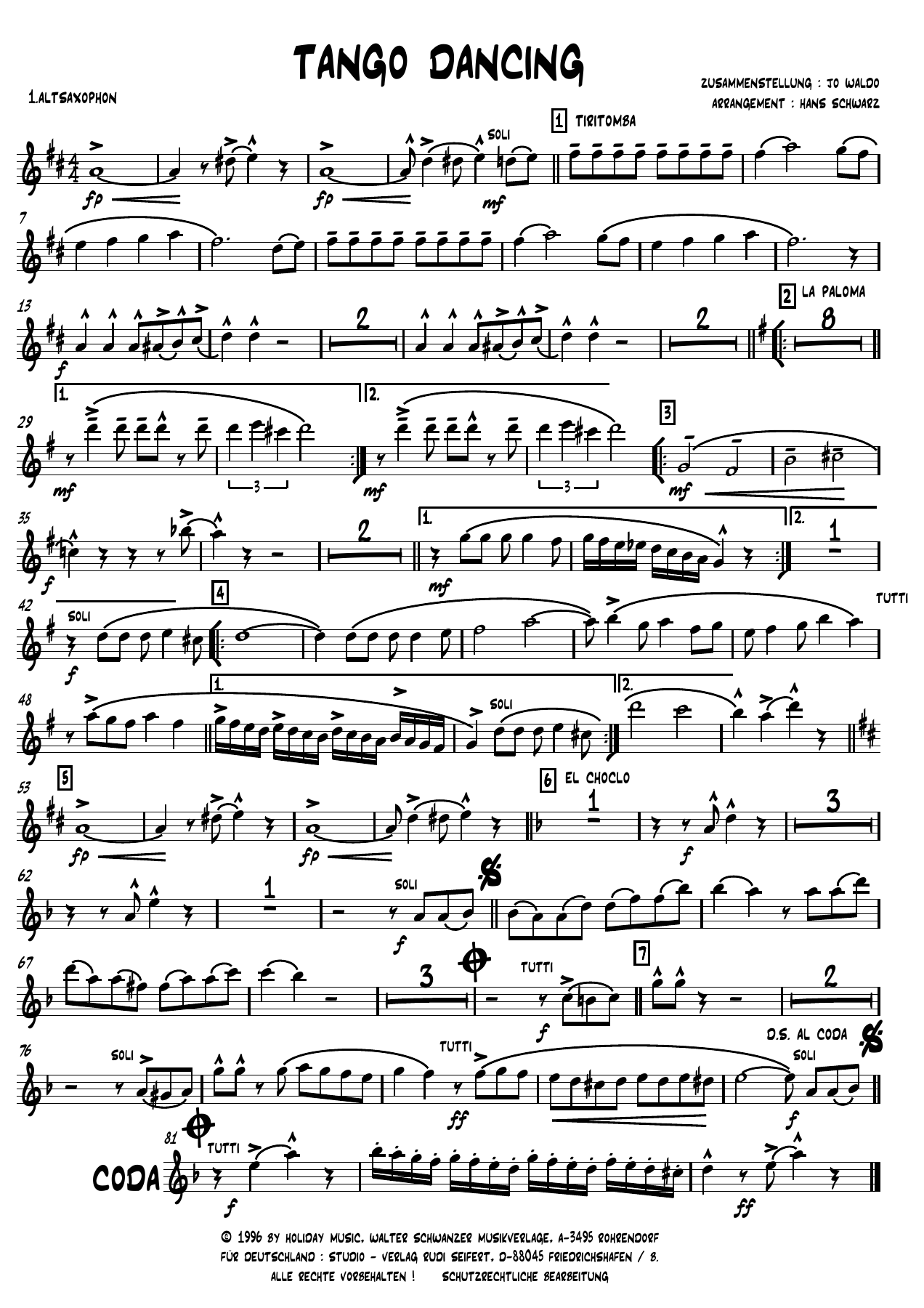
Tango Dancing - Jo Waldo (H.Schwarts)
Composed by Jo Waldo
Arranged by H. Schwarts
- Ensemble: Big Band Dance
- Style: Tango
- Pages: 17
- Instruments (14): 1. Altsaxophon, 2. Altsaxophon, 1. Tenorsaxophon, 2. Tenorsaxophon, Baritonsaxophon, 1. Trompete, 2. Trompete, 3. Trompete, 1. Posaune, 2. Posaune, Keyboard / Piano / Orgel, Gitarre, Bass, Drums
- Difficulty: easy
- Content: Individual Parts
- Format: PDF Download (Instant)
- Price: $24.99
"Tango Dancing," originally penned by the evocative composer Jo Waldo, emerges from an era when Latin rhythms began to profoundly influence American popular music and jazz, particularly in the mid-20th century. While not a traditional "jazz standard" in the swing or bebop sense, Waldo's composition captures the passionate, dramatic essence of the tango, a dance form that transcends cultural boundaries. Its enduring appeal lies in its sophisticated melodic lines and inherent rhythmic drive, making it a compelling piece for ensembles seeking to explore the richer, more theatrical side of the big band repertoire. It represents a period where dance orchestras frequently incorporated diverse global styles, enriching their performances with exotic flair and emotional depth. H. Schwarts's arrangement transforms Waldo's original into a vibrant, full-bodied big band dance chart, maintaining the tango's characteristic intensity while leveraging the orchestral power of 17 instruments. The piece is set in a driving, medium-tempo tango groove, typically around 120-130 BPM, with a clear 4/4 meter that emphasizes the distinctive syncopated feel. Schwarts masterfully employs lush, often dramatic voicings in the brass and saxophone sections, creating a rich harmonic tapestry that underpins the piece's melancholic yet fiery mood. Expect minor keys, frequent use of melodic chromaticism, and a dynamic range that sweeps from tender intimacy to powerful, full-ensemble pronouncements. The arrangement evokes a sense of romantic drama, perfect for a dance floor or a concert stage looking for a captivating, emotionally charged performance. The arrangement opens with a captivating statement of the main theme, often carried by the lead alto saxophone or a combined saxophone section, setting the stage with its memorable melody. Schwarts's signature is evident in the intricate counter-melodies woven throughout the brass and saxophones, creating a dialogue that builds tension and release. There are compelling soli sections, notably in the saxophones, where the section plays a harmonized melody with precision and unified articulation. While specific improvised solo sections are not the primary focus in this dance-oriented tango, there are opportunities for expressive lead playing within the melody lines. The technical challenges lie in achieving precise ensemble articulation, maintaining the rhythmic integrity of the tango feel, and navigating the dynamic contrasts that are crucial to the piece's emotional impact. The rewarding aspect is the sheer theatricality and emotional depth the band can achieve, presenting a captivating musical narrative. This arrangement is ideally suited for college-level big bands, advanced community ensembles, and professional dance orchestras. Its demands for precise ensemble playing, dynamic control, and a nuanced understanding of the tango idiom make it an excellent vehicle for developing musical maturity and stylistic versatility. High school bands with strong lead players and a dedicated rhythm section could also tackle this with focused rehearsal, benefiting immensely from its unique stylistic demands and the opportunity to explore a non-swing big band genre. "Tango Dancing" requires a precise and unified approach to articulation and dynamics to truly capture its dramatic essence. The tempo should be a consistent medium tango, around 120-130 BPM, with a strong emphasis on the characteristic rhythmic pulse rather than a strict metronomic feel. Conductors should guide the ensemble to differentiate between legato, staccato, and marcato markings, as these are crucial for conveying the melodic contours and emotional shifts. The brass section, particularly the trombones, will need to execute smooth, controlled glissandi where indicated, adding to the authentic tango flavor. Pay close attention to the dynamic swells and sudden diminuendos; these are not merely suggestions but integral to the piece's narrative. Rehearsal time should be dedicated to balancing the intricate counter-melodies between sections, ensuring that no single voice overpowers another unless specifically marked. The rhythm section must maintain a steady, driving pulse while allowing for rhythmic flexibility within the tango groove, particularly in the bass and piano parts. Q: What instruments are included in this arrangement of "Tango Dancing"? A: This arrangement is scored for a full 17-piece big band dance ensemble, including Alto Saxophone 1, Alto Saxophone 2, Tenor Saxophone 1, Tenor Saxophone 2, Baritone Saxophone, Trumpet 1, Trumpet 2, Trumpet 3, Trumpet 4, Trombone 1, Trombone 2, Trombone 3, Trombone 4, Piano, Bass, Drums, and Guitar. Q: What is the difficulty level of this arrangement? A: This arrangement is rated as medium-advanced, making it suitable for college-level big bands, advanced community ensembles, and professional dance orchestras. It requires precise ensemble playing, dynamic control, and a nuanced understanding of the tango idiom. Q: What musical style and historical context does "Tango Dancing" represent? A: "Tango Dancing" is a big band arrangement in the Tango style, reflecting the mid-20th century trend of dance orchestras incorporating diverse global rhythms. It captures the passionate, dramatic essence of the tango, offering a sophisticated and emotionally rich musical experience. Q: What makes H. Schwarts's arrangement of "Tango Dancing" unique? A: Schwarts's arrangement is distinctive for its lush, dramatic voicings across the brass and saxophone sections, intricate counter-melodies, and compelling soli sections. It masterfully leverages the full orchestral power of the big band to enhance the original tango's intensity and emotional depth. Q: What is the typical tempo for performing this arrangement? A: The typical tempo for "Tango Dancing" is a medium tango groove, generally performed around 120-130 BPM, with a clear 4/4 meter that emphasizes the characteristic syncopated feel of the tango.
Questions and answers
- What is included in the Tango Dancing - Jo Waldo (H.Schwarts) PDF?
- The verified current file contains individual parts across 17 pages.
- How many instruments or parts are listed for Tango Dancing - Jo Waldo (H.Schwarts)?
- The verified instrumentation list contains 14 entries for this Big Band Dance arrangement.
- Who is credited for Tango Dancing - Jo Waldo (H.Schwarts)?
- Composer: Jo Waldo. Arranger: H. Schwarts.
- What difficulty is listed for Tango Dancing - Jo Waldo (H.Schwarts)?
- The verified difficulty level is easy.
- What style is listed for Tango Dancing - Jo Waldo (H.Schwarts)?
- The catalog lists the style as Tango.
- Can I preview Tango Dancing - Jo Waldo (H.Schwarts) before buying?
- Yes. The product page provides a preview generated from the current PDF file.
- How is Tango Dancing - Jo Waldo (H.Schwarts) delivered?
- After successful payment, the digital PDF is made available for download. The displayed price is $24.99.
Musicians Also Search For
Tango Dancing - Jo Waldo H. Schwarts PDF • Tango Dancing - Jo Waldo H. Schwarts sheet music • Tango Dancing - Jo Waldo arranged by H. Schwarts • H. Schwarts big band dance charts • H. Schwarts jazz arrangements PDF • Tango Dancing - Jo Waldo Jo Waldo sheet music • Tango Dancing - Jo Waldo Jo Waldo big band dance arrangements • Jo Waldo big band dance charts • Tango Dancing - Jo Waldo big band dance arrangements • Tango Dancing - Jo Waldo big band dance PDF download • Tango Dancing - Jo Waldo jazz sheet music • big band dance sheet music download • Tango Dancing - Jo Waldo individual parts download • Tango Dancing - Jo Waldo sheet music PDF • Tango Dancing - Jo Waldo Tango charts • Tango big band dance arrangements • buy Tango Dancing - Jo Waldo sheet music • download Tango Dancing - Jo Waldo PDF • Tango Dancing - Jo Waldo jazz charts • best H. Schwarts big band dance arrangements • Jo Waldo arranged by H. Schwarts • Tango Dancing - Jo Waldo printable sheet music • big band dance repertoire PDF