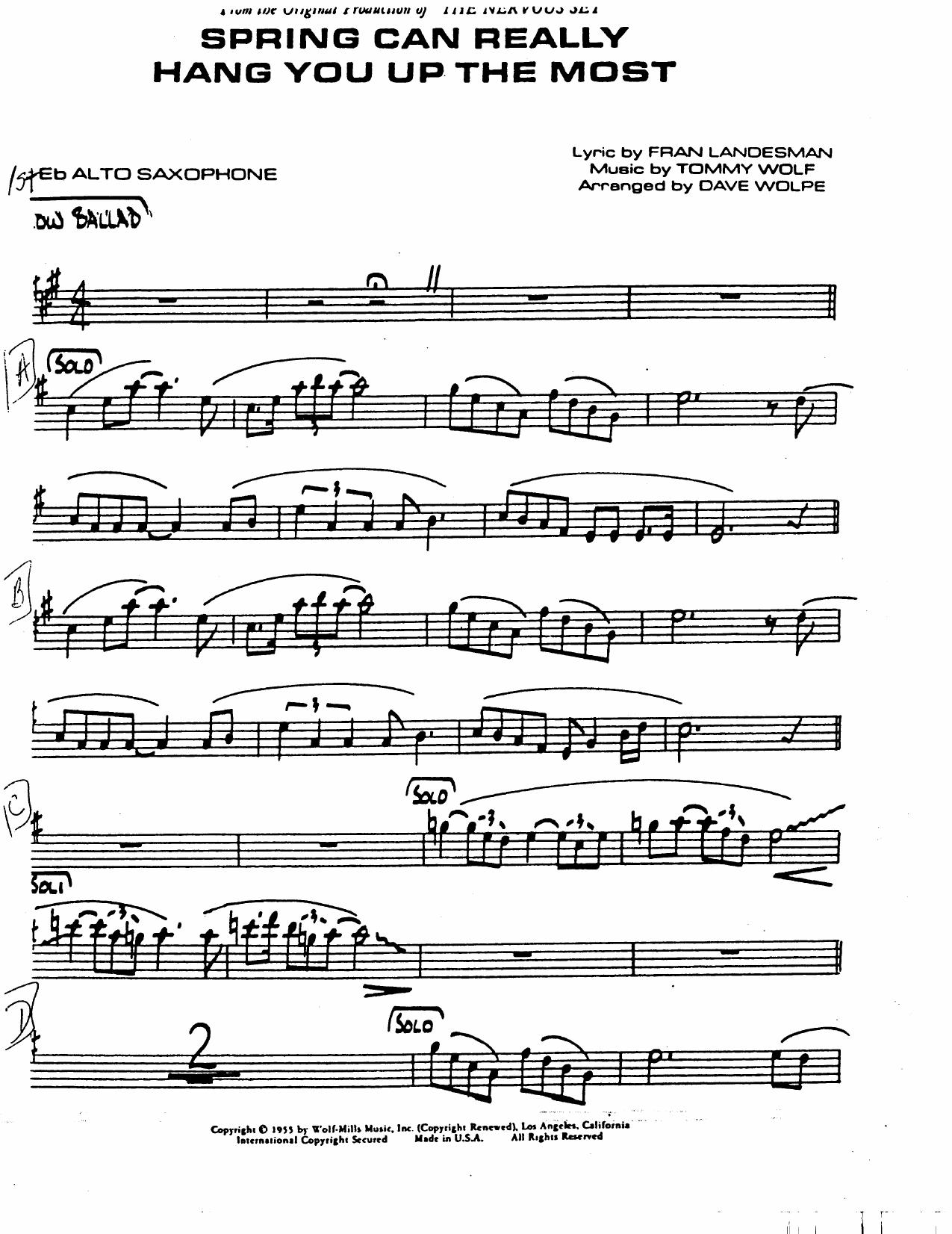
Spring Can Really Hang You Up The Most (D.Wolpe) sheet music preview

Spring Can Really Hang You Up The Most (D.Wolpe)

Composed by Fran Landesman

Arranged by Dave Wolpe

  • Ensemble: Big Band
  • Pages: 36
  • Instruments (17): 1st Eb Alto Saxophone, 2nd Eb Alto Saxophone, 1st Bb Tenor Saxophone, 2nd Bb Tenor Saxophone, Eb Baritone Saxophone, 1st Bb Trumpet, 2nd Bb Trumpet, 3rd Bb Trumpet, 4th Bb Trumpet, 1st Trombone, 2nd Trombone, 3rd Trombone, Bass Trombone, Piano, Bass, Drums, Guitar
  • Difficulty: medium
  • Content: Individual Parts
  • Format: PDF Download (Instant)
  • Price: $24.99

Originally born out of the 1959 London musical *Change Your Mind*, "Spring Can Really Hang You Up the Most" features a poignant, cynical lyric by Fran Landesman paired with Tommy Wolf’s strikingly sophisticated, melancholic melody. The song quickly transcended its theatrical origins to become a revered modern jazz standard, immortalized by legendary vocal and instrumental interpretations from artists like Ella Fitzgerald, Carmen McRae, and Stan Getz. Its bittersweet harmonic progression captures the poignant irony of springtime bringing emotional desolation rather than renewal, making it a masterclass in jazz storytelling and subtle, introspective mood-painting. Master arranger Dave Wolpe approaches this timeless classic as a lush, deeply expressive jazz ballad, maintaining a slow, rubato-leaning 4/4 feel that prioritizes rich textural warmth and emotional depth. The arrangement unfolds as a masterclass in contemporary big band writing, utilizing velvety saxophone solis, gorgeous flugelhorn and muted brass colorations, and sweeping harmonic shifts that evoke the classic West Coast cool school combined with a rich, cinematic studio-band aesthetic. The mood shifts seamlessly from aching vulnerability to moments of expansive, soaring intensity, driven by sophisticated chord extensions and lush chordal stacking across the full ensemble. The primary melodic weight is carried by the saxophone section and featured soloists, allowing an expressive lead alto or tenor player ample room for lyrical interpretation. Wolpe constructs dense, sophisticated voicings that demand exceptional breath control, intonation, and blend, particularly in the quiet, exposed choruses where the rhythm section must maintain an ultra-subtle, pulsing heartbeat. While the piece lacks frantic technical hurdles or aggressive up-tempo timekeeping, its true challenge lies in its emotional maturity, demanding supreme dynamic control, precise phrasing, and stylistic cohesion to deliver the requisite melancholic punch. Advanced high school ensembles with strong section players, as well as collegiate and professional big bands, will find this chart an ideal vehicle for showcasing their mature musicality, delicate ensemble balance, and expressive capabilities. It serves as a brilliant change-of-pace ballad for standard concert programs, offering audiences a refreshing emotional counterweight to high-octane swingers and complex contemporary fusion charts. Conductors should approach this chart with an emphasis on rubato flexibility while maintaining an underlying, steady pulse. The tempo should be kept relaxed and contemplative, allowing the harmonic shifts to breathe naturally without dragging. Balance is the primary technical hurdle: the brass must use cup or basket mutes where indicated to blend rather than overpower the delicate woodwind voicings. Saxophone players need to focus on seamless tone matching and effortless lower-register intonation, particularly during the exposed chordal passages. Rhythm section players must exercise extreme restraint; the drummer should rely on brushed snare patterns and subtle cymbal washes rather than heavy ride-cymbal driving, while the piano and bass outline the rich alterations of Wolf's harmony with transparent, economic voicings. Rehearsals should initially focus on sectional tuning and dynamic shaping before integrating the soloists, ensuring the ensemble can drop seamlessly from a rich forte climax down to an intimate, whisper-soft dynamic without losing core pitch stability. Q: What instruments and parts are included in this big band arrangement? A: The chart is scored for a standard 17-instrument big band lineup, featuring Alto Saxophone 1 & 2, Tenor Saxophone 1 & 2, Baritone Saxophone, 4 Trumpets, 4 Trombones, Piano, Guitar, Bass, and Drums, across a comprehensive 36-page score and set of parts. Q: What is the difficulty level of this Dave Wolpe arrangement? A: This arrangement is rated at an intermediate-to-advanced level (Grade 4), primarily due to its demands on expressive maturity, intonation, blend, and dynamic control rather than fast fingers or extreme technical displays. Q: What is the historical context and musical style of the piece? A: Written by Tommy Wolf and Fran Landesman in 1959, this piece is a classic jazz ballad standard that explores the bittersweet emotional irony of spring, arranged here in a lush, sophisticated contemporary big band ballad style. Q: What makes this specific arrangement by Dave Wolpe unique? A: Wolpe’s treatment stands out for its cinematic, West Coast-influenced harmonic colorings, utilizing rich brass mutes, lush saxophone voicings, and an atmospheric arrangement style that treats the big band like a sprawling, unified vocal accompanist. Q: What is the typical performance duration and tempo feel for this chart? A: The arrangement is designed as a slow, expressive ballad in 4/4 time, typically clocking in around 4 to 5 minutes depending on the expressive freedom taken with the tempo and the length of the featured solo sections.

Questions and answers

What is included in the Spring Can Really Hang You Up The Most (D.Wolpe) PDF?
The verified current file contains individual parts across 36 pages.
How many instruments or parts are listed for Spring Can Really Hang You Up The Most (D.Wolpe)?
The verified instrumentation list contains 17 entries for this Big Band arrangement.
Who is credited for Spring Can Really Hang You Up The Most (D.Wolpe)?
Composer: Fran Landesman. Arranger: Dave Wolpe.
What difficulty is listed for Spring Can Really Hang You Up The Most (D.Wolpe)?
The verified difficulty level is medium.
Can I preview Spring Can Really Hang You Up The Most (D.Wolpe) before buying?
Yes. The product page provides a preview generated from the current PDF file.
How is Spring Can Really Hang You Up The Most (D.Wolpe) delivered?
After successful payment, the digital PDF is made available for download. The displayed price is $24.99.

Musicians Also Search For

Spring Can Really Hang You Up The Most Dave Wolpe PDFSpring Can Really Hang You Up The Most Dave Wolpe sheet musicSpring Can Really Hang You Up The Most arranged by Dave WolpeDave Wolpe big band chartsDave Wolpe jazz arrangements PDFSpring Can Really Hang You Up The Most Fran Landesman sheet musicSpring Can Really Hang You Up The Most Fran Landesman big band arrangementsFran Landesman big band chartsSpring Can Really Hang You Up The Most big band arrangementsSpring Can Really Hang You Up The Most big band PDF downloadSpring Can Really Hang You Up The Most jazz sheet musicbig band sheet music downloadSpring Can Really Hang You Up The Most individual parts downloadSpring Can Really Hang You Up The Most sheet music PDFbuy Spring Can Really Hang You Up The Most sheet musicdownload Spring Can Really Hang You Up The Most PDFSpring Can Really Hang You Up The Most jazz chartsbest Dave Wolpe big band arrangementsFran Landesman arranged by Dave WolpeSpring Can Really Hang You Up The Most printable sheet musicbig band repertoire PDF

All arrangements by Dave Wolpe All Fran Landesman sheet music