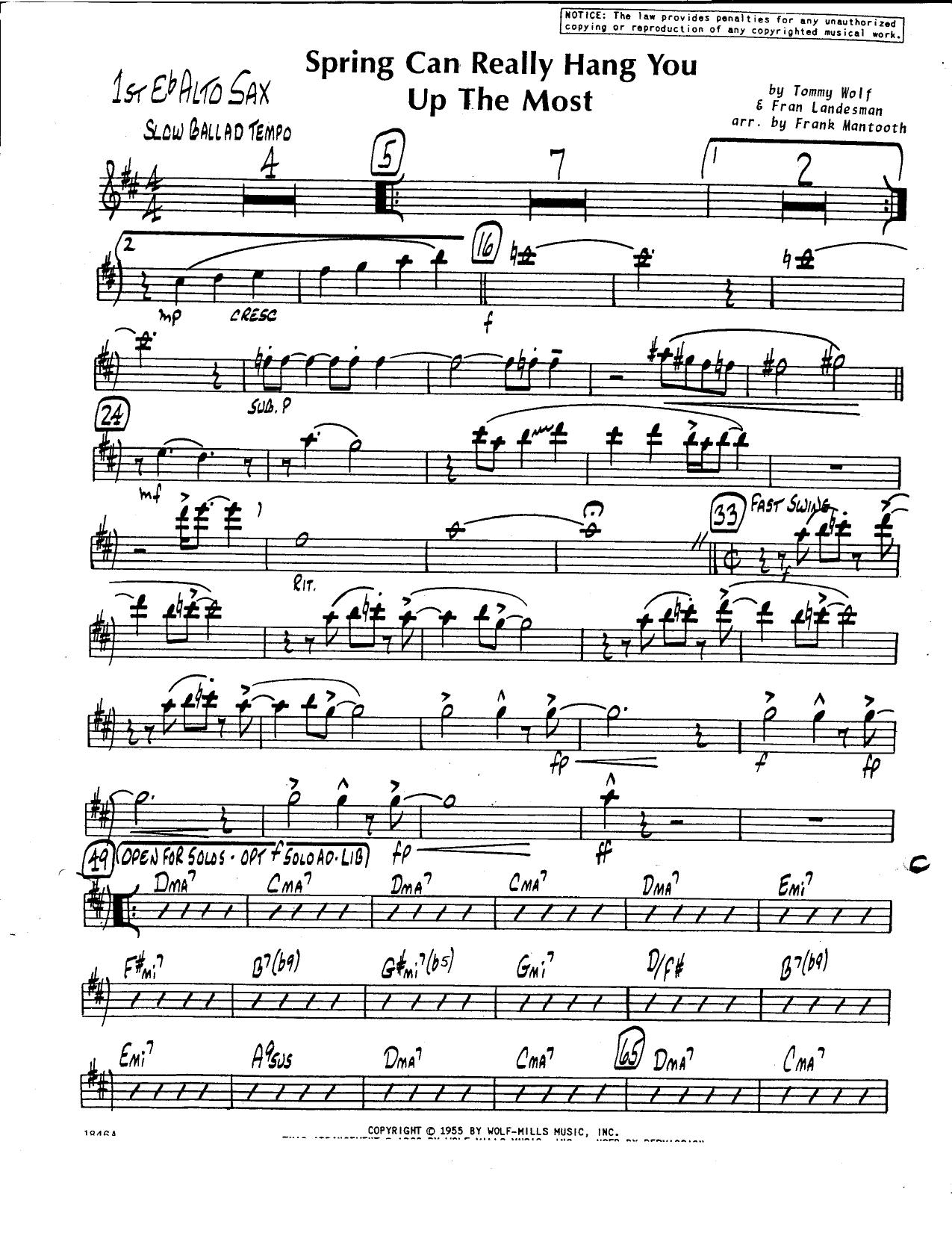
Spring Can Really Hang You Up The Most (F.Mantooth)
Composed by Fran Landesman
Arranged by Frank Mantooth
- Ensemble: Big Band
- Pages: 29
- Instruments (18): 1st Eb Alto Sax, 2nd Eb Alto Sax, 1st Bb Tenor Sax, 2nd Bb Tenor Sax, Eb Baritone Sax, Solo Flugelhorn (Opt. Sub. for Solo Trombone), 1st Bb Trumpet, 2nd Bb Trumpet, 3rd Bb Trumpet, 4th Bb Trumpet, Solo Trombone, 1st Trombone, 2nd Trombone, 3rd Trombone, 4th Trombone (Optional), Piano, Bass, Drums
- Difficulty: medium
- Content: Individual Parts
- Format: PDF Download (Instant)
- Price: $24.99
Originally born from the 1959 Broadway musical *The Nervous Set*, "Spring Can Really Hang You Up The Most" features lyrics by Fran Landesman and music by Tommy Wolf, quickly transcending its theatrical origins to become a revered modern jazz standard. Embraced by vocal icons like Ella Fitzgerald, Sarah Vaughan, and Carmen McRae, the tune captures a bittersweet, melancholic irony—the contrasting despair of heartbreak during a season universally associated with renewal and joy. Its sophisticated harmonic structure and lingering, bittersweet melody have made it a canvas for expressive interpretation across generations of jazz artists, capturing the contemplative essence of the cool and contemporary jazz movements. Frank Mantooth’s celebrated big band setting transforms this introspective vocal masterpiece into a lush, sophisticated instrumental ballad. Driven by a slow, rubato-inflected swing feel that settles into an evocative, unhurried pulse, the arrangement operates in a rich, extended harmonic palette characteristic of Mantooth's writing. The mood is deeply reflective, shifting between fragile, exposed ensemble textures and sweeping, cinematic climaxes. Mantooth avoids heavy-handed orchestration, instead utilizing dense, impressionistic voicings that evoke a late-night, atmospheric mood, perfectly mirroring the poetic desolation of the lyricism even without the vocal line present. The dramatic architecture of the chart relies heavily on coloristic contrast and sectional interplay. The melody is introduced intimately, carried primarily by the saxophones with subtle, shimmering brass pads underneath. Mantooth builds tension through sophisticated chordal suspensions and clever counterpoint before opening up into a soaring, emotional solo section that allows a featured horn player to tell a compelling story. Rather than a traditional high-energy shout chorus, the climax of the chart is a majestic, full-ensemble swell that showcases Mantooth’s signature contemporary-modal harmonies, resolving gracefully back into a whisper-quiet coda that leaves a profound emotional impact on the listener. Advanced high school, collegiate, and professional jazz ensembles will find this 29-page manuscript an exceptional vehicle for developing sophisticated listening skills, blend, and dynamic control. Because the chart relies heavily on nuanced balance, rubato pacing, and delicate chordal intonation rather than sheer velocity, it serves as a masterclass in ensemble maturity. Conductors looking to challenge their rhythm section and horns with rich contemporary voicings—while offering audiences a refreshing departure from standard up-tempo swinger openers—will discover that this arrangement commands absolute focus and delivers extraordinary artistic rewards. Navigating Frank Mantooth’s intricate voicings requires exceptional listening and internal pulse control, particularly during the rubato and half-time transitional phrases. The primary technical challenge lies in maintaining pristine intonation across dense, extended-tertian and quartal harmonies; players must constantly adjust their tuning to fit the shifting harmonic center. The tempo should feel languid and breathing, never rigid, requiring the rhythm section—especially the pianist and bassist—to tread lightly with sparse, supportive comping that respects the spatial beauty of the chart. Brass players should focus on a warm, covered tone, utilizing subtle vibrato and avoiding harsh edges even during dynamic swells. Rehearsal should begin by isolating the chordal sections without rhythm to balance the inner voices of the saxophone and brass choirs. Directors must emphasize long, connected phrasing lines and ensure that dynamic peaks are achieved through collective blend rather than individual force. Q: What instruments and parts are included in this big band arrangement? A: This 29-page arrangement is scored for a standard 18-instrument big band lineup, comprising Alto Saxophone 1, Alto Saxophone 2, Tenor Saxophone 1, Tenor Saxophone 2, Baritone Saxophone, four trumpets, four trombones, and a full rhythm section including piano, guitar, bass, and drum set. Q: What is the difficulty level of this Frank Mantooth chart? A: This arrangement is graded as advanced, making it best suited for collegiate, advanced high school, and professional big bands capable of handling sophisticated modern harmonies, subtle dynamic shading, and mature ensemble pacing. Q: What is the musical style and historical context of this piece? A: Written originally by Tommy Wolf and Fran Landesman in 1959, this piece is treated by Mantooth as a sophisticated, contemporary jazz ballad with a slow, expressive swing feel that reflects the moody, introspective tradition of modern jazz standards. Q: What makes this specific arrangement by Frank Mantooth unique? A: Mantooth's chart is distinguished by its impressionistic, lush chord voicings, lack of a traditional aggressive shout chorus, and its cinematic, coloristic approach that mirrors the bittersweet irony of the original song's lyricism. Q: What is the performance duration and tempo guidance for this arrangement? A: The arrangement is structured as a slow, unhurried ballad with a flowing, rubato-influenced feel, typically lasting around 5 to 6 minutes depending on the length of the featured instrumental solos and the conductor's pacing.
Questions and answers
- What is included in the Spring Can Really Hang You Up The Most (F.Mantooth) PDF?
- The verified current file contains individual parts across 29 pages.
- How many instruments or parts are listed for Spring Can Really Hang You Up The Most (F.Mantooth)?
- The verified instrumentation list contains 18 entries for this Big Band arrangement.
- Who is credited for Spring Can Really Hang You Up The Most (F.Mantooth)?
- Composer: Fran Landesman. Arranger: Frank Mantooth.
- What difficulty is listed for Spring Can Really Hang You Up The Most (F.Mantooth)?
- The verified difficulty level is medium.
- Can I preview Spring Can Really Hang You Up The Most (F.Mantooth) before buying?
- Yes. The product page provides a preview generated from the current PDF file.
- How is Spring Can Really Hang You Up The Most (F.Mantooth) delivered?
- After successful payment, the digital PDF is made available for download. The displayed price is $24.99.
Musicians Also Search For
Spring Can Really Hang You Up The Most Frank Mantooth PDF • Spring Can Really Hang You Up The Most Frank Mantooth sheet music • Spring Can Really Hang You Up The Most arranged by Frank Mantooth • Frank Mantooth big band charts • Frank Mantooth jazz arrangements PDF • Spring Can Really Hang You Up The Most Fran Landesman sheet music • Spring Can Really Hang You Up The Most Fran Landesman big band arrangements • Fran Landesman big band charts • Spring Can Really Hang You Up The Most big band arrangements • Spring Can Really Hang You Up The Most big band PDF download • Spring Can Really Hang You Up The Most jazz sheet music • big band sheet music download • Spring Can Really Hang You Up The Most individual parts download • Spring Can Really Hang You Up The Most sheet music PDF • buy Spring Can Really Hang You Up The Most sheet music • download Spring Can Really Hang You Up The Most PDF • Spring Can Really Hang You Up The Most jazz charts • best Frank Mantooth big band arrangements • Fran Landesman arranged by Frank Mantooth • Spring Can Really Hang You Up The Most printable sheet music • big band repertoire PDF