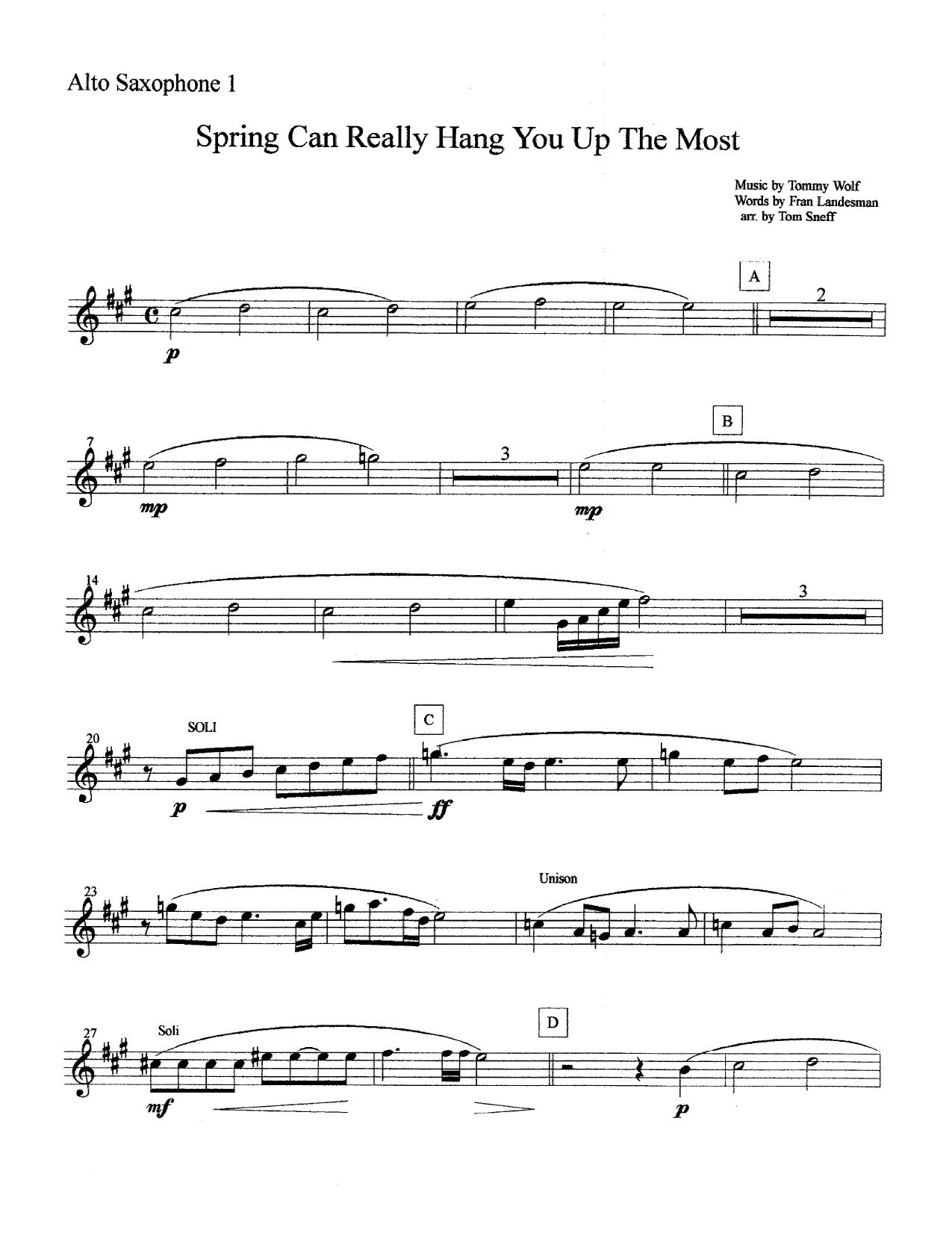
Spring Can Really Hang You Up The Most (T.Sneff) sheet music preview

Spring Can Really Hang You Up The Most (T.Sneff)

Composed by Fran Landesman

Arranged by T.Sneff

  • Ensemble: Big Band
  • Style: Jazz Standard
  • Pages: 26
  • Instruments (17): Alto Saxophone 1, Alto Saxophone 2, Tenor Saxophone 1, Tenor Saxophone 2, Baritone Saxophone, Trumpet in Bb 1, Trumpet in Bb 2, Trumpet in Bb 3, Trumpet in Bb 4, Trombone 1, Trombone 2, Trombone 3, Trombone 4, Piano, Double Bass, Drum Set, Guitar
  • Difficulty: medium
  • Content: Individual Parts
  • Format: PDF Download (Instant)
  • Price: $24.99

Fran Landesman and Tommy Wolf’s poignant masterpiece, "Spring Can Really Hang You Up the Most," occupies a revered space in the vocal jazz and instrumental standard canon, originally introduced in the 1959 Broadway musical *The Nervous Set* and subsequently immortalized by jazz icons like Ella Fitzgerald, Stan Getz, and Betty Carter. The composition is celebrated for its sophisticated, melancholic harmonic progression and its bittersweet lyrical meditation on the emotional dissonance of spring in the wake of a broken romance. It represents a pinnacle of late-1950s theatrical jazz sophistication, bridging the gap between sophisticated Great American Songbook writing and modern modal harmonic exploration. Within this striking big band adaptation by T.Sneff, the tune is cast as an expressive, late-night ballad delivered with an expansive rubato-to-tempo feel. The arrangement opens with an atmospheric, harmonically rich rubato intro that highlights lush woodwind doublings and shimmering upper-structure triad voicings in the brass, evoking a fragile, contemplative mood before settling into a slow, breathy 12/8 or triplet-weighted swing groove. T.Sneff’s writing eschews dense, aggressive shout choruses in favor of transparent, gorgeous textural layers, utilizing warm flugelhorn leads, muted trumpets, and a deeply expressive sax soli that recalls the sophisticated West Coast cool school while retaining a modern harmonic palette. The melodic narrative shifts organically across the ensemble, initially carried by a featured alto saxophone or flugelhorn soloist before the full horn section enters with sweeping, contrapuntal counterlines. The technical demands of the chart lie not in raw velocity, but in breath control, intonation, and stylistic restraint; the ensemble must maintain a continuous, flowing legato line through extended chord extensions, ninth and thirteenth chords, and subtle chromatic shifts. The rhythm section acts as a crucial textural anchor, requiring a sensitive pianist capable of sparse, impressionistic comping and a bassist who can outline the deep, rolling harmonic roots without cluttering the sonic space. Advanced high school ensembles with exceptional maturity, collegiate jazz orchestras, and professional regional big bands will find this chart an ideal vehicle for developing ensemble blend, dynamic nuance, and lyrical interpretation. T.Sneff’s thoughtful pacing provides a refreshing contrast to standard up-tempo swinger setlists, offering a deeply emotional centerpiece that challenges musicians to communicate profound musicality through restraint and sophisticated phrasing. Conductors approaching this arrangement should treat the opening rubato section with absolute flexibility, encouraging the featured soloist and rhythm section to breathe together before settling into the primary tempo. The ballad tempo should remain relaxed yet forward-moving, anchored by a subtle, understated triplet feel in the ride cymbal rather than a heavy backbeat. Intonation across the saxophone section is a primary technical challenge, particularly during exposed passages featuring close-voiced chords and parallel motion; regular section tuning rehearsals focusing on the upper register are strongly advised. Brass players must exercise extreme dynamic control, utilizing cup and harmon mutes where indicated to achieve a warm, velvety timbre rather than a biting edge. The conductor should emphasize phrase shapes over individual notes, ensuring that the cyclical harmonic resolutions feel natural and unhurried. Balance is critical: the accompanying horns must dynamically recede to a whisper whenever the featured soloist or primary melody line is active. Q: What instrumentation and parts are included in this arrangement? A: The chart is scored for a standard 17-instrument big band lineup comprising 2 alto saxophones, 2 tenor saxophones, 1 baritone saxophone, 4 trumpets, 4 trombones, guitar, piano, bass, and drums, spanning a 26-page master score and parts set. Q: What is the overall difficulty level of this arrangement? A: This arrangement is rated as advanced intermediate to advanced, primarily due to the high demands placed on intonation, dynamic control, stamina at slow tempos, and sophisticated stylistic phrasing rather than fast technical passages. Q: What is the style and historical context of this piece? A: Styled as a lush, expressive jazz ballad, this arrangement honors the sophisticated 1959 theatre origins of the Fran Landesman classic while incorporating contemporary post-bop harmonic voicings characteristic of modern big band writing. Q: What makes T.Sneff’s arrangement unique compared to other versions? A: T.Sneff avoids standard big band formulas by utilizing transparent textures, impressionistic rubato transitions, and rich, contemporary upper-structure harmonies that emphasize intimacy and emotional depth over loud, conventional shout choruses. Q: What is the performance duration and recommended tempo feel? A: The arrangement runs approximately 5 to 6 minutes depending on the length of the improvised solos, performed at a relaxed, flowing ballad tempo with a subtle triplet swing or 12/8 feel.

Questions and answers

What is included in the Spring Can Really Hang You Up The Most (T.Sneff) PDF?
The verified current file contains individual parts across 26 pages.
How many instruments or parts are listed for Spring Can Really Hang You Up The Most (T.Sneff)?
The verified instrumentation list contains 17 entries for this Big Band arrangement.
Who is credited for Spring Can Really Hang You Up The Most (T.Sneff)?
Composer: Fran Landesman. Arranger: T.Sneff.
What difficulty is listed for Spring Can Really Hang You Up The Most (T.Sneff)?
The verified difficulty level is medium.
What style is listed for Spring Can Really Hang You Up The Most (T.Sneff)?
The catalog lists the style as Jazz Standard.
Can I preview Spring Can Really Hang You Up The Most (T.Sneff) before buying?
Yes. The product page provides a preview generated from the current PDF file.
How is Spring Can Really Hang You Up The Most (T.Sneff) delivered?
After successful payment, the digital PDF is made available for download. The displayed price is $24.99.

Musicians Also Search For

Spring Can Really Hang You Up The Most T.Sneff PDFSpring Can Really Hang You Up The Most T.Sneff sheet musicSpring Can Really Hang You Up The Most arranged by T.SneffT.Sneff big band chartsT.Sneff jazz arrangements PDFSpring Can Really Hang You Up The Most Fran Landesman sheet musicSpring Can Really Hang You Up The Most Fran Landesman big band arrangementsFran Landesman big band chartsSpring Can Really Hang You Up The Most big band arrangementsSpring Can Really Hang You Up The Most big band PDF downloadSpring Can Really Hang You Up The Most jazz sheet musicbig band sheet music downloadSpring Can Really Hang You Up The Most individual parts downloadSpring Can Really Hang You Up The Most sheet music PDFSpring Can Really Hang You Up The Most Jazz Standard chartsJazz Standard big band arrangementsbuy Spring Can Really Hang You Up The Most sheet musicdownload Spring Can Really Hang You Up The Most PDFSpring Can Really Hang You Up The Most jazz chartsbest T.Sneff big band arrangementsFran Landesman arranged by T.SneffSpring Can Really Hang You Up The Most printable sheet musicbig band repertoire PDF

All arrangements by T.Sneff All Fran Landesman sheet music