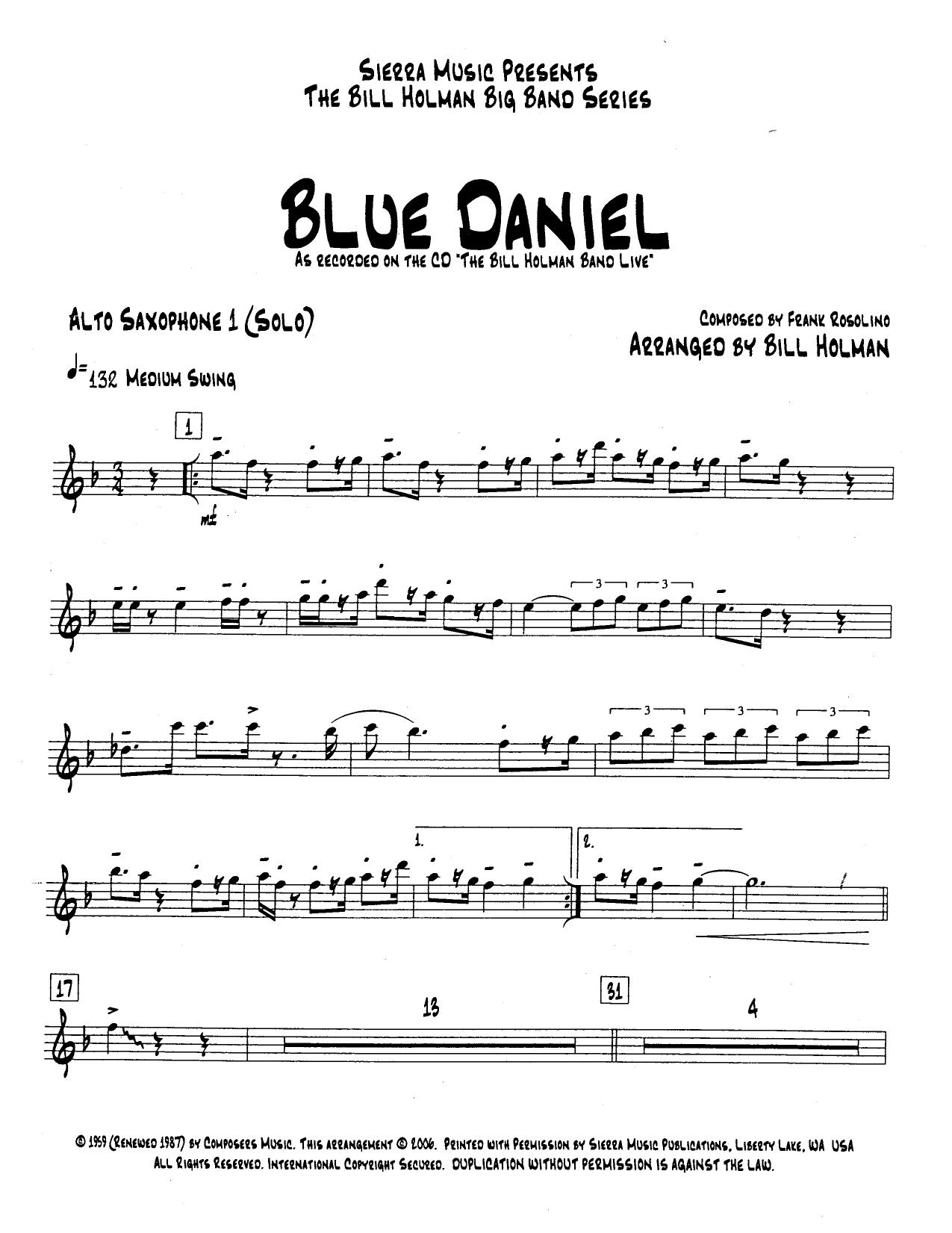
Blue Daniel (B.Holman) sheet music preview

Blue Daniel (B.Holman)

Composed by Bill Holman

Arranged by Bill Holman

  • Ensemble: Big Band
  • Pages: 94
  • Instruments (17): Alto Saxophone 1 (Solo), Alto Saxophone 2, Tenor Saxophone 1, Tenor Saxophone 2, Baritone Saxophone, Trumpet 1, Trumpet 2, Trumpet 3, Trumpet / Flugelhorn 4 (Solo), Trombone 1, Trombone 2, Trombone 3, Bass Trombone 4, Guitar, Piano (Solo), Bass, Drums
  • Difficulty: advanced
  • Content: Individual Parts
  • Format: PDF Download (Instant)
  • Price: $24.99

Composed and originally arranged by the legendary West Coast jazz master Bill Holman, "Blue Daniel" stands as a brilliant testament to post-bop big band writing, showcasing the sophisticated harmonic language and intricate linear counterpoint that defined the apex of the Modern Jazz Sounds era. First popularized through Holman's influential writing for leading west-coast orchestras and definitive recordings, the composition navigates a sophisticated harmonic landscape that balances gorgeous, lush melodic lyricism with the driving, intellectual punch characteristic of Holman's finest charts. Rather than relying on predictable block-chord writing, Holman treats the 17-piece big band as an interconnected chamber orchestra, weaving independent melodic lines through the brass and reed sections to create a rich, textured sonic architecture. At a pulsing, driving medium tempo, the arrangement opens with an evocative, atmospheric introduction that immediately establishes its sophisticated modal-inflected mood before settling into a vibrant swing groove. The emotional trajectory shifts seamlessly between introspective, harmonically dense ballad-like interludes and high-energy, swinging ensemble passages that evoke the cool sophistication of 1960s Los Angeles jazz clubs. Holman's orchestration places heavy demands on sectional independence; the saxophone section—comprising two altos, two tenors, and baritone—frequently navigates complex, intertwined counterlines, while the brass section alternates between warm, muted background textures and searing, aggressive upper-register shout choruses that test a band's dynamic control and intonation. The arrangement features expansive solo space for key improvisers, supported by ingenious, shifting background figures that evolve dynamically behind the soloist rather than serving as static pads. Holman's signature writing techniques are on full display here, particularly his clever use of chromatic displacement, surprising modulation points, and interlocking brass-and-reed soli sections that require absolute precision and articulation uniformity. The rhythm section acts as the crucial engine, with the piano and guitar parts requiring a sophisticated understanding of modern chord voicings (often utilizing rootless, altered extensions) and the bass and drums maintaining a resilient, forward-leaning swing feel that propels the complex meter changes and phrase lengths. Advanced collegiate, professional, and elite community big bands will find this chart to be a profoundly rewarding centerpiece for a concert program, offering an masterclass in ensemble balance, stylistic cohesion, and modern harmonic interpretation. Because of its reliance on advanced reading skills, agile sectional blend, and mature stylistic awareness, it demands a high level of musicianship across all chairs. Performing this arrangement offers audiences and performers alike a masterclass in West Coast big band arranging at its absolute zenith, combining intellectual rigor with undeniable swinging momentum. Navigating Bill Holman’s intricate charts requires meticulous attention to sectional balance and rhythmic precision. The primary technical challenge lies in executing the complex, fast-moving counterlines without sacrificing the underlying swing feel. Conductors should ensure the tempo remains steady and resilient; dragging will cause the dense harmonic shifts to lose their forward momentum. Pay close attention to dynamic markings, as Holman often buries vital melodic fragments inside the inner voices of the saxophone or trombone sections. In rehearsal, practice the ensemble sections slowly, isolating the reed and brass choirs before combining them to lock in the tricky articulations and subtle syncopations. Horn players should maintain a light, articulate jazz articulation, avoiding heavy accents unless specifically indicated by the score. Rhythm section players must carefully voice the extended and altered chords, keeping the texture transparent to let the horns' linear writing breathe. Q: What instruments and parts are included in this big band arrangement? A: This arrangement is scored for a standard 17-piece big band instrumentation, including 5 saxophones (2 altos, 2 tenors, 1 baritone), 4 trumpets, 4 trombones, guitar, piano, bass, and drums, across a comprehensive 94-page master score and set of parts. Q: What is the difficulty level of this Bill Holman arrangement? A: This chart is graded as advanced, making it best suited for top-tier collegiate ensembles, professional big bands, and elite community jazz orchestras capable of handling complex harmonies and rapid sectional interplay. Q: What is the historical style and background of "Blue Daniel"? A: Composed in the mid-20th century, this piece represents the sophisticated West Coast jazz style pioneered by Bill Holman, merging advanced bebop harmonies with meticulous, counterpoint-driven orchestral writing. Q: What makes this specific arrangement unique compared to standard big band charts? A: It is distinguished by Holman's signature compositional techniques, including independent linear counterpoint, shifting harmonic voicings, and dynamic background figures that evolve constantly behind the soloists. Q: What is the recommended performance tempo and duration for this piece? A: The arrangement is written for a driving medium swing tempo, allowing for expressive melodic interpretation and expansive solo sections while maintaining an engaging overall performance length typical of advanced concert jazz repertoire.

Questions and answers

What is included in the Blue Daniel (B.Holman) PDF?
The verified current file contains individual parts across 94 pages.
How many instruments or parts are listed for Blue Daniel (B.Holman)?
The verified instrumentation list contains 17 entries for this Big Band arrangement.
Who is credited for Blue Daniel (B.Holman)?
Composer: Bill Holman. Arranger: Bill Holman.
What difficulty is listed for Blue Daniel (B.Holman)?
The verified difficulty level is advanced.
Can I preview Blue Daniel (B.Holman) before buying?
Yes. The product page provides a preview generated from the current PDF file.
How is Blue Daniel (B.Holman) delivered?
After successful payment, the digital PDF is made available for download. The displayed price is $24.99.

Musicians Also Search For

Blue Daniel Bill Holman PDFBlue Daniel Bill Holman sheet musicBlue Daniel arranged by Bill HolmanBill Holman big band chartsBill Holman jazz arrangements PDFBlue Daniel Bill Holman big band arrangementsBlue Daniel big band arrangementsBlue Daniel big band PDF downloadBlue Daniel jazz sheet musicbig band sheet music downloadBlue Daniel individual parts downloadBlue Daniel sheet music PDFbuy Blue Daniel sheet musicdownload Blue Daniel PDFBlue Daniel jazz chartsbest Bill Holman big band arrangementsBlue Daniel printable sheet musicbig band repertoire PDF

All arrangements by Bill Holman All Bill Holman sheet music