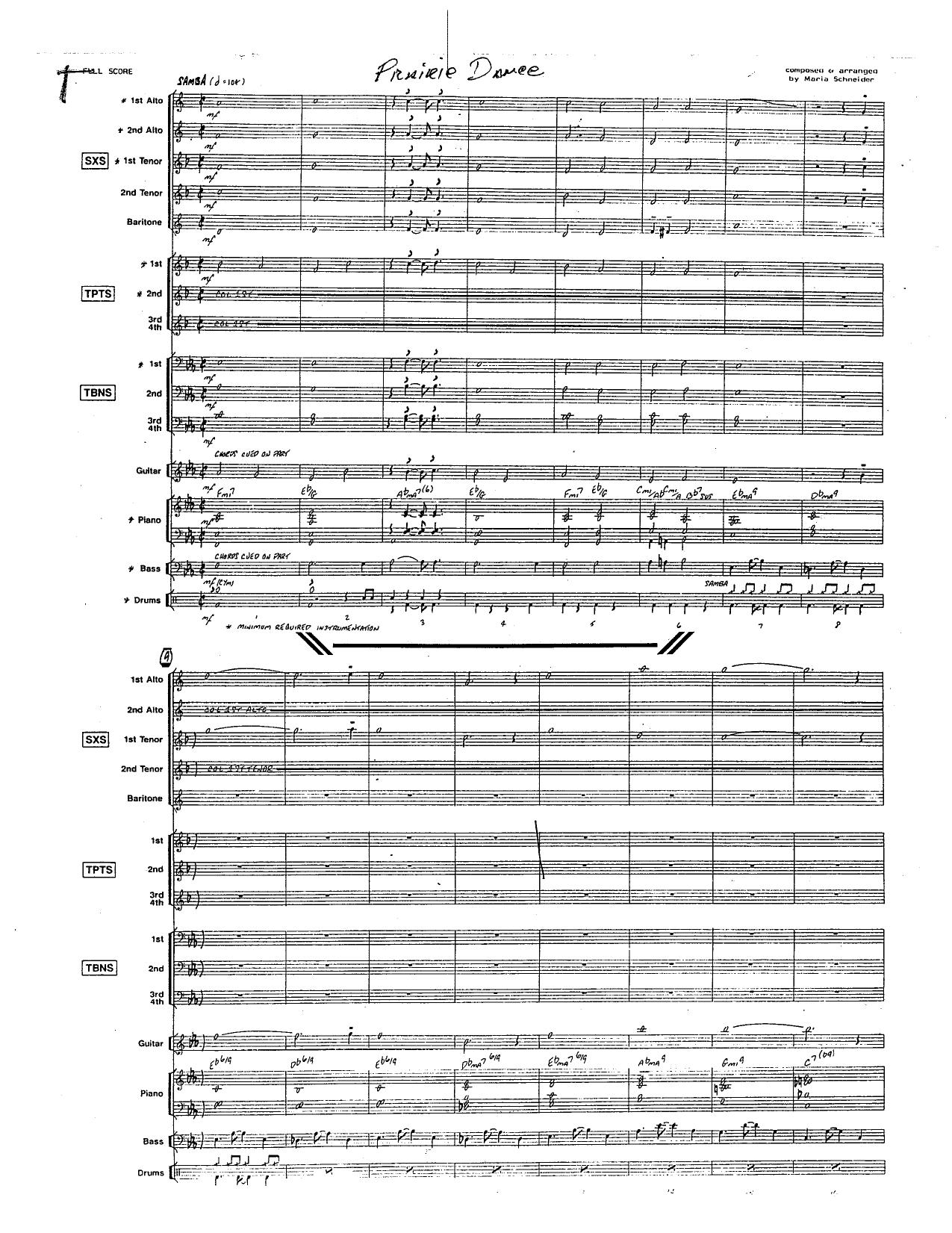
Prairie Dance (M.Schneider) sheet music preview

Prairie Dance (M.Schneider)

Composed by Maria Schneider

Arranged by Maria Schneider

  • Ensemble: Big Band
  • Pages: 48
  • Instruments (17): 1st Eb Alto Sax, 2nd Eb Alto Sax, 1st Bb Tenor Sax, 2nd Bb Tenor Sax, Eb Baritone Sax, 1st Bb Trumpet, 2nd Bb Trumpet, 3rd Bb Trumpet, 4th Bb Trumpet, 1st Trombone, 2nd Trombone, 3rd Trombone, 4th Trombone, Guitar, Piano, Bass, Drums
  • Difficulty: medium
  • Content: Individual Parts
  • Format: PDF Download (Instant)
  • Price: $24.99

Originally published in the late 1980s and drawing inspiration from the wide-open spaces of the composer's Midwestern childhood, "Prairie Dance" stands as a brilliant entry point into the distinctive compositional voice of multiple Grammy-winner Maria Schneider. While Schneider is internationally renowned for her expansive, texturally complex modern jazz orchestra works, this chart demonstrates her uncanny ability to distill sophisticated harmonic concepts and vibrant rhythmic vitality into an accessible format tailored for developing big bands. It reflects a transitional era where Schneider was establishing her voice in New York City—having studied under Gil Evans and Bob Brookmeyer—before forming her own eponymous orchestra. Driven by an infectious, high-energy samba groove, the chart unfolds in a bright, buoyant tempo with an exuberant mood that captures the kinetic joy of a breezy expanse across the grasslands. The musical architecture relies heavily on syncopated Brazilian rhythmic figures interwoven with transparent big band voicings. Rather than relying on dense walls of sound, Schneider utilizes bright brass accents and interlocking woodwind countermelodies to evoke wide horizons and cascading movement. The emotional trajectory is consistently uplifting, buoyed by bright major-key harmonic extensions and a refreshing momentum that keeps both performers and listeners thoroughly engaged from the first downbeat to the final chord. True to Schneider’s signature methodology, the arrangement avoids mundane stock arranging tropes, instead treating the ensemble to fluid voice-leading and colorful dynamic shifts. The melodic weight is shared gracefully across sections, allowing the saxophone and brass choirs to trade crisp ostinatos and conversational counterlines. Alto Saxophone 1 is highlighted as the primary featured soloist, provided with structured solo space that bridges written melodic material with open improvisation. Technical demands are kept intentionally moderate—avoiding extreme brass ranges or complex woodwind doubling—making the chart an exceptional educational vehicle for teaching syncopated Latin-jazz phrasing, articulation control, and internal subdivision to younger players without sacrificing artistic integrity. Ensembles ranging from advanced middle schools and high schools to collegiate and community big bands will find remarkable value in the 48 pages of score and parts. The chart is uniquely flexible: while standard big band instrumentation is fully supported, it is structurally adaptable to smaller setups—playable by as few as three saxophones, two trumpets, one trombone, and rhythm section—without losing its stylistic punch. This scalability, combined with Schneider’s sophisticated yet accessible writing, ensures that groups of varying competencies can master the nuances of contemporary jazz-Latin styles while developing tight ensemble interplay. Achieving an authentic performance of "Prairie Dance" hinges on maintaining a light, articulate, and forward-moving samba feel. The rhythm section serves as the engine; the bass player should lock in a steady, pulsing tumbao-inspired groove, while the drummer utilizes crisp cross-stick patterns on the snare and clean hi-hat chick accents on beats two and four rather than a heavy swing ride rhythm. For the wind sections, precision in short articulations is vital. Staccato notes must be clipped and bright, avoiding any heavy jazz accents that could bog down the Latin groove. Ensure that the syncopated eighth-note figures across the saxophones and brass are cleanly articulated with uniform tongue placement. Conductors should rehearse the ensemble in balanced tiers, ensuring that background figures underneath the alto saxophone solo do not over-power the soloist. Because completely written-out rhythm and solo parts are included alongside chord changes, directors can use these as scaffolding to transition hesitant players into confident improvisers. Q: What instruments and parts are included in this arrangement? A: The package contains a comprehensive 48-page score and complete parts for standard big band instrumentation (5 saxophones, 4 trumpets, 4 trombones, and 4 rhythm) with no woodwind doubles required. It is also cleverly formatted to be fully playable by reduced ensembles featuring as few as 3 saxes, 2 trumpets, 1 trombone, and rhythm. Q: What is the difficulty level of this arrangement? A: This piece is graded as medium-easy, making it an ideal choice for middle school, junior high, or early high school jazz bands. It presents manageable brass ranges and clear rhythmic structures designed to build confidence in young players. Q: What is the musical style and historical context of the piece? A: Composed by Maria Schneider, this piece is an energetic Latin-samba chart originally published in 1989. It reflects Schneider's early compositional era and showcases her ability to introduce foundational Brazilian grooves to educational jazz markets. Q: What makes this Maria Schneider arrangement unique? A: Unlike her expansive, highly complex professional repertoire, this chart combines sophisticated harmonic colors with flexible instrumentation options and written-out pedagogical support materials, such as written solos for timid performers. Q: What is the performance duration and tempo feel of the piece? A: The arrangement has a brisk duration of approximately 2 minutes and 30 seconds, propelled by a lively, medium-tempo samba feel.

Questions and answers

What is included in the Prairie Dance (M.Schneider) PDF?
The verified current file contains a conductor score and individual parts across 48 pages.
How many instruments or parts are listed for Prairie Dance (M.Schneider)?
The verified instrumentation list contains 17 entries for this Big Band arrangement.
Who is credited for Prairie Dance (M.Schneider)?
Composer: Maria Schneider. Arranger: Maria Schneider.
What difficulty is listed for Prairie Dance (M.Schneider)?
The verified difficulty level is medium.
Can I preview Prairie Dance (M.Schneider) before buying?
Yes. The product page provides a preview generated from the current PDF file.
How is Prairie Dance (M.Schneider) delivered?
After successful payment, the digital PDF is made available for download. The displayed price is $24.99.

Musicians Also Search For

Prairie Dance Maria Schneider PDFPrairie Dance Maria Schneider sheet musicPrairie Dance arranged by Maria SchneiderMaria Schneider big band chartsMaria Schneider jazz arrangements PDFPrairie Dance Maria Schneider big band arrangementsPrairie Dance big band arrangementsPrairie Dance big band PDF downloadPrairie Dance jazz sheet musicbig band sheet music downloadPrairie Dance conductor score PDFPrairie Dance individual parts downloadPrairie Dance sheet music PDFbuy Prairie Dance sheet musicdownload Prairie Dance PDFPrairie Dance jazz chartsbest Maria Schneider big band arrangementsPrairie Dance printable sheet musicbig band repertoire PDF

All arrangements by Maria Schneider All Maria Schneider sheet music