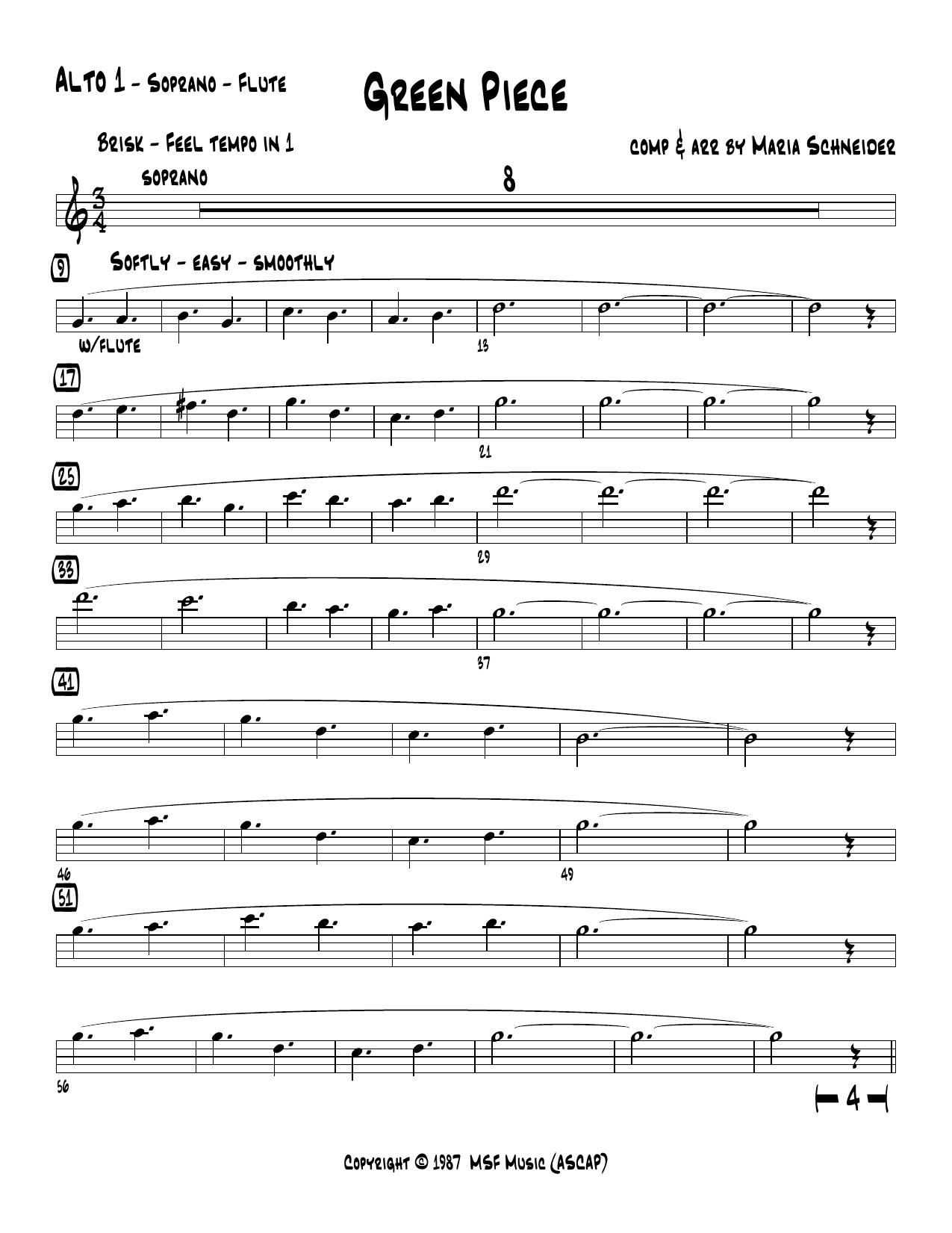
Green Piece (M.Schneider) sheet music preview

Green Piece (M.Schneider)

Composed by Maria Schneider

Arranged by Maria Schneider

  • Ensemble: Big Band
  • Pages: 145
  • Instruments (17): Alto Saxophone 1 (doubling Soprano Saxophone and Flute), Alto Saxophone 2 (doubling Flute), Tenor Saxophone 1, Tenor Saxophone 2, Baritone Saxophone (doubling Bass Clarinet), Trumpet 1 (doubling Flugelhorn), Trumpet 2 (doubling Flugelhorn), Trumpet 3 (doubling Flugelhorn), Trumpet 4 (doubling Flugelhorn), Trombone 1, Trombone 2, Trombone 3, Bass Trombone, Guitar, Piano, Bass, Drums
  • Difficulty: advanced
  • Content: Individual Parts
  • Format: PDF Download (Instant)
  • Price: $24.99

Master composer and orchestrator Maria Schneider expands the boundaries of contemporary large jazz ensemble literature with "Green Piece," a captivating work that showcases her peerless ability to evoke pastoral imagery through sophisticated modern harmonic palettes. Originally recorded on her landmark debut album *Evanescence* (Enja Records, 1994), this composition established Schneider as a visionary voice carrying the torch of the Gil Evans orchestration tradition while forging an entirely distinct, highly personal compositional language. Rather than relying on standard bebop idioms, the piece reflects Schneider’s deep connection to the natural world, unfolding with a cinematic sense of space, organic pacing, and lush, impressionistic textures that have become touchstones of modern orchestral jazz. At its core, "Green Piece" is characterized by a flowing, rubato-infused momentum that gradually coalesces into an expansive, lyrical groove. The harmonic landscape avoids predictable functional progressions in favor of shimmering modal suspensions, polychords, and cascading woodwind lines that mimic the rustling of leaves and shifting light. The mood shifts masterfully from tranquil, reflective introspection to swelling, emotional climaxes brimming with pent-up vitality. Schneider’s signature approach utilizes non-traditional big band instrumentation—doubling on woodwinds, flutes, and soprano saxophones—to create a pastel-like spectrum of timbre where individual section identities blur into a unified, orchestral canvas. The melody is carried primarily by the soprano saxophone and alto saxophone, weaving fluidly over undulating chord clusters in the lower brass and rhythm section. Rather than featuring a traditional high-energy shout chorus, the arrangement builds tension through incremental textural density, expanding dynamic horizons, and artfully placed counter-melodies that traverse the entire ensemble. Improvisation is integrated organically into the form, serving the overarching programmatic narrative rather than acting as a rigid solo vehicle. Technical challenges center heavily on intonation, balance, and rhythmic elasticity; players must navigate complex time feels, subtle rubato transitions, and intricate counterpoint where blend and dynamic sensitivity take precedence over sheer volume. Advanced collegiate, professional, and elite metropolitan community big bands will find "Green Piece" an immensely rewarding centerpiece for concert programming. Because the chart demands refined listening across all chairs, subtle dynamic control, and an advanced grasp of contemporary modal harmony, it serves as an exceptional pedagogical tool for pushing advanced musicians beyond traditional swing-era constraints. Ensembles willing to invest the rehearsal time required to master its delicate coloristic nuances will discover a transcendent musical experience that leaves audiences spellbound. Conductors approaching "Green Piece" must prioritize transparency of texture and absolute precision in intonation above all else. The tempo requires a fluid, breathing quality rather than a rigid metronomic pulse; players should internalize the rhythmic subdivisions to ensure smooth transitions between rubato passages and the underlying groove. A primary technical hurdle lies in the demanding woodwind doublings and the soft, exposed entrances in the upper registers; players must maintain a warm, centered core sound without forcing the tone. Rehearsals should begin in sections, isolating the intricate interweaving woodwind counterlines before integrating the brass pads. Emphasize balance within the chord voicings, ensuring that inner voices project clearly beneath the primary melody. Conductors should guide the ensemble to treat crescendos and decrescendos as organic swells rather than abrupt dynamic shifts, capturing the impressionistic, breathing character that defines Maria Schneider’s inimitable writing style. Q: What instruments and parts are included in this 145-page big band arrangement? A: The arrangement is scored for a 10-instrument flexible modern big band configuration featuring Soprano Saxophone, Alto Saxophone, Tenor Saxophone, Baritone Saxophone, Trumpet parts, and expanded rhythm section instrumentation tailored to Schneider's specific orchestration needs. Q: What is the official difficulty level of this arrangement? A: This piece is graded as advanced (professional/collegiate level), requiring exceptional ensemble listening skills, precise intonation control, and advanced proficiency with contemporary modal harmonies and subtle rubato phrasing. Q: What is the musical style and historical background of "Green Piece"? A: Composed by Maria Schneider and originally featured on her critically acclaimed 1994 debut album *Evanescence*, the piece belongs to the contemporary orchestral jazz genre, heavily influenced by the impressionistic arranging traditions of Gil Evans. Q: What makes this specific Maria Schneider arrangement unique? A: Unlike traditional big bands that rely on standard shout choruses and swing grooves, this arrangement is celebrated for its pastoral, cinematic imagery, non-traditional woodwind-heavy voicings, and an organic architectural build that prioritizes texture and color over standard form. Q: What is the approximate performance duration and tempo feel of the piece? A: The work typically runs between 6 to 8 minutes in performance, featuring an expansive, breathing tempo feel that moves fluidly between open, rubato sections and a flowing, sustained contemporary groove.

Questions and answers

What is included in the Green Piece (M.Schneider) PDF?
The verified current file contains a conductor score and individual parts across 145 pages.
How many instruments or parts are listed for Green Piece (M.Schneider)?
The verified instrumentation list contains 17 entries for this Big Band arrangement.
Who is credited for Green Piece (M.Schneider)?
Composer: Maria Schneider. Arranger: Maria Schneider.
What difficulty is listed for Green Piece (M.Schneider)?
The verified difficulty level is advanced.
Can I preview Green Piece (M.Schneider) before buying?
Yes. The product page provides a preview generated from the current PDF file.
How is Green Piece (M.Schneider) delivered?
After successful payment, the digital PDF is made available for download. The displayed price is $24.99.

Musicians Also Search For

Green Piece Maria Schneider PDFGreen Piece Maria Schneider sheet musicGreen Piece arranged by Maria SchneiderMaria Schneider big band chartsMaria Schneider jazz arrangements PDFGreen Piece Maria Schneider big band arrangementsGreen Piece big band arrangementsGreen Piece big band PDF downloadGreen Piece jazz sheet musicbig band sheet music downloadGreen Piece conductor score PDFGreen Piece individual parts downloadGreen Piece sheet music PDFbuy Green Piece sheet musicdownload Green Piece PDFGreen Piece jazz chartsbest Maria Schneider big band arrangementsGreen Piece printable sheet musicbig band repertoire PDF

All arrangements by Maria Schneider All Maria Schneider sheet music