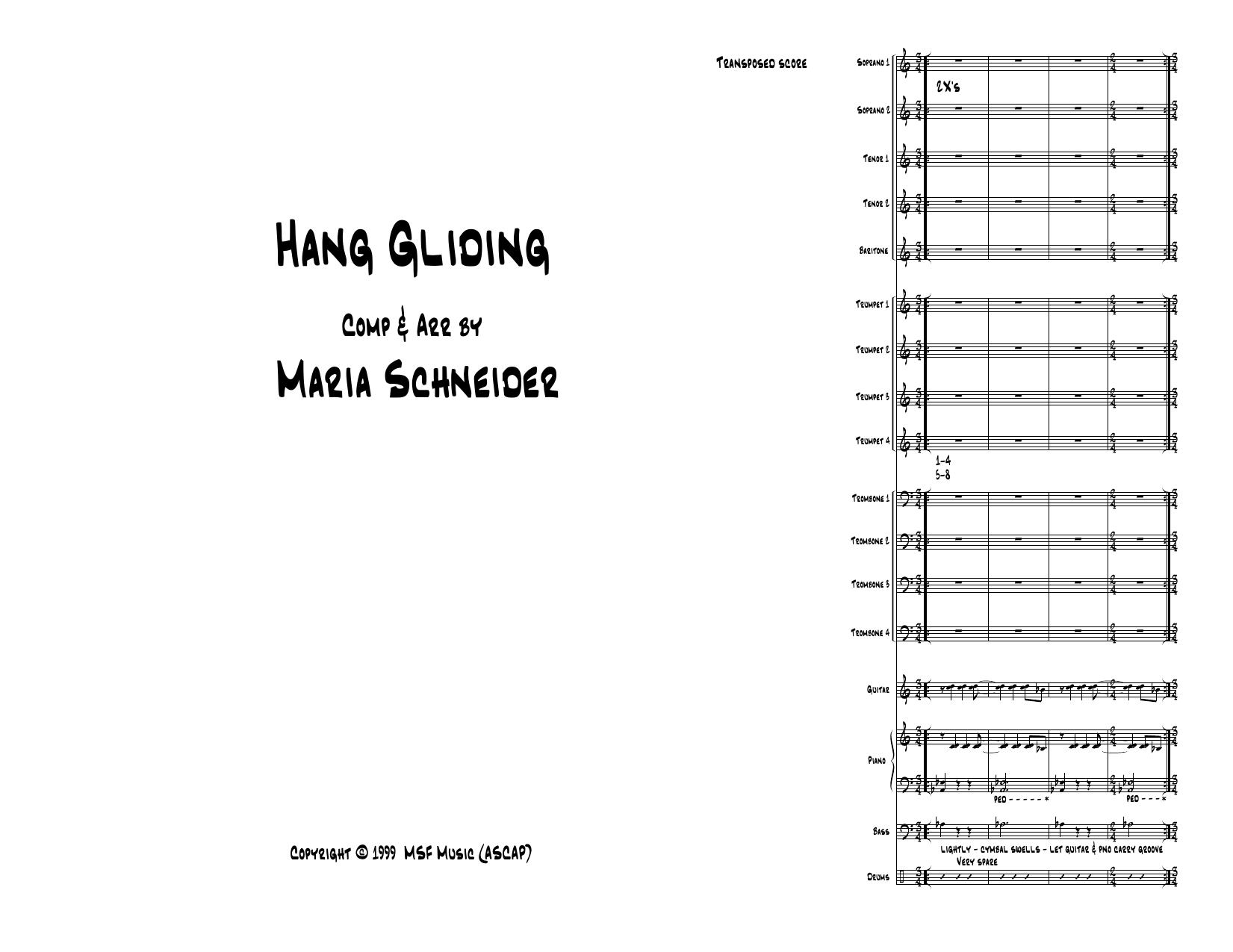
Hang Gliding (M.Schneider) sheet music preview

Hang Gliding (M.Schneider)

Composed by Maria Schneider

Arranged by Maria Schneider

  • Ensemble: Big Band
  • Pages: 38
  • Instruments (23): Soprano Saxophone 1, Soprano Saxophone 2, Tenor Saxophone 1, Tenor Saxophone 2, Baritone Saxophone, Flute, Alto Flute, Trumpet 1, Trumpet 2, Trumpet 3, Trumpet 4, Flugelhorn 1, Flugelhorn 2, Flugelhorn 3, Flugelhorn 4, Trombone 1, Trombone 2, Trombone 3, Trombone 4, Guitar, Piano, Double Bass, Drums
  • Difficulty: medium
  • Content: Individual Parts
  • Format: PDF Download (Instant)
  • Price: $24.99

Maria Schneider’s "Hang Gliding" stands as a monumental achievement in modern large ensemble jazz, originally appearing on her acclaimed 1994 debut album *Evanescence*. Emerging during a period when the big band genre was heavily reliant on retroswing revivals and standard repertory ensembles, Schneider’s composition helped redefine contemporary orchestral jazz by introducing a cinematic, programmatic approach to writing. The piece captures the serene, breathtaking, and fluid sensation of soaring through open air, reflecting Schneider’s deep mentorship under Gil Evans while forging an unmistakably personal, impressionistic compositional voice that has since become a cornerstone of modern jazz education and professional programming. Harmonically and rhythmically, the work unfolds with a mesmerizing sense of space and suspension, utilizing lush, extended chord voicings, non-functional harmony, and shifting meter feels that avoid a rigid, pounding swing beat in favor of an undulating, floating pulse. The mood shifts seamlessly from quiet, reflective atmospheric textures to sweeping, panoramic crescendos that evoke thermal drafts and sudden altitude shifts. Schneider avoids traditional big band shout-chorus formulas, opting instead for organic, through-composed developments where motivic fragments drift between sections, creating a seamless tapestry of sound that relies heavily on dynamic nuance, subtle rubato sections, and intricate counterpoint. The 17-instrument orchestration makes brilliant use of woodwind doubling and textural variety, frequently featuring soprano saxophones alongside traditional alto, tenor, and baritone roles to achieve a brighter, more ethereal upper-register sheen. Melody lines are shared fluidly across the ensemble, requiring exceptional blend and intonation, particularly within the saxophone and brass sections. Solos are woven organically into the architectural design of the arrangement, demanding improvisers who can navigate sophisticated modal harmonic landscapes with a lyrical, storytelling approach rather than relying on standard bebop clichés. The technical challenges lie primarily in ensemble cohesion, precise control of dynamic swells, and mastering the fluid, asymmetrical phrasing that defines Schneider’s unique compositional idiom. Advanced collegiate, professional, and top-tier community big bands will find this chart an immensely rewarding centerpiece for concert programs. Because it demands sophisticated listening across all sections, mature time-feel, and a refined group aesthetic away from traditional heavy-handed big band tropes, it serves as an extraordinary vehicle for stretching an ensemble’s musicality, tonal palette, and expressive range. Conductors approaching "Hang Gliding" must prioritize horizontal phrasing and transparent balance over sheer volume. The opening requires an extraordinary level of patience; maintain a flexible, breathing tempo sense that allows the rubato-like atmospheric passages to expand naturally without losing the underlying pulse. Rhythmic precision is paramount during the shifting metric feels and mixed-meter transitions—practicing these sections with a subdivision click before integrating the ensemble will help lock in the floating groove. Saxophonists should focus on matching pitch and timbre across soprano and alto doubles to ensure the soaring unison lines sound unified. Brass players need to exercise extreme dynamic restraint, utilizing warm, unforced tones even during the work's massive, panoramic climaxes. Rehearsals should initially isolate the complex inner-voice counterpoint so musicians can hear how their specific lines fit into Schneider's broader impressionistic harmonic canvas. Q: What instruments and parts are included in this big band arrangement? A: The 17-instrument orchestration includes two soprano saxophones, two tenor saxophones, baritone saxophone, standard brass instrumentation (typically 4 trumpets and 2-4 trombones depending on the specific edition setup, plus rhythm section), and a comprehensive conductor score spanning 38 pages. Q: What is the difficulty level of Maria Schneider's "Hang Gliding"? A: This arrangement is designated as advanced, tailored specifically for top-tier collegiate, professional, and elite community big bands that possess strong reading skills, mature intonation, and advanced improvisers. Q: What is the musical style and historical background of this piece? A: Composed by Maria Schneider and originally released on her 1994 Grammy-nominated debut album *Evanescence*, the piece represents the pinnacle of modern impressionistic big band jazz, blending contemporary classical textures with sophisticated jazz harmony. Q: What makes this specific arrangement unique within modern big band repertoire? A: Unlike traditional swing charts that rely on heavy shout choruses and standard blues or AABA forms, "Hang Gliding" utilizes a programmatic, through-composed structure, floating metric feels, and extensive woodwind doubling to create a cinematic, soaring aesthetic. Q: What is the performance duration and tempo approach for this arrangement? A: The piece is a substantial, multi-movement-like journey typically running around 8 to 10 minutes in duration, featuring an elastic, breathing tempo framework rather than a rigid, mechanical metronomic beat.

Questions and answers

What is included in the Hang Gliding (M.Schneider) PDF?
The verified current file contains a conductor score across 38 pages.
How many instruments or parts are listed for Hang Gliding (M.Schneider)?
The verified instrumentation list contains 23 entries for this Big Band arrangement.
Who is credited for Hang Gliding (M.Schneider)?
Composer: Maria Schneider. Arranger: Maria Schneider.
What difficulty is listed for Hang Gliding (M.Schneider)?
The verified difficulty level is medium.
Can I preview Hang Gliding (M.Schneider) before buying?
Yes. The product page provides a preview generated from the current PDF file.
How is Hang Gliding (M.Schneider) delivered?
After successful payment, the digital PDF is made available for download. The displayed price is $24.99.

Musicians Also Search For

Hang Gliding Maria Schneider PDFHang Gliding Maria Schneider sheet musicHang Gliding arranged by Maria SchneiderMaria Schneider big band chartsMaria Schneider jazz arrangements PDFHang Gliding Maria Schneider big band arrangementsHang Gliding big band arrangementsHang Gliding big band PDF downloadHang Gliding jazz sheet musicbig band sheet music downloadHang Gliding conductor score PDFHang Gliding sheet music PDFbuy Hang Gliding sheet musicdownload Hang Gliding PDFHang Gliding jazz chartsbest Maria Schneider big band arrangementsHang Gliding printable sheet musicbig band repertoire PDF

All arrangements by Maria Schneider All Maria Schneider sheet music