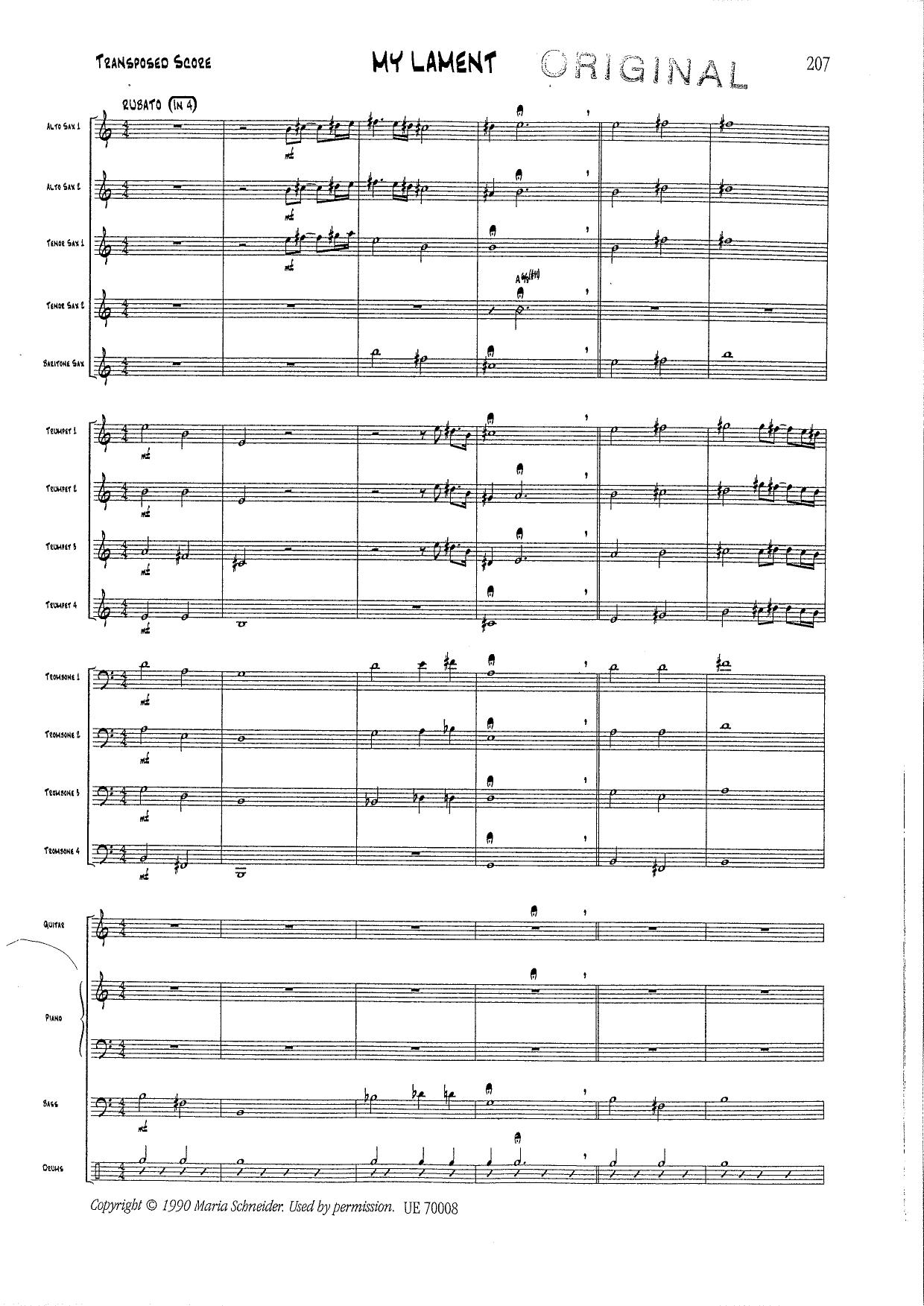
My Lament (M.Schneider) sheet music preview

My Lament (M.Schneider)

Composed by Maria Schneider

Arranged by Maria Schneider

  • Ensemble: Big Band
  • Pages: 38
  • Instruments (17): Alto Saxophone 1, Alto Saxophone 2, Tenor Saxophone 1, Tenor Saxophone 2 (Solo), Baritone Saxophone, Trumpet 1, Trumpet 2, Trumpet 3, Trumpet 4, Trombone 1, Trombone 2, Trombone 3, Trombone 4, Guitar, Piano, Bass, Drums
  • Difficulty: medium
  • Content: Individual Parts
  • Format: PDF Download (Instant)
  • Price: $24.99

Maria Schneider’s compositional voice occupies a singular space in modern large jazz ensemble literature, bridging the rich, impressionistic orchestration traditions of Gil Evans with contemporary modal jazz and folk-infused textures. "My Lament" exemplifies her mastery of long-form narrative arcs within a big band framework, utilizing subtle shifts in density, color, and harmonic suspension to create an intensely evocative sonic landscape. Rather than relying on standard driving swing beats or predictable shout choruses, Schneider constructs a spacious, breathing environment where silence and sustained tone clusters carry as much weight as rhythmic momentum. The work showcases her signature approach to jazz composition: a departure from rigid sectional writing in favor of fluid, interwoven counterpoint and lush, extended tertian and quartal harmonies that challenge the conventional boundaries of big band arranging. At a measured, contemplative tempo, the piece unfolds in a minor key center characterized by a delicate balance of melancholic yearning and serene resolution. The emotional trajectory is deeply introspective, evoking wide-open spaces, gentle grief, and quiet introspection through shifting metric feels and rubato-like phrasing. Woodwind doubling and non-traditional brass mutes play a foundational role in establishing the mood, creating an ethereal timbre that feels closer to a contemporary classical chamber orchestra than a traditional swing-era dance band. Melodic fragments are passed seamlessly across the ensemble, often beginning softly in the low reeds before blossoming into soaring, expressive lines carried by the upper woodwinds and flugelhorns. Schneider’s scoring treats the nine-instrument lineup—featuring an agile front line of alto, tenor, and baritone saxophones, matched with brass and rhythm—with chamber-like intimacy, demanding absolute precision in intonation and balance. Solos within the arrangement are organically integrated into the overarching form rather than serving as isolated blowing sections; they emerge naturally from the texture, giving featured improvisers a canvas rich with harmonic color. Technical challenges lie primarily in blend, dynamic control at extreme pianissimos, and the execution of nuanced, elastic phrasing that avoids mechanical subdivision. Performers must navigate complex metric modulations and subtle rubato cues, requiring a high degree of listening across sections to maintain the seamless, cloud-like momentum that defines Schneider's aesthetic. Advanced collegiate, professional, and elite contemporary community jazz orchestras will find this arrangement an extraordinary centerpiece for a concert program. Because the writing demands sophisticated dynamic awareness, advanced harmonic comprehension, and a mature ensemble concept far beyond standard swinging repertoire, it serves as an invaluable masterclass in modern big band artistry. Ensembles dedicated to exploring the outer edges of contemporary jazz composition will discover a deeply rewarding challenge that consistently captivates listeners through its sheer emotional resonance and textural brilliance. Conductors approaching "My Lament" must prioritize dynamic transparency and microscopic balance over raw volume. The primary technical challenge rests in maintaining rich, stable intonation during sustained, cluster-heavy chord voicings, particularly when the ensemble plays at whisper-soft dynamics. Establish a fluid, flexible internal pulse early in rehearsals, as rigid metronomic playing will strip the work of its organic, breathing quality. Section leaders should ensure that countermelodies woven through the inner voices do not accidentally mask the primary thematic material, which frequently shifts between the saxophone and brass sections. Encourage players to utilize a warm, centered tone devoid of excessive vibrato to preserve the modern, transparent orchestral aesthetic. Pay close attention to subtle rubato indications and transitional interludes, treating them not as disruptions, but as natural breaths between phrases. Muted passages require careful selection of equipment to match the specific tonal colors intended by the composer, ensuring that the blend remains cohesive across the entire ensemble. Q: What specific instruments and parts are included in this arrangement? A: This arrangement is scored for a 9-instrument core ensemble comprising Alto Saxophone, Tenor Saxophone, Baritone Saxophone, Trumpet, Trombone, and an integrated rhythm section supporting the horn lines across its 38 pages of detailed score and parts. Q: What is the difficulty level of this arrangement? A: It is rated as advanced, making it best suited for elite collegiate, professional, and top-tier contemporary community jazz orchestras capable of handling sophisticated modern harmony and delicate dynamic control. Q: What is the musical style and historical context of the piece? A: Written in the distinct contemporary impressionistic jazz style championed by Maria Schneider, the piece represents modern large-ensemble writing that draws equally from jazz tradition and classical chamber orchestration. Q: What makes this specific arrangement unique? A: It stands out for its lack of a traditional driving swing groove, instead utilizing expansive, texturally rich modal harmonies, fluid counterpoint, and chamber-like writing that treats the big band as an impressionistic palette. Q: What is the approximate performance duration and tempo character? A: The piece is performed at a slow, contemplative, and flexible ballad tempo, relying on rubato-esque phrasing and subtle rhythmic shifts rather than a fixed, high-speed metronomic pulse.

Questions and answers

What is included in the My Lament (M.Schneider) PDF?
The verified current file contains a conductor score and individual parts across 38 pages.
How many instruments or parts are listed for My Lament (M.Schneider)?
The verified instrumentation list contains 17 entries for this Big Band arrangement.
Who is credited for My Lament (M.Schneider)?
Composer: Maria Schneider. Arranger: Maria Schneider.
What difficulty is listed for My Lament (M.Schneider)?
The verified difficulty level is medium.
Can I preview My Lament (M.Schneider) before buying?
Yes. The product page provides a preview generated from the current PDF file.
How is My Lament (M.Schneider) delivered?
After successful payment, the digital PDF is made available for download. The displayed price is $24.99.

Musicians Also Search For

My Lament Maria Schneider PDFMy Lament Maria Schneider sheet musicMy Lament arranged by Maria SchneiderMaria Schneider big band chartsMaria Schneider jazz arrangements PDFMy Lament Maria Schneider big band arrangementsMy Lament big band arrangementsMy Lament big band PDF downloadMy Lament jazz sheet musicbig band sheet music downloadMy Lament conductor score PDFMy Lament individual parts downloadMy Lament sheet music PDFbuy My Lament sheet musicdownload My Lament PDFMy Lament jazz chartsbest Maria Schneider big band arrangementsMy Lament printable sheet musicbig band repertoire PDF

All arrangements by Maria Schneider All Maria Schneider sheet music