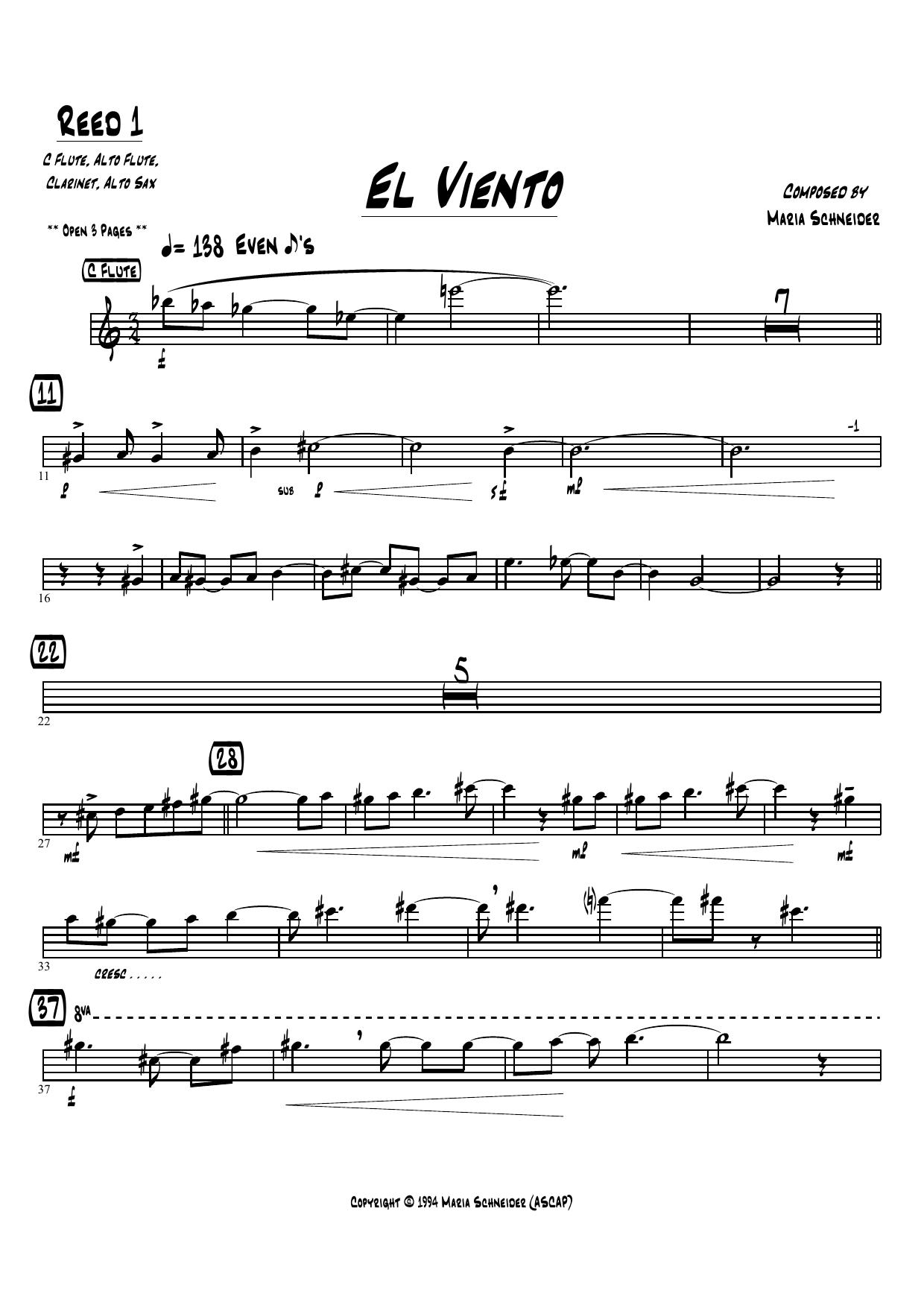
El Viento (M.Schneider) sheet music preview

El Viento (M.Schneider)

Composed by Maria Schneider

Arranged by Maria Schneider

  • Ensemble: Big Band
  • Pages: 175
  • Instruments (17): Reed 1 (C Flute, Alto Flute, Clarinet, Alto Sax), Reed 2 (C Flute, Soprano Sax, Clarinet), Reed 3 (Tenor Sax), Reed 4 (Tenor Sax), Reed 5 (Clarinet, Baritone Sax), Trumpet 1 (Trumpet, Flugelhorn), Trumpet 2 (Trumpet, Flugelhorn), Trumpet 3 (Trumpet, Flugelhorn), Trumpet 4 (Trumpet, Flugelhorn), Trombone 1, Trombone 2, Trombone 3, Trombone 4, Guitar, Piano, Bass, Drums
  • Difficulty: advanced
  • Content: Individual Parts
  • Format: PDF Download (Instant)
  • Price: $24.99

Commissioned in 1994 by the Carnegie Hall Jazz Orchestra and famously recorded on the landmark album *Coming About*, "El Viento" stands as one of Maria Schneider’s most striking and structurally unified big band compositions. Conceived after the composer experienced a riveting performance by flamenco master Paco de Lucia at Lincoln Center, the piece masterfully fuses modern classical chamber-orchestra sensibilities with fiery Andalusian traditions. Schneider synthesizes these divergent influences into an expansive, continuous narrative arc that avoids standard big-band formulas, instead treating the jazz orchestra as an impressionistic palette of shimmering instrumental colors and shifting textures. Driven primarily by an evocative, restless 3/4 meter, the musical character of "El Viento"—translating from Spanish as "the wind"—is both turbulent and deeply lyrical. The work operates on a grand architectural scale, utilizing a sophisticated structural design that relies on a continuous, masterfully paced emotional build rather than static sectional checkpoints. Schneider weaves improvisation seamlessly into the compositional fabric, deploying three distinct soloists consecutively to propel the piece forward through its shifting landscape. The journey unfolds through three interconnected solo vehicles—originally charted for guitar (or optional tenor saxophone), trombone, and a brilliant, high-register trumpet—that gradually escalate the dramatic tension from mysterious, whispered counterpoint into an explosive, cathartic climax. Schneider’s signature approach is immediately evident in her intricate, transparent voicings and extensive use of woodwind doubles, which give the ensemble a chamber-like transparency. Rather than relying on traditional, heavy-handed shout choruses, she achieves dynamic power through cumulative rhythmic layering, sophisticated harmonic extensions, and cross-rhythms that disguise the underlying meter, making the 3/4 feel elusive and constantly shifting. The melody and core motifs snake fluidly across various sections of the ensemble, demanding an extraordinary degree of blend, intonation, and rhythmic flexibility from every player on the stage. Performing this 175-page masterwork requires an advanced professional, top-tier collegiate, or elite community jazz orchestra equipped with exceptional technical facility and mature artistic sensitivity. Because the arrangement relies heavily on nuanced dynamic control, precise execution of complex metric modulations, and specialized endurance—particularly from the trumpet and upper-reed chairs—it offers a deeply rewarding challenge for ensembles seeking to master contemporary post-bop jazz orchestration at its highest level. Conductors approaching "El Viento" must prioritize rhythmic elasticity and internal subdivision, as the piece’s 3/4 groove frequently blurs metric boundaries, requiring the rhythm section to anchor shifting accents without rushing. Rehearsals should initially focus on sectional balance, ensuring that delicate woodwind counterlines are never obscured by underlying brass pads. The lead trumpet and secondary trumpet parts demand elite upper-register endurance and control, specifically for navigating extended high-register lines (including sustained concert Fs and F#s) and executing a convincing, fiery flamenco-style soloistic cadence. Soloists should treat their features not as isolated blowing spaces, but as critical structural pillars that drive the composition's overarching narrative arc from tension to release. Pay meticulous attention to dynamic markings; Schneider’s subtle shadings are the primary mechanism for capturing the unpredictable, gusting nature of the wind. Q: What instruments and specific parts are included in this arrangement? A: This comprehensive 175-page arrangement is scored for a 10-instrument core expanding into a full jazz orchestra instrumentation, featuring a standard saxophone section (with extensive woodwind doubles including flutes, clarinets, and soprano sax), brass, and a rhythm section comprising piano, bass, drums, and guitar. Q: What is the difficulty level of this arrangement? A: This piece is designated as an advanced, professional-level work intended for elite college, community, and professional big bands possessing high technical chops, strong endurance, and advanced sight-reading capabilities. Q: What is the musical style and historical background of "El Viento"? A: Composed in 1994 as a commission for the Carnegie Hall Jazz Orchestra, the piece reflects Maria Schneider's unique post-bop and modern classical aesthetic, heavily inspired by the passion and rhythmic intensity of flamenco music after hearing Paco de Lucia. Q: What makes this specific arrangement unique within big band literature? A: The arrangement stands out for its continuous, through-composed architectural form, chamber-orchestra transparency, inventive use of woodwind textures, and the way it weaves three consecutive soloists into a long, narrative-driven structural build rather than relying on standard head-solos-head formatting. Q: What is the performance duration and tempo framework of the piece? A: "El Viento" is an extended composition lasting approximately 11.5 minutes, driven primarily by a flowing, sophisticated 3/4 metrical framework that feels fluid and elastic rather than rigidly dance-oriented.

Questions and answers

What is included in the El Viento (M.Schneider) PDF?
The verified current file contains a conductor score and individual parts across 175 pages.
How many instruments or parts are listed for El Viento (M.Schneider)?
The verified instrumentation list contains 17 entries for this Big Band arrangement.
Who is credited for El Viento (M.Schneider)?
Composer: Maria Schneider. Arranger: Maria Schneider.
What difficulty is listed for El Viento (M.Schneider)?
The verified difficulty level is advanced.
Can I preview El Viento (M.Schneider) before buying?
Yes. The product page provides a preview generated from the current PDF file.
How is El Viento (M.Schneider) delivered?
After successful payment, the digital PDF is made available for download. The displayed price is $24.99.

Musicians Also Search For

El Viento Maria Schneider PDFEl Viento Maria Schneider sheet musicEl Viento arranged by Maria SchneiderMaria Schneider big band chartsMaria Schneider jazz arrangements PDFEl Viento Maria Schneider big band arrangementsEl Viento big band arrangementsEl Viento big band PDF downloadEl Viento jazz sheet musicbig band sheet music downloadEl Viento conductor score PDFEl Viento individual parts downloadEl Viento sheet music PDFbuy El Viento sheet musicdownload El Viento PDFEl Viento jazz chartsbest Maria Schneider big band arrangementsEl Viento printable sheet musicbig band repertoire PDF

All arrangements by Maria Schneider All Maria Schneider sheet music