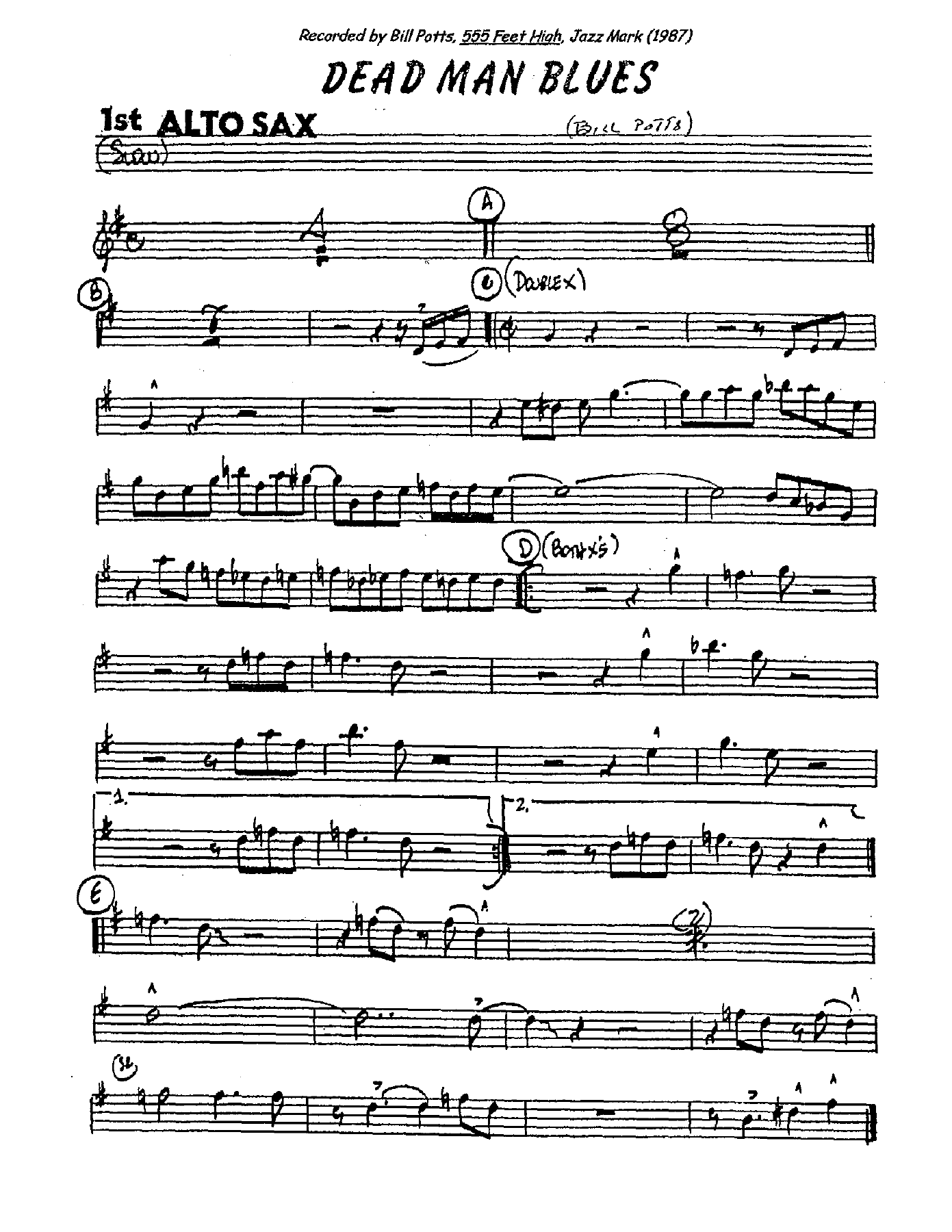
Dead Man's Blues (B.Potts)
Composed by Jelly Roll Morton
Arranged by Bill Potts
- Ensemble: Big Band
- Style: Jazz Standard
- Pages: 34
- Instruments (15): 1st Alto Saxophone, 2nd Alto Saxophone, 1st Tenor Saxophone, 2nd Tenor Saxophone, Baritone Saxophone, 1st Trumpet, 2nd Trumpet, 3rd Trumpet, 4th Trumpet, 1st Trombone, 2nd Trombone, 3rd Trombone, 4th Trombone, Piano/Guitar/Bass, Drums
- Difficulty: medium
- Content: Individual Parts
- Format: PDF Download (Instant)
- Price: $24.99
Jelly Roll Morton's "Dead Man's Blues" stands as a foundational pillar in the early jazz repertoire, a vivid soundscape composed and first recorded in 1926 by Morton and his Red Hot Peppers. This piece emerged during a pivotal era when New Orleans jazz was solidifying its distinct identity, characterized by collective improvisation, polyphonic textures, and a strong blues sensibility. Morton, often credited as jazz's first significant composer and arranger, masterfully blended elements of ragtime, blues, and Creole music, frequently incorporating what he termed the "Spanish Tinge" – a rhythmic element derived from Caribbean influences. "Dead Man's Blues" itself is renowned for its evocative, funereal mood, famously opening with a musical quote from the traditional New Orleans dirge "Flee as a bird to the mountain," immediately establishing a somber yet swinging atmosphere. Its structure, often described as a series of blues choruses, showcases Morton's unique approach to harmony and form, demonstrating that improvised jazz could be effectively notated and arranged while retaining its essential spirit. Bill Potts' big band arrangement of "Dead Man's Blues" reimagines Morton's classic through the lens of a mid-20th century large ensemble, transforming the intimate, polyphonic charm of the original into a powerful, brassy, and swinging statement. Potts, a self-taught musician and highly regarded arranger known for his work with jazz luminaries like Woody Herman, Buddy Rich, and Ella Fitzgerald, possessed an arranging style characterized by bold voicings and a strong sense of swing. His treatments often feature intricate soli sections for the saxophone and brass choirs, vibrant shout choruses that build intensity, and sophisticated harmonic extensions that add depth without sacrificing the original's bluesy core. Potts had a profound understanding of how to make a large ensemble swing, ensuring that even complex arrangements felt natural and authentic to the jazz idiom. This particular arrangement is likely to showcase his signature ability to orchestrate with clarity and drive, making the ensemble itself a dynamic, cohesive unit. The musical character of this arrangement is a medium-tempo swing, maintaining the original's mournful yet rhythmic essence but amplifying it with the full power of a big band. Expect a mood that oscillates between reflective melancholy and buoyant, driving swing, evoking a sense of New Orleans processionals that transition from solemn marches to celebratory dances. The arrangement likely features the melody passed between sections, perhaps opening with a mournful brass or saxophone choir, before moving into powerful soli passages. Solo opportunities are almost certainly present, offering space for improvisation over the blues-infused harmony. Technical challenges might include precise ensemble articulation, dynamic control across the large group, and navigating Potts' characteristic harmonic language. The reward lies in performing a historically significant piece through a brilliant arranger's vision, offering both musical depth and an exhilarating swing experience. This arrangement is ideally suited for college-level jazz ensembles, advanced community big bands, and professional groups seeking a challenging yet deeply rewarding piece that bridges early jazz tradition with mid-century big band sophistication. This arrangement of "Dead Man's Blues" requires careful attention to rhythmic precision and dynamic contrast to fully realize Bill Potts' masterful interpretation. Maintain a consistent medium swing feel throughout, emphasizing a relaxed yet propulsive groove, particularly from the rhythm section. The opening section, drawing on the funereal march, demands a somber, controlled tone from the brass and reeds, with precise articulation to convey the dirge-like quality. Conductors should guide the band to differentiate clearly between the mournful opening and the subsequent swinging sections, allowing the energy to build organically. Technical challenges include intricate soli passages that require strong sectional blend and intonation, as well as navigating Potts' rich harmonic voicings, which may demand careful listening across the ensemble. Encourage soloists to embrace the blues aesthetic of the original while exploring the expanded harmonic possibilities of the big band setting. Pay close attention to dynamic markings, utilizing them to shape phrases and highlight the interplay between sections. Q: What instruments are included in this arrangement? A: This big band arrangement of "Dead Man's Blues (B.Potts)" is scored for 17 instruments, including Alto Saxophone 1, Alto Saxophone 2, Tenor Saxophone 1, Tenor Saxophone 2, Baritone Saxophone, four Trumpets, four Trombones, Piano, Bass, and Drums. Q: What is the difficulty level of this arrangement? A: This arrangement is suitable for college-level jazz ensembles, advanced community big bands, and professional groups. It presents challenges in ensemble precision, dynamic control, and harmonic interpretation, making it rewarding for experienced musicians. Q: What is the musical style and historical context of "Dead Man's Blues"? A: "Dead Man's Blues" is a jazz standard originally composed by Jelly Roll Morton in 1926, representing the New Orleans jazz era. It blends ragtime, blues, and Creole influences, known for its funereal opening and evolving swing feel. Q: What makes Bill Potts' arrangement of "Dead Man's Blues" unique? A: Bill Potts' treatment transforms Morton's classic into a big band showpiece, featuring his signature bold, brassy, and swinging style. It incorporates sophisticated voicings, intricate soli sections, and powerful shout choruses, expanding the original's character for a large ensemble. Q: What is the approximate performance duration or tempo of this piece? A: While exact duration can vary with performance, this arrangement is designed as a medium-tempo swing. The original recording by Jelly Roll Morton runs approximately 3 minutes and 15 seconds.
Questions and answers
- What is included in the Dead Man's Blues (B.Potts) PDF?
- The verified current file contains individual parts across 34 pages.
- How many instruments or parts are listed for Dead Man's Blues (B.Potts)?
- The verified instrumentation list contains 15 entries for this Big Band arrangement.
- Who is credited for Dead Man's Blues (B.Potts)?
- Composer: Jelly Roll Morton. Arranger: Bill Potts.
- What difficulty is listed for Dead Man's Blues (B.Potts)?
- The verified difficulty level is medium.
- What style is listed for Dead Man's Blues (B.Potts)?
- The catalog lists the style as Jazz Standard.
- Can I preview Dead Man's Blues (B.Potts) before buying?
- Yes. The product page provides a preview generated from the current PDF file.
- How is Dead Man's Blues (B.Potts) delivered?
- After successful payment, the digital PDF is made available for download. The displayed price is $24.99.
Musicians Also Search For
Dead Man's Blues Bill Potts PDF • Dead Man's Blues Bill Potts sheet music • Dead Man's Blues arranged by Bill Potts • Bill Potts big band charts • Bill Potts jazz arrangements PDF • Dead Man's Blues Jelly Roll Morton sheet music • Dead Man's Blues Jelly Roll Morton big band arrangements • Jelly Roll Morton big band charts • Dead Man's Blues big band arrangements • Dead Man's Blues big band PDF download • Dead Man's Blues jazz sheet music • big band sheet music download • Dead Man's Blues individual parts download • Dead Man's Blues sheet music PDF • Dead Man's Blues Jazz Standard charts • Jazz Standard big band arrangements • buy Dead Man's Blues sheet music • download Dead Man's Blues PDF • Dead Man's Blues jazz charts • best Bill Potts big band arrangements • Jelly Roll Morton arranged by Bill Potts • Dead Man's Blues printable sheet music • big band repertoire PDF