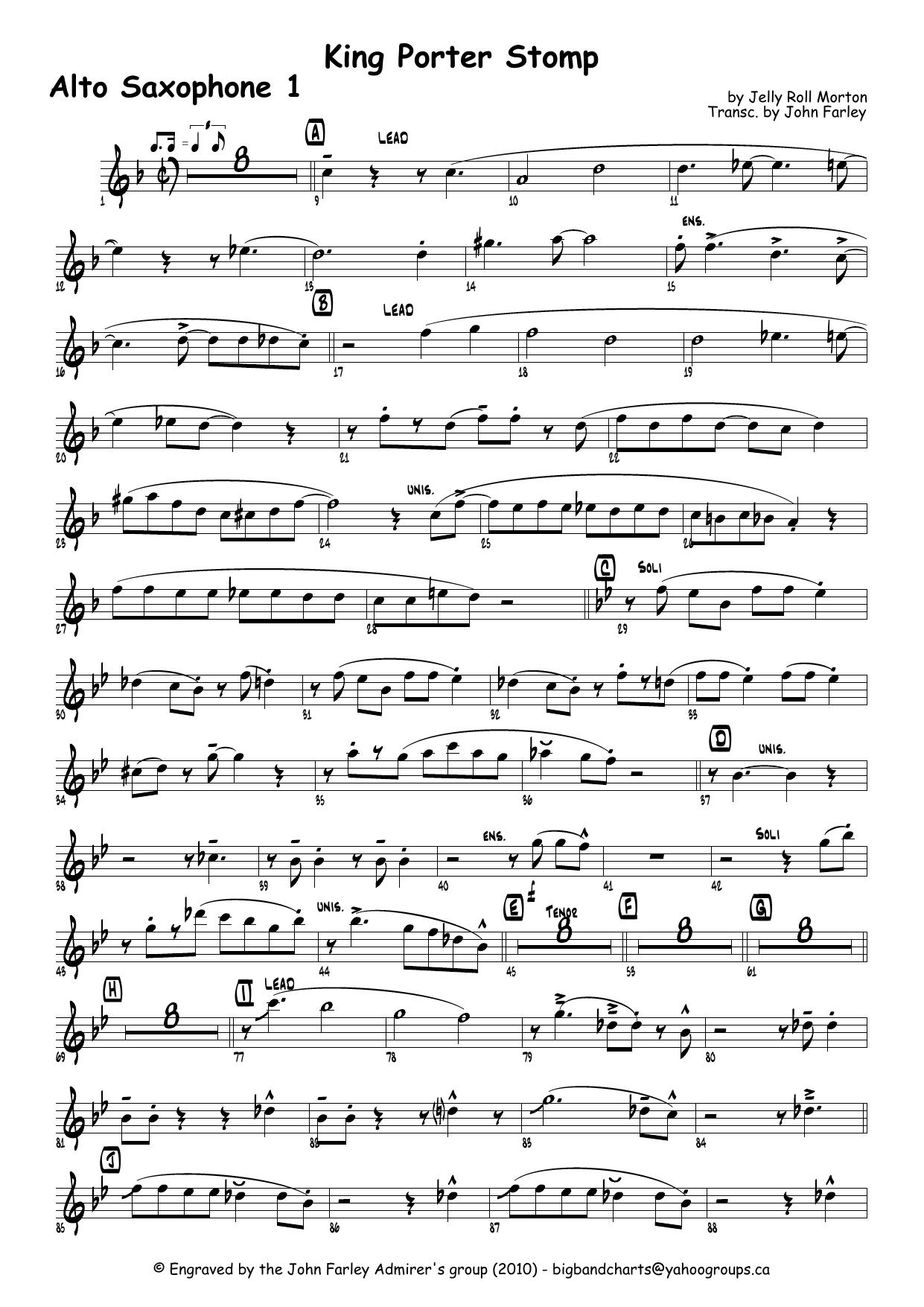
King Porter Stomp (J.Farley)
Composed by Jelly Roll Morton
Arranged by John Farley
- Ensemble: Big Band
- Pages: 51
- Instruments (17): Alto Saxophone 1, Alto Saxophone 2, Tenor Saxophone 1, Tenor Saxophone 2, Baritone Saxophone, Trumpet in Bb 1, Trumpet in Bb 2, Trumpet in Bb 3, Trumpet in Bb 4, Trombone 1, Trombone 2, Trombone 3, Trombone 4, Guitar, Piano, Bass, Drum Set
- Difficulty: advanced
- Content: Individual Parts
- Format: PDF Download (Instant)
- Price: $24.99
Jelly Roll Morton’s iconic 1923 composition "King Porter Stomp" stands as a foundational pillar of early jazz and swing era repertoire, later transformed into a definitive anthem of the big band era through Fletcher Henderson’s legendary 1935 arrangement. Named after pianist and bellhop Porter King, the tune bridges the structural sophistication of ragtime with the kinetic, improvisational drive of early New Orleans jazz. Its most famous structural feature—the blistering, rhythmically complex "stomp" strain penned by Morton and later expanded with Benny Goodman’s high-octane sensibilities—presents a masterclass in transitional jazz history, capturing the exact moment small-group collective polyphony crystallized into the powerhouse sectional writing of the swing era. Brimming with high-octane energy and relentless forward momentum, this big band interpretation crackles at a brisk, driving swing tempo in a bright concert key. The mood shifts effortlessly from playful, stride-inspired swagger to ferocious, high-voltage exhilaration. The arrangement opens with a jaunty, syncopated thematic statement that evokes the smoky atmosphere of 1920s dance halls before exploding into modern, brass-heavy textures that command attention from the downbeat. The emotional arc moves from nostalgic reverence for early jazz roots to unbridled, festival-grade excitement during the climactic ensemble passages. John Farley approaches the classic material with a brilliant balance of historical respect and contemporary big band muscle. Rather than merely transcribing earlier recordings, Farley reimagines the voice-leading through lush, extended tertian and quartal harmonies, introducing clever chromatic inner-voice movements that give the saxophones a rich, modern textural warmth. The brass writing utilizes punchy, aggressive articulation markings, sharp dynamic contrasts, and sophisticated call-and-response figures between the trumpets and trombones. A meticulously crafted shout chorus serves as the compositional crown jewel, building density layer by layer through cascading modal shifts before resolving into a roaring, full-ensemble tutti. Melodic duties are shared democratically across the ensemble, though the woodwinds frequently carry the primary thematic weight with sparkling bebop-inflected scalar runs, punctuated by aggressive brass stabs. Open solo sections are provided for lead trumpet and tenor saxophone, offering ample space for players to stretch out over changes that honor the traditional harmonic framework while inviting modern linear exploration. Technical demands center on tight rhythmic unison in the saxophone section, nimble fingerwork across fast tempo changes, and high-register endurance for the lead trumpet. The reward for the ensemble is a deeply engaging, historically resonant tour de force that brings audiences to their feet. Advanced high school ensembles with strong section players, college jazz orchestras, and professional community big bands will find this chart an ideal centerpiece for standard concert programs and festival sets. The 51-page score and parts demand mature time-feel, excellent sectional blend, and confident soloists, making it an exceptional vehicle for developing rigorous ensemble precision and stylistic versatility. Success with this arrangement hinges on maintaining an infectious, buoyant medium-up swing feel without letting the tempo drag or rush. Conductor and rhythm section players should prioritize a lightweight, driving ride cymbal pulse and a crisp 2-and-4 hi-hat snap that honors the stride roots of Morton’s original piano conception. The primary technical challenge lies in the execution of the intricate syncopated figures and rapid ensemble unisons. Horn sections must meticulously match articulations—giving short notes adequate length and treating accented notes with a fat, rounded front rather than a harsh edge. Players should anticipate several stylistic embellishments throughout the charts, including scripted plunger mutes in the trombone section, dramatic brass falls, and energetic doits that add authentic 1930s color. Rehearsal time should be divided evenly between isolating the complex saxophone soli passages at a reduced tempo and building endurance for the brass section through the extended, high-register shout chorus. Ensure the rhythm section locks in tightly during the transition between the stride-style rhythm and the modern four-beat swing feel to maximize the chart's inherent momentum. Q: What instruments and parts are included in this arrangement? A: This 51-page big band publication includes a full standard 17-instrument lineup consisting of 4 trumpets, trombones (including bass trombone), 5 saxophones (alto 1-2, tenor 1-2, baritone), and a full rhythm section comprising piano, guitar, bass, and drums. Q: What is the difficulty level of this arrangement? A: This chart is graded as advanced, making it best suited for collegiate jazz ensembles, highly proficient high school bands, and professional community big bands with strong lead players and secure section reading skills. Q: What is the historical style and background of the piece? A: Rooted in Jelly Roll Morton’s 1923 composition, this piece represents the vital evolutionary bridge between early New Orleans ragtime-jazz and the high-energy swing big band style popularized by Fletcher Henderson and Benny Goodman. Q: What makes John Farley’s arrangement unique? A: Farley injects contemporary big band vitality into historical source material by utilizing lush extended harmonies, innovative inner-voice movements, and a meticulously structured shout chorus that builds dense modal tension before resolving into a roaring tutti. Q: What is the performance duration and recommended tempo? A: The arrangement is designed to be performed at a brisk, driving swing tempo (approximately quarter note = 180–192 BPM), resulting in a performance duration of roughly 3.5 to 4.5 minutes depending on solo choruses.
Questions and answers
- What is included in the King Porter Stomp (J.Farley) PDF?
- The verified current file contains a conductor score and individual parts across 51 pages.
- How many instruments or parts are listed for King Porter Stomp (J.Farley)?
- The verified instrumentation list contains 17 entries for this Big Band arrangement.
- Who is credited for King Porter Stomp (J.Farley)?
- Composer: Jelly Roll Morton. Arranger: John Farley.
- What difficulty is listed for King Porter Stomp (J.Farley)?
- The verified difficulty level is advanced.
- Can I preview King Porter Stomp (J.Farley) before buying?
- Yes. The product page provides a preview generated from the current PDF file.
- How is King Porter Stomp (J.Farley) delivered?
- After successful payment, the digital PDF is made available for download. The displayed price is $24.99.
Musicians Also Search For
King Porter Stomp John Farley PDF • King Porter Stomp John Farley sheet music • King Porter Stomp arranged by John Farley • John Farley big band charts • John Farley jazz arrangements PDF • King Porter Stomp Jelly Roll Morton sheet music • King Porter Stomp Jelly Roll Morton big band arrangements • Jelly Roll Morton big band charts • King Porter Stomp big band arrangements • King Porter Stomp big band PDF download • King Porter Stomp jazz sheet music • big band sheet music download • King Porter Stomp conductor score PDF • King Porter Stomp individual parts download • King Porter Stomp sheet music PDF • buy King Porter Stomp sheet music • download King Porter Stomp PDF • King Porter Stomp jazz charts • best John Farley big band arrangements • Jelly Roll Morton arranged by John Farley • King Porter Stomp printable sheet music • big band repertoire PDF