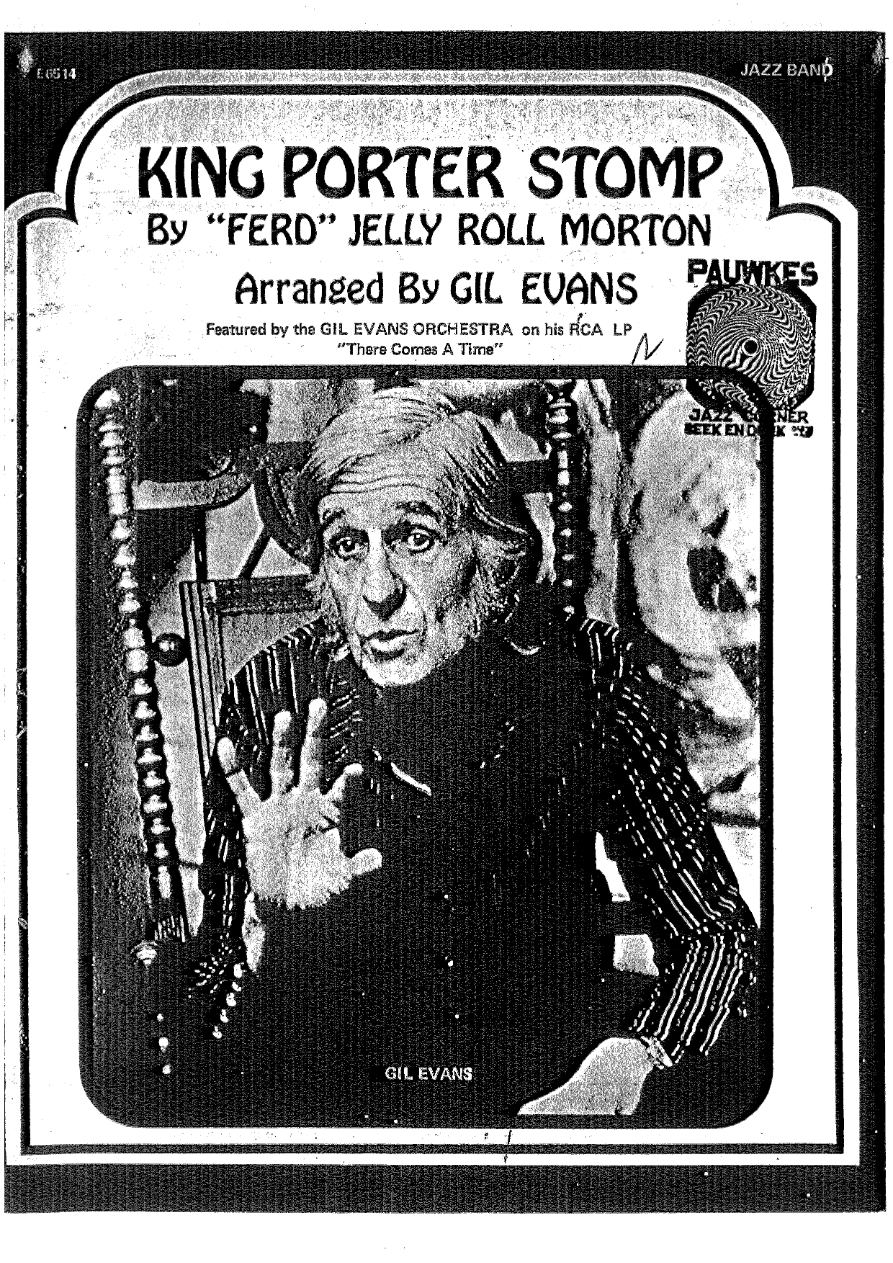
King Porter Stomp (G.Evans) sheet music preview

King Porter Stomp (G.Evans)

Composed by Jelly Roll Morton

Arranged by Gil Evans

  • Ensemble: Big Band
  • Pages: 73
  • Instruments (19): Full Score, 1st Eb Alto Saxophone, 2nd Eb Alto Saxophone, 1st Bb Tenor Saxophone, 2nd Bb Tenor Saxophone, Eb Baritone Saxophone, 1st Bb Trumpet, 2nd Bb Trumpet, 3rd Bb Trumpet, 4th Bb Trumpet, 1st Trombone, 2nd Trombone, 3rd Trombone, 4th Trombone (Bass), Piano, Guitar, Bass, Drums, Tuba
  • Difficulty: advanced
  • Content: Individual Parts
  • Format: PDF Download (Instant)
  • Price: $24.99

Jelly Roll Morton’s seminal 1923 ragtime-jazz masterpiece "King Porter Stomp" underwent a radical metamorphosis when filtered through the brilliant, forward-thinking compositional mind of Gil Evans. Originally popularized across the swing era by the Benny Goodman Orchestra—whose Fletcher Henderson arrangement galvanized the 1935 swing craze—the composition serves as a foundational bridge between early New Orleans polyphony and modern big band architecture. Evans approached this classic canvas not as a nostalgic recreation, but as an opportunity for structural deconstruction, injecting the work with his signature impressionistic harmonic palette, unorthodox voicings, and shifting textural densities that anticipate his legendary later work with Miles Davis. Brimming with kinetic energy and sophisticated tension, this arrangement drives forward with a blistering, infectious medium-up swing tempo. The mood shifts fluidly between ferocious, hard-swinging big band outbursts and cool, shimmering chordal voicings that dissolve traditional functional harmony in favor of lush, suspended colors. Evans reinterprets Morton’s multi-strained form by manipulating register and timbre, utilizing unconventional pairings of woodwinds and brass to create an orchestral depth rarely found in conventional stock arrangements. The interplay between sparse, haunting background figures and explosive, brass-heavy shout choruses evokes a dynamic spectrum that ranges from subtle, hushed intrigue to overwhelming sonic power. True to his idiosyncratic style, Gil Evans avoids predictable call-and-response formulas, instead weaving counterpoint that demands absolute rhythmic precision and acute listening across the entire ensemble. The saxophones—featuring prominent writing for alto, tenor, and baritone—frequently act as an integrated, fluid choir that mirrors string textures, while the trumpet and trombone sections deliver punchy, harmonically advanced counterlines. Extended chords, polychords, and subtle chromatic sliding are woven seamlessly into the arrangement's DNA, transforming familiar thematic material into a modernist landscape. Solos are integrated organically into the structural fabric, allowing featured improvisers space to stretch out over sophisticated chord substitutions that elevate the underlying blues and rag elements. Advanced collegiate, professional, and elite community big bands will find this 73-page masterwork to be an immensely rewarding centerpiece for concert programming. Because of its dense harmonic language, intricate rhythmic unisons, and demand for stylistic versatility—bridging the gap between swing tradition and cool-school modernism—it requires a mature ensemble capable of balancing aggressive dynamic swells with delicate ensemble blend. Conductor and players alike will uncover endless nuance upon repeated study, making it a definitive statement on how a master arranger reimagines jazz history. The primary technical challenge in Gil Evans’ setting of "King Porter Stomp" lies in maintaining immaculate intonation and rhythmic buoyancy through dense, shifting chromatic harmonies. The tempo must remain relentlessly steady; resist the urge to rush the shout choruses, as the rhythmic tension relies heavily on the band's collective ability to sit squarely in the pocket at a brisk clip. Saxophones must focus on a warm, blended section sound during the impressionistic soli passages, ensuring that inner-voice alterations speak clearly without overpowering the lead player. Brass players should master a wide dynamic spectrum—from controlled, breathy whispers to brilliant, brassy crescendos—without forcing tone quality. Pay close attention to subtle articulation markings; detached notes must be crisp and light, contrasting sharply with the legato, flowing counterlines. Rehearsal should begin section by section, isolating the complex harmonic shifts before integrating the rhythm section, which must anchor the modern re-harmonizations with a driving, unyielding swing feel. Q: What specific instrumentation and parts are included in this arrangement? A: This chart is scored for a standard 8-instrument core ensemble format featuring Alto Saxophone, Tenor Saxophone, Baritone Saxophone, Trumpet, Trombone, and a fully integrated rhythm section. Q: What is the official difficulty level of this Gil Evans arrangement? A: This arrangement is graded as advanced, making it best suited for college, conservatory, professional, and elite community big bands with strong sight-readers and mature section players. Q: How does this version differ historically from the standard Benny Goodman big band arrangement? A: While Fletcher Henderson’s famous Goodman arrangement leans heavily into driving 1930s swing era tropes, Gil Evans reinterprets the material through a modernist, impressionistic lens featuring advanced harmonies and unorthodox orchestral textures. Q: What makes this specific 73-page score unique within the big band repertoire? A: It showcases Evans' signature approach to voice-leading, polychords, and structural deconstruction, turning a classic ragtime-era stomp into a sophisticated, multi-layered concert work. Q: What is the performance duration and recommended tempo feel for this piece? A: The arrangement is designed to be performed at a brisk, driving medium-up swing tempo, with a typical duration of approximately 4 to 5 minutes depending on the length of improvised solo choruses.

Questions and answers

What is included in the King Porter Stomp (G.Evans) PDF?
The verified current file contains a conductor score and individual parts across 73 pages.
How many instruments or parts are listed for King Porter Stomp (G.Evans)?
The verified instrumentation list contains 19 entries for this Big Band arrangement.
Who is credited for King Porter Stomp (G.Evans)?
Composer: Jelly Roll Morton. Arranger: Gil Evans.
What difficulty is listed for King Porter Stomp (G.Evans)?
The verified difficulty level is advanced.
Can I preview King Porter Stomp (G.Evans) before buying?
Yes. The product page provides a preview generated from the current PDF file.
How is King Porter Stomp (G.Evans) delivered?
After successful payment, the digital PDF is made available for download. The displayed price is $24.99.

Musicians Also Search For

King Porter Stomp Gil Evans PDFKing Porter Stomp Gil Evans sheet musicKing Porter Stomp arranged by Gil EvansGil Evans big band chartsGil Evans jazz arrangements PDFKing Porter Stomp Jelly Roll Morton sheet musicKing Porter Stomp Jelly Roll Morton big band arrangementsJelly Roll Morton big band chartsKing Porter Stomp big band arrangementsKing Porter Stomp big band PDF downloadKing Porter Stomp jazz sheet musicbig band sheet music downloadKing Porter Stomp conductor score PDFKing Porter Stomp individual parts downloadKing Porter Stomp sheet music PDFbuy King Porter Stomp sheet musicdownload King Porter Stomp PDFKing Porter Stomp jazz chartsbest Gil Evans big band arrangementsJelly Roll Morton arranged by Gil EvansKing Porter Stomp printable sheet musicbig band repertoire PDF

All arrangements by Gil Evans All Jelly Roll Morton sheet music