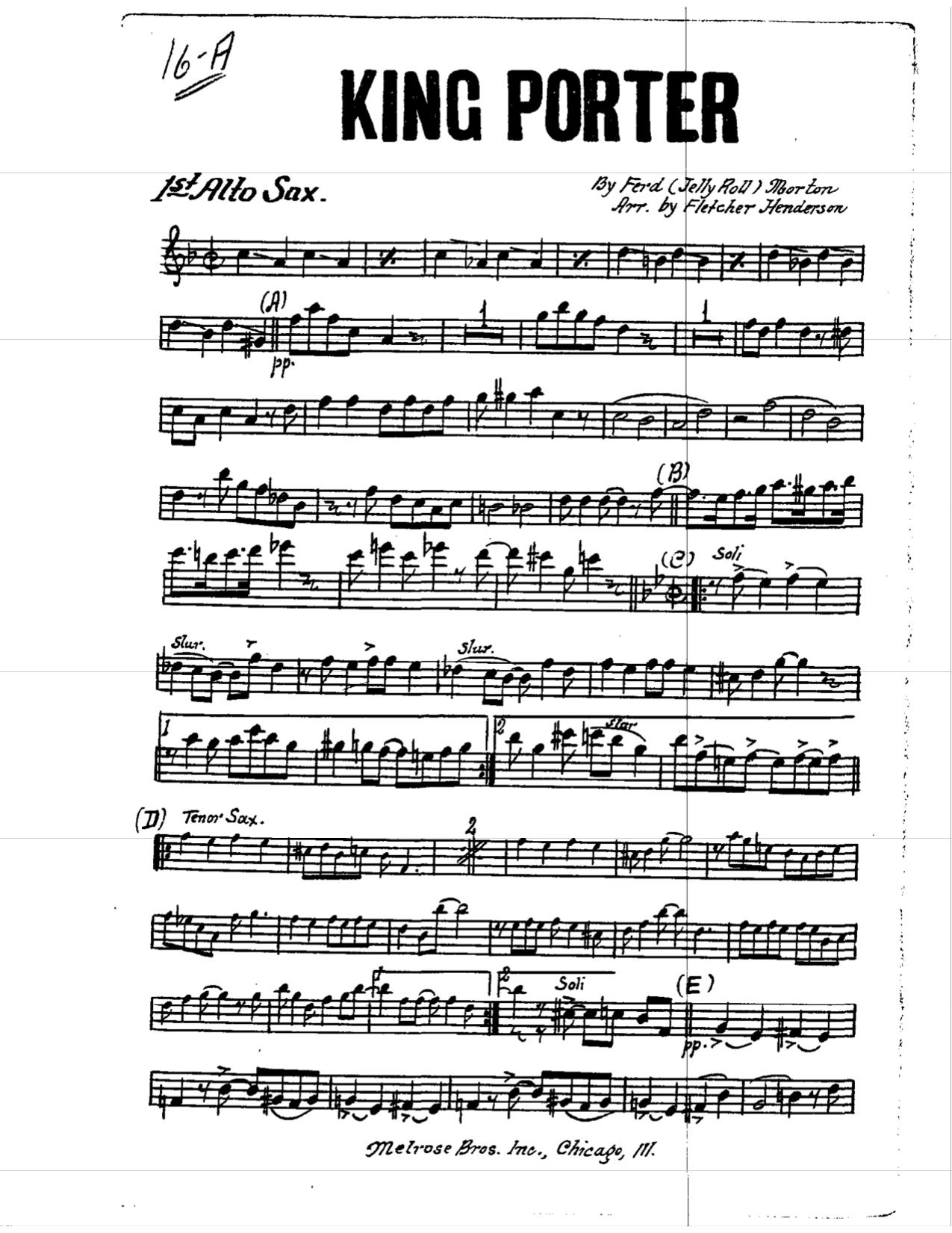
King Porter Stomp (F.Henderson) sheet music preview

King Porter Stomp (F.Henderson)

Composed by Jelly Roll Morton

Arranged by Fletcher Henderson

  • Ensemble: Big Band
  • Pages: 23
  • Instruments (15): 1st Alto Sax., 2nd Alto Sax., 1st Tenor Sax., 2nd Tenor Sax., 1st Bb Trumpet, 2nd Bb Trumpet, 3rd Bb Trumpet, 1st Trombone, 2nd Trombone, Violin (B), Violin (C), Piano, Drums, Bass, Banjo-Guitar
  • Difficulty: medium
  • Content: Individual Parts
  • Format: PDF Download (Instant)
  • Price: $24.99

Jelly Roll Morton originally penned "King Porter Stomp" in 1905 as a ragtime piano masterpiece, but it was Fletcher Henderson’s revolutionary 1928 and 1935 big band recordings that transformed the tune into a cornerstone of the swing era. Henderson’s arrangement serves as the blueprint for the entire big band idiom, famously helping to launch the Benny Goodman Orchestra into national superstardom. This seminal work bridges the gap between early New Orleans polyphony and the high-octane, section-driven swing architecture that would dominate the 1930s. It stands as a masterclass in jazz composition, capturing the exuberant, high-energy spirit of Harlem's dance halls while retaining the syncopated charm of early jazz piano styles. Propelled by an infectious, driving medium-up swing tempo, the arrangement crackles with irrepressible energy and shifting textures. The harmonic language is firmly rooted in traditional swing changes, utilizing bright major tonalities, clever secondary dominants, and a famous stride-piano foundation that keeps the rhythmic pulse relentlessly moving forward. Listeners are immediately swept up in a mood of joyous celebration, marked by call-and-response figures between the brass and reeds. The emotional trajectory builds steadily from a jaunty, playful head statement to a thunderous, roof-raising climax that never fails to electrify an audience. Henderson’s signature approach relies on brilliant section-against-section writing, pitting crisp reed solis against punchy brass counter-lines. Rather than relying on dense, modern extended harmonies, Henderson achieves his rich sonic palette through masterful voice-leading, clever spatial distribution, and dynamic contrasts. The arrangement features the iconic climactic strain—often credited as the birth of the swing-era "shout chorus"—where the entire ensemble locks into a unified, roaring rhythmic unison that demands absolute precision and articulation uniformity from every player. Navigating this 23-page manuscript requires an ensemble with strong stylistic awareness of early-to-mid swing phrasing, particularly regarding dotted-eighth-and-sixteenth-note feels versus straight triplet swings. The alto and tenor saxophone sections carry the primary thematic weight during the intricate soli passages, while the trumpet and trombone sections provide biting, punctuating stabs. Featured solo opportunities allow individual players to stretch out over classic rhythm changes, calling for an authentic, blues-drenched vocabulary. Advanced high school, collegiate, and professional big bands will find this chart deeply rewarding; it exposes musicians to the historical roots of big band arranging while demanding the tight ensemble cohesion characteristic of elite professional units. Executing Fletcher Henderson’s classic arrangement demands meticulous attention to stylistic authenticity and rhythmic crispness. The tempo should sit comfortably in a driving, energetic medium-swing zone (around 160–168 BPM); rushing the tempo will muddy the stride-piano feel and destroy the danceability. Key technical challenges center around the articulation of syncopated figures. Conductors must ensure that all short notes are clipped and uniform across sections, avoiding heavy accents on weak beats unless explicitly marked. The reed players need agile fingerwork for the rapid scalar runs in the soli sections, while the brass must balance punchy, aggressive attack with a warm, non-brash tone. Special techniques include occasional plunger effects in the brass and subtle fall-offs at phrase endings, which should mimic vocal inflections rather than sounding cartoonish. Rehearsal should begin with the rhythm section locked in; have the piano and bass establish the unyielding stride pulse before layering in the horns section by section to build proper harmonic balance. Q: What instruments and parts are included in this 23-page arrangement? A: This arrangement is scored for an 8-instrument ensemble format, featuring dedicated parts for Alto Saxophone, Tenor Saxophone, Trumpet, Trombone, Piano, and rhythm section support, optimized for smaller big band configurations. Q: What is the difficulty level of this Fletcher Henderson chart? A: It is graded as advanced-intermediate to advanced, making it ideal for skilled high school ensembles, collegiate bands, and professional groups due to its rigorous demands on stylistic phrasing, endurance, and section tightness. Q: What historical era and style does "King Porter Stomp" represent? A: Composed by Jelly Roll Morton and arranged by Fletcher Henderson, this piece represents the vital bridge between 1920s early jazz/ragtime and the fully formed 1930s swing era big band style. Q: What makes this specific arrangement unique? A: It features Henderson’s iconic blueprint for the swing shout chorus, utilizing brilliant call-and-response textures, interlocking reed solis, and a driving stride-piano foundation that defined the sound of the swing era. Q: What is the performance duration and recommended tempo for this piece? A: The performance duration is approximately 3 to 4 minutes, and it is best performed at an energetic medium-swing tempo between 160 and 168 beats per minute.

Questions and answers

What is included in the King Porter Stomp (F.Henderson) PDF?
The verified current file contains individual parts across 23 pages.
How many instruments or parts are listed for King Porter Stomp (F.Henderson)?
The verified instrumentation list contains 15 entries for this Big Band arrangement.
Who is credited for King Porter Stomp (F.Henderson)?
Composer: Jelly Roll Morton. Arranger: Fletcher Henderson.
What difficulty is listed for King Porter Stomp (F.Henderson)?
The verified difficulty level is medium.
Can I preview King Porter Stomp (F.Henderson) before buying?
Yes. The product page provides a preview generated from the current PDF file.
How is King Porter Stomp (F.Henderson) delivered?
After successful payment, the digital PDF is made available for download. The displayed price is $24.99.

Musicians Also Search For

King Porter Stomp Fletcher Henderson PDFKing Porter Stomp Fletcher Henderson sheet musicKing Porter Stomp arranged by Fletcher HendersonFletcher Henderson big band chartsFletcher Henderson jazz arrangements PDFKing Porter Stomp Jelly Roll Morton sheet musicKing Porter Stomp Jelly Roll Morton big band arrangementsJelly Roll Morton big band chartsKing Porter Stomp big band arrangementsKing Porter Stomp big band PDF downloadKing Porter Stomp jazz sheet musicbig band sheet music downloadKing Porter Stomp individual parts downloadKing Porter Stomp sheet music PDFbuy King Porter Stomp sheet musicdownload King Porter Stomp PDFKing Porter Stomp jazz chartsbest Fletcher Henderson big band arrangementsJelly Roll Morton arranged by Fletcher HendersonKing Porter Stomp printable sheet musicbig band repertoire PDF

All arrangements by Fletcher Henderson All Jelly Roll Morton sheet music