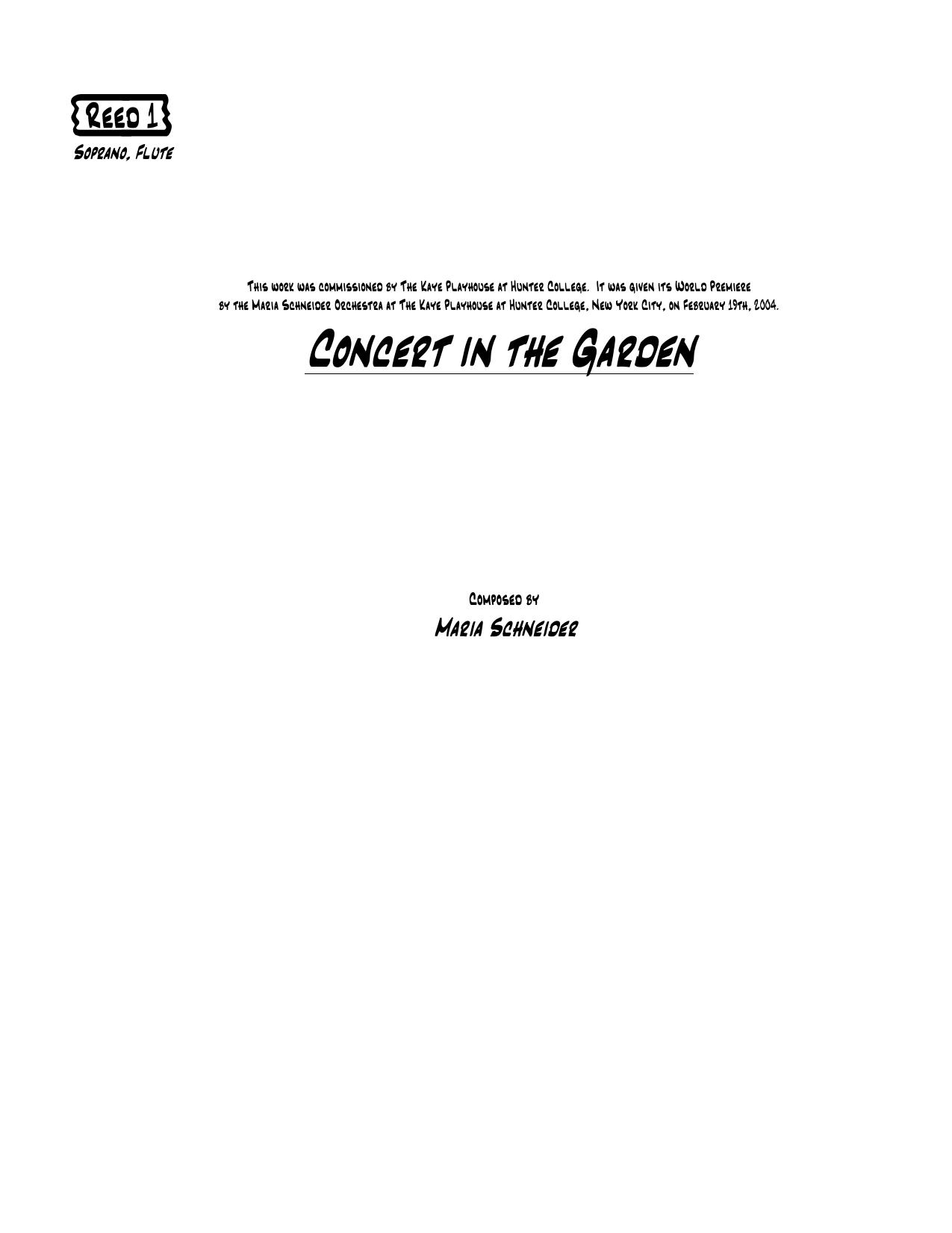
Concert In The Garden (M.Schneider) sheet music preview

Concert In The Garden (M.Schneider)

Composed by Maria Schneider

Arranged by Maria Schneider

  • Ensemble: Big Band
  • Pages: 186
  • Instruments (14): Soprano Saxophone, Flute, Tenor Saxophone, Clarinet, Trumpet, Fluegelhorn, Trombone, Bass Trombone, Accordion, Voice, Piano, Guitar, Bass, Drums
  • Difficulty: advanced
  • Content: Individual Parts
  • Format: PDF Download (Instant)
  • Price: $24.99

*Concert In The Garden*, the title track from Maria Schneider’s landmark 2004 Grammy Award-winning album, stands as a monumental achievement in modern large jazz ensemble composition. Commissioned by the Greater Bridgeport Symphony and later expanded for her own orchestra, this masterwork bridges the worlds of contemporary classical orchestration and post-bop jazz. Schneider, a protégé of Gil Evans, rejects standard big band formulas in favor of sweeping, programmatic soundscapes that evoke rural expansiveness, shifting natural light, and deep emotional introspection. The piece captured widespread critical acclaim, earning a Grammy for Best Large Jazz Ensemble Album and historic recognition as the first-ever Grammy-winning album distributed primarily via the internet. Rooted in a shimmering, organic modern jazz aesthetic, the work eschews rigid swing beats for undulating meters, rubato openings, and flowing, cyclical grooves that evoke a serene yet restless pastoral landscape. The harmonic language is lush and sophisticated, utilizing extended tertian structures, polytonal clusters, and non-functional chord progressions that create a sense of perpetual motion without relying on traditional bebop changes. Schneider’s scoring utilizes unconventional doubling—frequently featuring soprano saxophone, flutes, and low woodwinds—to blend timbres in ways that recall Ravel or Debussy. The emotional arc transitions from tranquil, evocative impressionism to soaring, ecstatic climaxes that demand immense dynamic control and expressive maturity from every player. Within this 186-page tour de force, the melodic weight is shared democratically across the entire ensemble rather than resting solely in the traditional brass sections. The woodwinds—anchored by a versatile soprano sax lead—frequently introduce intricate, cascading motifs that require chamber-music levels of intonation and balance. Featured solo spaces allow for deeply personal improvisational exploration over impressionistic harmonic pads. Technical challenges abound: performers must navigate shifting odd meters, subtle rubato tempo fluctuations, wide dynamic extremes ranging from whispered *pianissimos* to roaring brass swells, and complex rhythmic unisons that test the cohesion of the entire rhythm section. The rhythmic foundation requires a drummer comfortable with textural, coloristic percussion and a pianist adept at voicing delicate, impressionistic cluster chords. Due to its demanding polyrhythms, intricate ensemble interplay, and advanced harmonic vocabulary, *Concert In The Garden* is best suited for elite university jazz orchestras, advanced regional ensembles, and professional big bands. Performing this repertoire offers an extraordinary educational and artistic reward, stretching a band's capacity for listening, blend, and nuanced storytelling. Conductor and ensemble alike will find that mastering Schneider’s unique vernacular provides a transformative group experience, elevating big band performance into high art. Rehearsing *Concert In The Garden* requires an ensemble-wide shift in mindset from traditional hard-swing playing to a deeply integrated, chamber-orchestral approach. The conductor must function less as a time-keeper and more as a balance monitor, ensuring that delicate woodwind textures are never obscured by the rhythm section or brass pads. The primary technical challenge lies in the execution of fluid, non-metric rubato sections and transitions into persistent, undulating grooves. Conductors should spend early rehearsals isolating the rhythm section to establish a relaxed yet driving pulse that breathes rather than ticks. Intonation is paramount; because Schneider utilizes closely voiced harmonies and sustained cluster chords, minor pitch discrepancies will heavily color the overall sonography. Players should practice their parts with a drone or tuner to lock in these modern voicings. Dynamic contrast forms the emotional core of the piece. Ensure the ensemble strictly observes the written sub-ito dynamics and gradual swells, treating crescendos not merely as getting louder, but as opening up the acoustic space of the band. Mutes should be prepared in advance as specified in the score, and players must focus on a warm, vocal quality across all registers. Q: What instruments and parts are included in this arrangement? A: This 186-page score and parts set is scored for a 10-instrument core ensemble format featuring soprano saxophone, alto saxophone, tenor saxophone, baritone saxophone, and a designated trumpet section, alongside a full rhythm section. Q: What is the difficulty level of this arrangement? A: This piece is graded as advanced/professional, designed specifically for elite university jazz orchestras and professional big bands capable of handling complex modern harmonies and shifting meters. Q: What is the musical style and historical context of the piece? A: Written by Maria Schneider and released in 2004, the piece belongs to the contemporary orchestral jazz genre, blending impressionistic classical composition techniques with modern post-bop jazz sensibilities. Q: What makes this Maria Schneider arrangement unique? A: It features Schneider’s signature avoidance of standard big band shout choruses in favor of organic, through-composed programmatic development, impressionistic woodwind doublings, and lush, extended harmonic voicings. Q: What is the performance duration and tempo character of the work? A: The piece is an extended, multi-movement-style journey featuring fluid, shifting tempos and cyclical grooves rather than a static, fixed-tempo swing feel, requiring roughly 10 to 12 minutes of performance time.

Questions and answers

What is included in the Concert In The Garden (M.Schneider) PDF?
The verified current file contains a conductor score and individual parts across 186 pages.
How many instruments or parts are listed for Concert In The Garden (M.Schneider)?
The verified instrumentation list contains 14 entries for this Big Band arrangement.
Who is credited for Concert In The Garden (M.Schneider)?
Composer: Maria Schneider. Arranger: Maria Schneider.
What difficulty is listed for Concert In The Garden (M.Schneider)?
The verified difficulty level is advanced.
Can I preview Concert In The Garden (M.Schneider) before buying?
Yes. The product page provides a preview generated from the current PDF file.
How is Concert In The Garden (M.Schneider) delivered?
After successful payment, the digital PDF is made available for download. The displayed price is $24.99.

Musicians Also Search For

Concert In The Garden Maria Schneider PDFConcert In The Garden Maria Schneider sheet musicConcert In The Garden arranged by Maria SchneiderMaria Schneider big band chartsMaria Schneider jazz arrangements PDFConcert In The Garden Maria Schneider big band arrangementsConcert In The Garden big band arrangementsConcert In The Garden big band PDF downloadConcert In The Garden jazz sheet musicbig band sheet music downloadConcert In The Garden conductor score PDFConcert In The Garden individual parts downloadConcert In The Garden sheet music PDFbuy Concert In The Garden sheet musicdownload Concert In The Garden PDFConcert In The Garden jazz chartsbest Maria Schneider big band arrangementsConcert In The Garden printable sheet musicbig band repertoire PDF

All arrangements by Maria Schneider All Maria Schneider sheet music