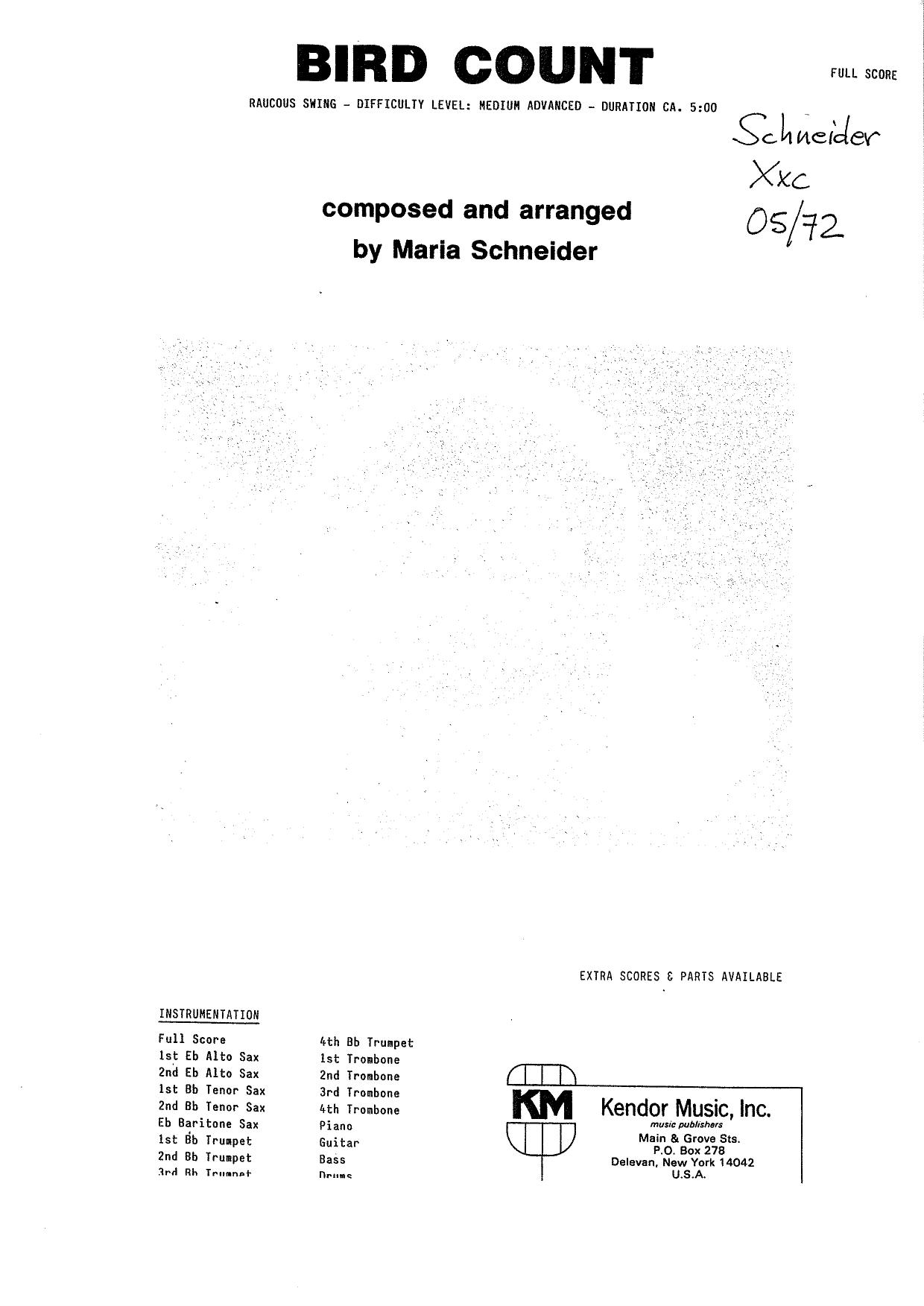
Bird Count (M.Schneider) sheet music preview

Bird Count (M.Schneider)

Composed by Maria Schneider

Arranged by Maria Schneider

  • Ensemble: Big Band
  • Pages: 76
  • Instruments (17): 1st Eb Alto Sax, 2nd Eb Alto Sax, 1st Bb Tenor Sax, 2nd Bb Tenor Sax, Eb Baritone Sax, 1st Bb Trumpet, 2nd Bb Trumpet, 3rd Bb Trumpet, 4th Bb Trumpet, 1st Trombone, 2nd Trombone, 3rd Trombone, 4th Trombone, Piano, Guitar, Bass, Drums
  • Difficulty: advanced
  • Content: Individual Parts
  • Format: PDF Download (Instant)
  • Price: $24.99

Originally composed during Maria Schneider’s graduate studies at the Eastman School of Music and later immortalized on the live album *Days of Wine and Roses – Live at the Jazz Standard*, "Bird Count" represents a fascinating early chapter in the catalog of one of modern jazz’s most celebrated composers. Conceived initially with a distinct nod to the driving, earthy aesthetic of Charles Mingus, Schneider later reshaped the work for her own professional jazz orchestra, where its infectious energy made it a legendary closing staple for their long-term Monday residency at Visiones in Greenwich Village. Grounded in the traditional framework of a blues in F, the composition bridges the gap between classic straight-ahead ensemble writing and the intricate, textural sophistication that would later define her multi-Grammy-winning style. Operating at a brisk, buoyant tempo feel, the chart bounces forward with a romping, high-spirited melody line interwoven with punchy, interlocking band riffs. The mood is celebratory, relentless, and unpretentious, functioning almost as a self-contained party that builds in momentum chorus after chorus. Rather than relying on dense, impressionistic washes of sound characteristic of her later tone poems, this arrangement utilizes taut, clever counterpoint and blues-drenched harmonies. The writing showcases a rare structural feature for Schneider's library: the complete absence of woodwind doubles, allowing each section to dig into straight-ahead acoustic textures without the distraction of instrument switching. The architecture of the chart distributes melodic responsibility dynamically across the entire ensemble, keeping every section actively engaged in driving the groove. Solos are a focal point, traditionally featuring space for piano, trumpet, alto saxophone, and baritone saxophone over the blues form, though the arrangement is flexible enough to accommodate alternative soloists or open up for extended stretches. Technical demands center heavily on rhythmic precision, articulation clarity, and stamina, as the relentless swing groove requires the rhythm section and horns to maintain a buoyant, forward-leaning pulse over numerous choruses. Ensembles ranging from ambitious high school and collegiate jazz bands to professional big bands will find this chart immensely rewarding. Because it avoids extreme technical hurdles like woodwind doubling or avant-garde metric modulation while still demanding sophisticated swing phrasing and stylistic cohesion, it serves as an exceptional vehicle for teaching traditional blues form within a contemporary large-ensemble context. It provides a perfect showcase for strong soloists while rewarding the collective ensemble with an unforgettable, high-energy closer. Sustaining the buoyant, driving swing feel without letting the tempo drag or rush is the primary challenge of this arrangement. The rhythm section must lock in tightly, keeping the ride cymbal and walking bass propulsive and transparent. Horn players should focus on clean, uniform articulations on the snappy background riffs, ensuring that dynamic accents enhance rather than overpower the soloists. Because the form is an F blues, soloists should be encouraged to build their improvisations organically over multiple choruses, utilizing dynamic contrast and motivic development rather than relying solely on scalar patterns. Conductors should rehearse the ensemble sections with a light, horizontal mindset, emphasizing the "bounce" of the rhythm rather than heavy vertical stabs. Utilize the open-ended nature of the form to tailor the length of the piece to the band's soloistic depth and concert pacing. Q: What instruments and parts are included in this arrangement? A: The instrumentation features 5 saxophones (with no woodwind doubles: Soprano, Alto, Tenor, Baritone, though Alto 1 and Tenor/Soprano roles are specified), 4 trumpets, 3 trombones, 1 bass trombone, guitar, piano, bass, and drums, spanning a 76-page comprehensive score and part set. Q: What is the difficulty level of this arrangement? A: It is graded as medium-advanced, making it highly accessible for advanced high school, collegiate, and professional big bands due to its straight-ahead harmonic language and lack of woodwind doubling. Q: What is the musical style and historical context of "Bird Count"? A: Composed originally during Maria Schneider's time at Eastman and later recorded live at the Jazz Standard, it is an energetic F-blues influenced by a Mingus-esque vibe that famously served as a nightly closer for her New York residency. Q: What makes this particular arrangement unique? A: Uniquely for a Maria Schneider chart, it features zero woodwind doubles, relying instead on pure, straight-ahead big band scoring and interactive blues riffs that allow solo sections to be easily opened up or reallocated. Q: What is the performance duration and tempo guidance? A: While performance duration is flexible depending on how many solo choruses are opened up, the piece is designed as a brisk, high-energy swing chart where tempo can be adjusted to match the technical readiness of the ensemble.

Questions and answers

What is included in the Bird Count (M.Schneider) PDF?
The verified current file contains a conductor score and individual parts across 76 pages.
How many instruments or parts are listed for Bird Count (M.Schneider)?
The verified instrumentation list contains 17 entries for this Big Band arrangement.
Who is credited for Bird Count (M.Schneider)?
Composer: Maria Schneider. Arranger: Maria Schneider.
What difficulty is listed for Bird Count (M.Schneider)?
The verified difficulty level is advanced.
Can I preview Bird Count (M.Schneider) before buying?
Yes. The product page provides a preview generated from the current PDF file.
How is Bird Count (M.Schneider) delivered?
After successful payment, the digital PDF is made available for download. The displayed price is $24.99.

Musicians Also Search For

Bird Count Maria Schneider PDFBird Count Maria Schneider sheet musicBird Count arranged by Maria SchneiderMaria Schneider big band chartsMaria Schneider jazz arrangements PDFBird Count Maria Schneider big band arrangementsBird Count big band arrangementsBird Count big band PDF downloadBird Count jazz sheet musicbig band sheet music downloadBird Count conductor score PDFBird Count individual parts downloadBird Count sheet music PDFbuy Bird Count sheet musicdownload Bird Count PDFBird Count jazz chartsbest Maria Schneider big band arrangementsBird Count printable sheet musicbig band repertoire PDF

All arrangements by Maria Schneider All Maria Schneider sheet music