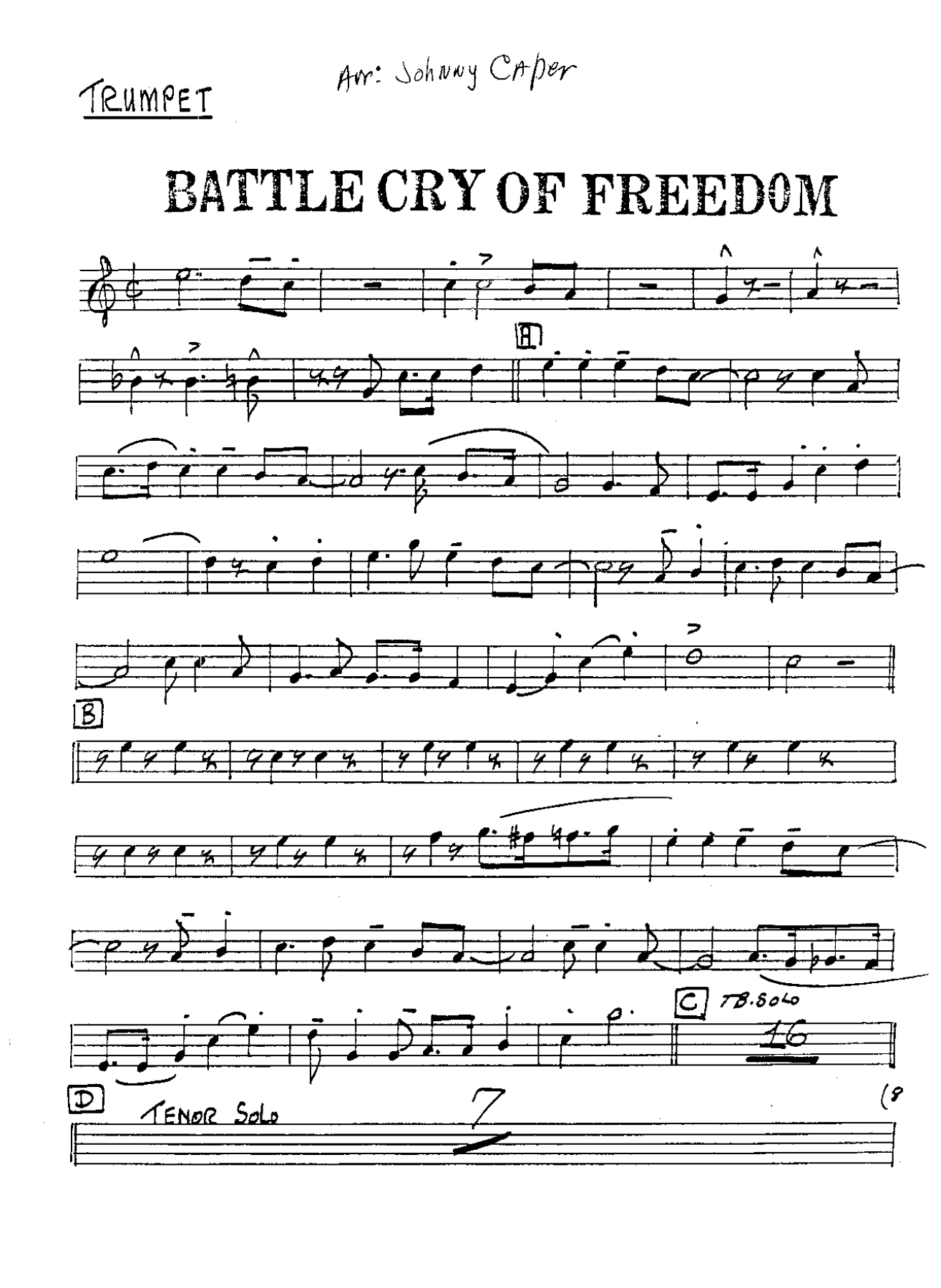
Battle Cry Of Freedom (J.Caper)
Composed by George Frederick Root
Arranged by J.Caper
- Ensemble: Dixieland Band
- Style: Jazz Standard
- Pages: 18
- Difficulty: easy
- Content: Sheet Music
- Format: PDF Download (Instant)
- Price: $18.99
"The Battle Cry Of Freedom," originally penned by American composer George Frederick Root in 1862, emerged as one of the most resonant and widely embraced songs of the American Civil War era. Root composed the piece in a single day in response to President Abraham Lincoln's call for 300,000 Union Army volunteers, and it quickly became a powerful anthem for Unionism and abolitionism. Its popularity was immense, with an estimated 500,000 to 750,000 copies of the sheet music circulating, requiring 14 printing presses to keep up with demand. Soldiers sang it in camps, on marches, and even on battlefields, finding in its stirring melody and patriotic lyrics a profound source of morale and unity. The song's impact was so significant that even Confederate forces adapted it with altered lyrics, testifying to its undeniable musical appeal. Over a century later, its enduring melodic structure and historical significance have cemented its place as a quintessential American folk and patriotic standard, ripe for reinterpretation across various musical genres. J.Caper's Dixieland arrangement breathes new life into this historic anthem, transforming its martial origins into a vibrant celebration of early jazz. This rendition is set in a bright, medium-up swing tempo, typically around 140-160 BPM, infusing the piece with the infectious energy characteristic of classic Dixieland. The arrangement maintains a lively and optimistic mood, primarily in a major key, evoking the joyous, communal spirit of New Orleans street parades and traditional jazz halls. The musical character is defined by its buoyant rhythmic drive and the interplay of the front-line instruments, creating a dense, exciting, and layered soundscape. It's a sound that encourages toe-tapping and spontaneous movement, designed to uplift and engage both performers and listeners. J.Caper's distinctive approach to this jazz standard is evident in the clever use of collective improvisation and a robust, driving rhythm section. The arrangement features the iconic Dixieland front line—trumpet, clarinet, and trombone—engaging in spirited contrapuntal lines, with each voice contributing to the melodic texture without a single dominant soloist throughout. However, there are strategically placed open sections for featured solos, allowing individual musicians to showcase their improvisational prowess over the familiar harmonic framework. J.Caper expertly balances ensemble sections, where the full band delivers the memorable melody with a unified, powerful sound, with moments of call-and-response between instrumental groups. The arrangement includes signature Dixieland voicings, such as the clarinet's soaring obligato above the trumpet's lead melody and the trombone's "tailgate" glissandos, adding authentic stylistic flavor. The arrangement also incorporates a dynamic shout chorus towards the end, building excitement and bringing the piece to a thrilling climax. This arrangement is ideally suited for college, community, and semi-professional Dixieland bands seeking a challenging yet immensely rewarding piece to add to their repertoire. Its technical demands are moderate to difficult, requiring solid ensemble playing, confident individual improvisation, and a keen understanding of Dixieland stylistic nuances. The rewarding aspect lies in the opportunity for musicians to engage in the collaborative spirit of Dixieland, where listening and reacting to one another are paramount. Specific musical moments, such as the initial ensemble statement of the theme, the lively collective improvisation sections, and the powerful final shout chorus, stand out as highlights. Performing this arrangement offers a chance to connect with a piece of American history through the energetic and expressive lens of traditional jazz. This Dixieland arrangement of "Battle Cry Of Freedom" thrives on a vibrant, medium-up swing feel, ideally performed between 140-160 BPM. Conductors should emphasize a consistent, driving pulse from the rhythm section, with the tuba or bass providing a strong foundation on beats one and three, complemented by the banjo or piano's chordal accompaniment. Key technical challenges include maintaining clarity and balance during collective improvisation sections, where the trumpet leads the melody, the clarinet weaves intricate counter-melodies, and the trombone provides harmonic and rhythmic fills. Musicians should focus on active listening to ensure their improvised lines complement, rather than clash with, the other front-line instruments. Special techniques like trombone glissandos ("tailgate" style) and clarinet obligatos should be executed with characteristic flair. Rehearsal tips include isolating the front-line parts to refine individual lines before combining them for collective sections, and encouraging rhythmic precision and articulation typical of the Dixieland style. **Q: What instruments/parts are included in this arrangement?** A: This Dixieland Band arrangement typically includes parts for trumpet (or cornet), clarinet, trombone, banjo (or guitar), piano, tuba (or string bass), and drums. This instrumentation allows for the classic Dixieland front-line and rhythm section sound. **Q: What is the difficulty level of this arrangement?** A: This arrangement is rated as moderate to difficult, suitable for college, community, and semi-professional Dixieland bands. It requires proficient instrumental technique, strong ensemble cohesion, and comfort with jazz improvisation. **Q: What is the musical style and historical context of this piece?** A: This is a Dixieland Jazz Standard arrangement of "The Battle Cry Of Freedom," a patriotic song originally composed by George Frederick Root in 1862 during the American Civil War. The arrangement reinterprets this historical anthem through the energetic lens of early 20th-century New Orleans jazz. **Q: What makes J.Caper's arrangement unique?** A: J.Caper's arrangement is distinguished by its authentic Dixieland voicings, dynamic collective improvisation sections, and a powerful shout chorus. It skillfully blends the historical gravitas of the original melody with the joyful, swinging energy and contrapuntal interplay characteristic of the Dixieland style. **Q: What is the approximate performance duration or tempo of this arrangement?** A: This arrangement is designed for a medium-up swing tempo, typically in the range of 140-160 BPM. The exact performance duration will vary slightly based on the tempo chosen and the length of any improvised solos.
Musicians Also Search For
Battle Cry Of Freedom J.Caper PDF • Battle Cry Of Freedom J.Caper sheet music • Battle Cry Of Freedom arranged by J.Caper • J.Caper dixieland band charts • J.Caper jazz arrangements PDF • Battle Cry Of Freedom George Frederick Root sheet music • Battle Cry Of Freedom George Frederick Root dixieland band arrangement • George Frederick Root dixieland band charts • Battle Cry Of Freedom dixieland band arrangement • Battle Cry Of Freedom dixieland band PDF download • Battle Cry Of Freedom jazz ensemble sheet music • dixieland band sheet music instant download • Battle Cry Of Freedom sheet music with parts • Battle Cry Of Freedom Jazz Standard chart • Jazz Standard dixieland band arrangements • buy Battle Cry Of Freedom sheet music online • download Battle Cry Of Freedom PDF • Battle Cry Of Freedom jazz chart • best J.Caper dixieland band arrangements • George Frederick Root songs arranged by J.Caper • Battle Cry Of Freedom printable sheet music • dixieland band repertoire PDF