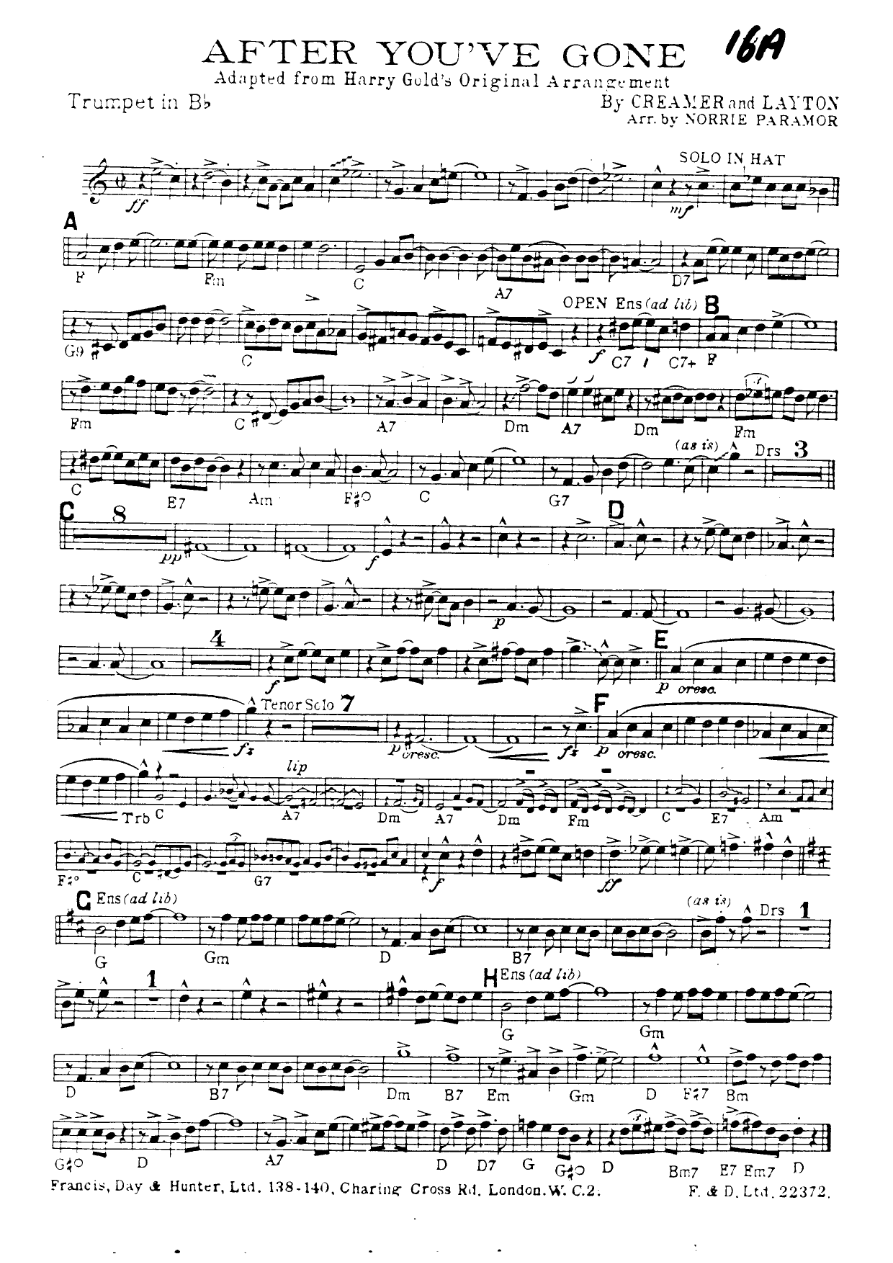
After You've Gone (C.Layton)
Composed by Turner Layton, Henry Creamer
Arranged by CREAMER and LAYTON
- Ensemble: Dixieland Band
- Style: Dixieland
- Pages: 11
- Instruments (8): Trumpet in Bb, Drums, Tenor Saxophone, Bass, Guitar Chords, Piano, Bb Clarinet, Trombone
- Difficulty: easy
- Content: Individual Parts
- Format: PDF Download (Instant)
- Price: $18.99
Penned in 1918 by Turner Layton and Henry Creamer, "After You've Gone" quickly transcended its Tin Pan Alley origins to become a foundational pillar of the jazz repertoire. Its poignant lyrics, detailing the lament of a lover left behind, combined with a memorable, driving melody, resonated deeply with audiences and musicians alike. The song's adoption by early jazz pioneers like Louis Armstrong, Bessie Smith, and later Benny Goodman cemented its status as an enduring standard, showcasing its versatility across vocal and instrumental interpretations. It stands as a testament to the era when popular songs seamlessly transitioned into vehicles for jazz improvisation, embodying the spirited, often bittersweet, energy of the nascent jazz age. Its harmonic structure, typically a 32-bar AABA form, provides a robust framework for both melodic statement and inventive soloing, making it a favorite for generations of improvisers. This arrangement by CREAMER and LAYTON masterfully captures the ebullient spirit of classic Dixieland, presenting "After You've Gone" with an authentic, medium-up tempo feel in the key of F major. The musical character is one of joyous, collective improvisation, underpinned by a driving 4/4 rhythm that encourages toe-tapping and spirited ensemble interplay. The mood is undeniably upbeat and celebratory, despite the song's lyrical content, a hallmark of the Dixieland style where energy often trumps sentimentality. The arrangement emphasizes the infectious counterpoint and call-and-response dynamics characteristic of the genre, ensuring a vibrant and engaging performance from start to finish. CREAMER and LAYTON's approach to this Dixieland standard is both respectful of tradition and expertly crafted for modern ensembles. The arrangement features the melody initially carried by the clarinet, often doubling or harmonizing with the trumpet, establishing that quintessential Dixieland front-line sound. Subsequent choruses introduce a delightful interplay of polyphonic lines, with the trombone providing a robust counter-melody or rhythmic fills, while the rhythm section (piano, bass, drums, banjo/guitar) lays down a solid, swinging foundation. There are ample opportunities for featured solos, typically allocated to the trumpet, clarinet, and trombone, allowing individual musicians to showcase their improvisational flair within the collective framework. The arrangement culminates in a spirited shout chorus, bringing all voices together in a joyous, driving finale that leaves audiences exhilarated. Performing this arrangement is a rewarding experience for intermediate to advanced Dixieland bands, including ambitious high school, college, community, and semi-professional ensembles. The technical challenges lie primarily in maintaining the crisp articulation and rhythmic precision required for collective improvisation, as well as navigating the often-intricate contrapuntal lines. The ability to blend and balance within the ensemble, while simultaneously projecting individual voices, is paramount. The payoff, however, is immense: a truly authentic and exhilarating rendition of a jazz classic that celebrates the communal joy and spontaneous energy at the heart of Dixieland jazz. Approaching "After You've Gone" demands a keen sense of rhythmic drive and collective listening. Maintain a consistent medium-up tempo (around quarter note = 180-200 BPM) with a strong, two-beat feel in the rhythm section, even if the melody is played in cut time. Articulation should be crisp and light, avoiding heavy accents unless specifically marked. Encourage individual soloists to embrace the melodic and harmonic language of early jazz, focusing on clear phrasing and blues inflections. The ensemble passages require careful balancing, ensuring the clarinet's upper register doesn't overpower the trumpet, and the trombone's fills are present but not intrusive. Pay close attention to dynamics, using subtle swells and decays to add shape to the collective improvisation. A plunger mute for the trumpet or trombone can add authentic color during solo sections or specific ensemble hits, enhancing the traditional Dixieland sound. Q: What instruments/parts are included in this arrangement? A: This arrangement typically includes parts for Trumpet, Clarinet, Trombone, Piano, Bass, Drums, and Banjo/Guitar, comprising the standard Dixieland band instrumentation. Q: What is the difficulty level of this arrangement? A: This arrangement is suitable for intermediate to advanced ensembles, including ambitious high school, college, community, and semi-professional Dixieland bands. Q: What musical style and historical context does "After You've Gone" represent in this arrangement? A: This arrangement is firmly rooted in the Dixieland jazz style, reflecting the lively, collective improvisation and melodic interplay characteristic of early 20th-century jazz. Q: What makes this specific arrangement by CREAMER and LAYTON unique? A: CREAMER and LAYTON's arrangement provides an authentic Dixieland treatment, featuring classic front-line counterpoint, ample solo opportunities, and a spirited shout chorus, all expertly crafted for modern ensembles. Q: What is the typical performance duration or tempo for this piece? A: "After You've Gone" is typically performed at a medium-up tempo, around 180-200 BPM, resulting in a performance duration of approximately 2:30 to 3:30 minutes depending on the number and length of solos.
Questions and answers
- What is included in the After You've Gone (C.Layton) PDF?
- The verified current file contains a conductor score and individual parts across 11 pages.
- How many instruments or parts are listed for After You've Gone (C.Layton)?
- The verified instrumentation list contains 8 entries for this Dixieland Band arrangement.
- Who is credited for After You've Gone (C.Layton)?
- Composer: Turner Layton, Henry Creamer. Arranger: CREAMER and LAYTON.
- What difficulty is listed for After You've Gone (C.Layton)?
- The verified difficulty level is easy.
- What style is listed for After You've Gone (C.Layton)?
- The catalog lists the style as Dixieland.
- Can I preview After You've Gone (C.Layton) before buying?
- Yes. The product page provides a preview generated from the current PDF file.
- How is After You've Gone (C.Layton) delivered?
- After successful payment, the digital PDF is made available for download. The displayed price is $18.99.
Musicians Also Search For
After You've Gone CREAMER and LAYTON PDF • After You've Gone CREAMER and LAYTON sheet music • After You've Gone arranged by CREAMER and LAYTON • CREAMER and LAYTON dixieland band charts • CREAMER and LAYTON jazz arrangements PDF • After You've Gone Turner Layton, Henry Creamer sheet music • After You've Gone Turner Layton, Henry Creamer dixieland band arrangements • Turner Layton, Henry Creamer dixieland band charts • After You've Gone dixieland band arrangements • After You've Gone dixieland band PDF download • After You've Gone jazz sheet music • dixieland band sheet music download • After You've Gone conductor score PDF • After You've Gone individual parts download • After You've Gone sheet music PDF • After You've Gone Dixieland charts • Dixieland dixieland band arrangements • buy After You've Gone sheet music • download After You've Gone PDF • After You've Gone jazz charts • best CREAMER and LAYTON dixieland band arrangements • Turner Layton, Henry Creamer arranged by CREAMER and LAYTON • After You've Gone printable sheet music • dixieland band repertoire PDF