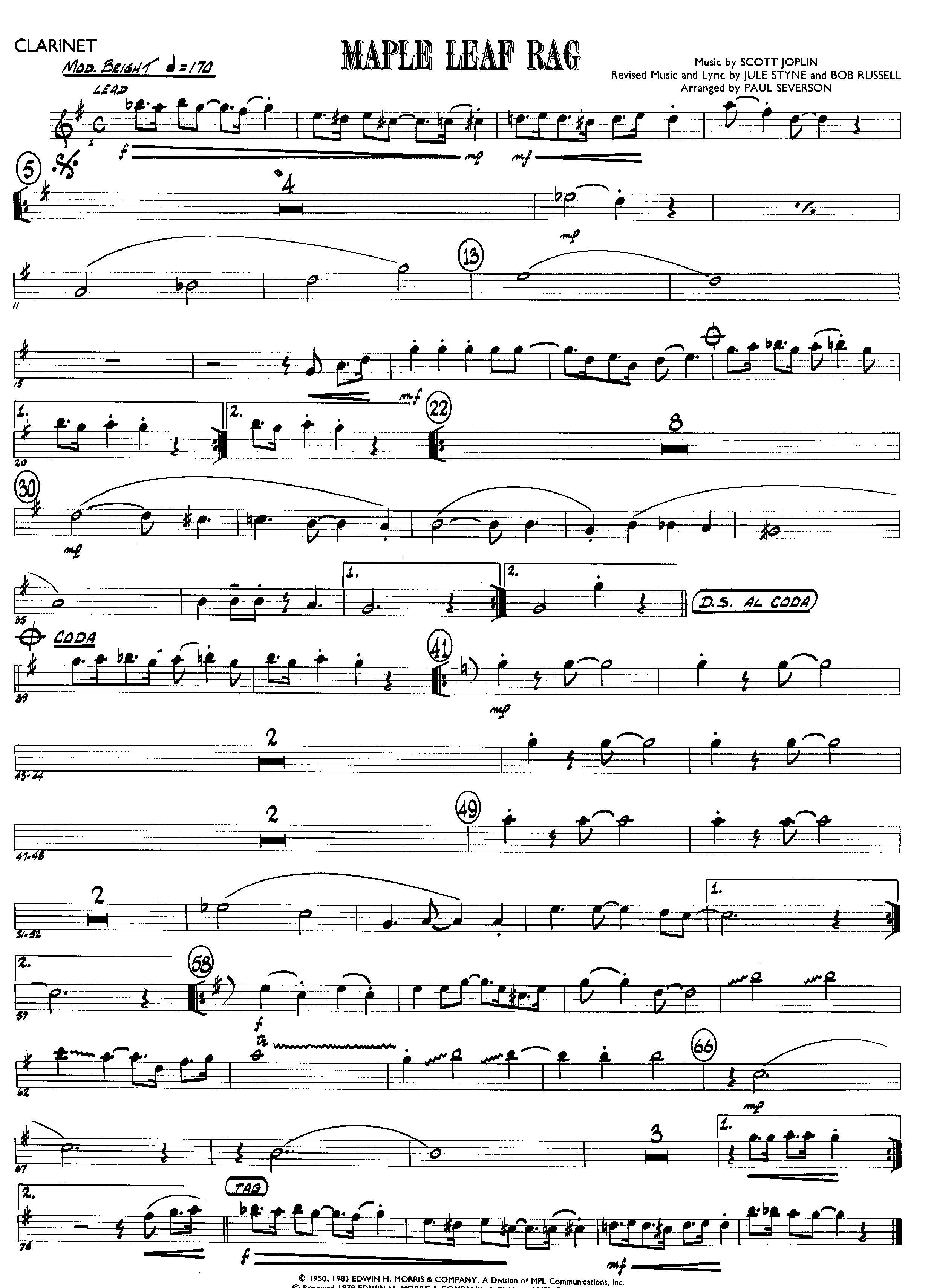
Maple Leaf Rag (Severson) sheet music preview

Maple Leaf Rag (Severson)

Composed by Scott Joplin

Arranged by Severson

  • Ensemble: Dixieland Band
  • Style: Ragtime
  • Pages: 10
  • Instruments (8): Clarinet, Tenor Sax, Trumpet, Trombone, Bass/Tuba, Drums, Guitar/Banjo, Piano/Conductor
  • Difficulty: easy
  • Content: Individual Parts
  • Format: PDF Download (Instant)
  • Price: $18.99

Scott Joplin's "Maple Leaf Rag," originally published in 1899, stands as one of the most iconic and influential compositions of the Ragtime era, a pivotal precursor to jazz. Its immediate and widespread success cemented Joplin's reputation as the "King of Ragtime" and helped popularize the syncopated piano style across America and beyond. The piece's infectious melodies and driving, syncopated rhythms embody the vibrant spirit of the turn of the 20th century, capturing a sense of joyous energy and sophisticated charm. Its enduring popularity has made it a true American classic, frequently performed and adapted, and a cornerstone of the early jazz repertoire, showcasing the intricate interplay of European march forms with African American rhythmic sensibilities. Severson's Dixieland Band arrangement of "Maple Leaf Rag" masterfully translates Joplin's piano original into a dynamic and authentic ensemble experience. This rendition maintains the original's bright, march-like tempo, typically around quarter note = 100-120 bpm, while infusing it with the characteristic buoyant feel of traditional Dixieland. The arrangement is primarily in the key of B-flat major, offering a comfortable and resonant setting for the brass and woodwind instruments. The mood is unequivocally celebratory and spirited, designed to evoke the lively atmosphere of early 20th-century dance halls and street parades. Severson's approach emphasizes clear melodic lines, rhythmic precision, and the call-and-response patterns inherent in the Dixieland style, ensuring a faithful yet freshly interpreted performance. The arrangement features the melody prominently carried by the trumpet and clarinet in various sections, often in unison or harmonized in classic Dixieland counterpoint, while the trombone provides robust harmonic support and rhythmic drive. There are no extended improvised solos in the traditional sense; instead, the arrangement focuses on collective ensemble playing, with opportunities for individual instruments to briefly step out with melodic fragments or rhythmic fills, echoing the spontaneous interplay of early jazz. A notable feature is the carefully crafted soli sections, where the full ensemble articulates Joplin's intricate piano figurations with precise articulation and dynamic contrast. The technical challenges lie in maintaining rhythmic accuracy and crisp articulation at a brisk tempo, particularly in the syncopated passages and the rapid sixteenth-note figures often found in the clarinet and trumpet parts. The arrangement is highly rewarding to perform, offering a chance for each musician to contribute to a cohesive, energetic, and historically rich musical tapestry. This arrangement is ideally suited for high school, college, and community Dixieland bands seeking an authentic and engaging piece for their repertoire. Its clear structure, well-defined parts, and adherence to the Dixieland idiom make it an excellent vehicle for teaching ensemble blend, rhythmic precision, and the stylistic nuances of early jazz. Professional groups will also appreciate its faithful yet vibrant interpretation, making it a crowd-pleasing addition to any concert or performance. The arrangement's 10-page length indicates a comprehensive and well-developed treatment of the original work, providing ample musical material for a substantial performance. Conductors should emphasize a crisp, detached articulation throughout, particularly in the brass, to capture the authentic ragtime feel. The tempo should be steady and unwavering, around quarter note = 100-120 bpm, maintaining a buoyant, march-like character without rushing. Encourage the rhythm section (tuba/bass, banjo/piano, drums) to lay down a solid, driving foundation, focusing on a clear two-beat feel. Technical challenges include the precise execution of syncopated rhythms and rapid sixteenth-note passages, especially for the clarinet and trumpet; sectional rehearsals focusing on these figures will be beneficial. No special techniques like plungers or falls are explicitly notated, but subtle stylistic inflections common in Dixieland, such as short scoops into notes or light vibrato, can be encouraged where appropriate. Ensure dynamic contrasts are observed to highlight melodic lines and ensemble soli sections. Q: What instruments and parts are included in this arrangement? A: This Dixieland Band arrangement typically includes parts for Bb Clarinet, Bb Trumpet, Trombone, Tuba (or String Bass), Banjo (or Piano), and Drums. Specific instrumentation may vary slightly but adheres to the standard Dixieland ensemble. Q: What is the difficulty level of "Maple Leaf Rag (Severson)"? A: This arrangement is rated as medium difficulty, suitable for high school, college, and community Dixieland bands. It requires good rhythmic precision and articulation from all players, with some technically demanding passages for the melodic instruments. Q: What is the musical style and historical context of this piece? A: This arrangement is in the Dixieland style, based on Scott Joplin's iconic "Maple Leaf Rag," a foundational piece of the Ragtime era (late 19th to early 20th century). It captures the lively, syncopated spirit that predates and influenced early jazz. Q: What makes Severson's arrangement of "Maple Leaf Rag" unique? A: Severson's arrangement uniquely translates Joplin's piano original into an authentic Dixieland ensemble setting, emphasizing clear melodic lines, rhythmic precision, and classic Dixieland counterpoint and soli sections, rather than featuring extended improvised solos. Q: What is the typical performance duration and recommended tempo for this arrangement? A: The typical performance duration for this 10-page arrangement is approximately 3-4 minutes, depending on the chosen tempo. The recommended tempo is a bright, march-like quarter note = 100-120 bpm, maintaining a buoyant and energetic feel.

Questions and answers

What is included in the Maple Leaf Rag (Severson) PDF?
The verified current file contains a conductor score and individual parts across 10 pages.
How many instruments or parts are listed for Maple Leaf Rag (Severson)?
The verified instrumentation list contains 8 entries for this Dixieland Band arrangement.
Who is credited for Maple Leaf Rag (Severson)?
Composer: Scott Joplin. Arranger: Severson.
What difficulty is listed for Maple Leaf Rag (Severson)?
The verified difficulty level is easy.
What style is listed for Maple Leaf Rag (Severson)?
The catalog lists the style as Ragtime.
Can I preview Maple Leaf Rag (Severson) before buying?
Yes. The product page provides a preview generated from the current PDF file.
How is Maple Leaf Rag (Severson) delivered?
After successful payment, the digital PDF is made available for download. The displayed price is $18.99.

Musicians Also Search For

Maple Leaf Rag Severson PDFMaple Leaf Rag Severson sheet musicMaple Leaf Rag arranged by SeversonSeverson dixieland band chartsSeverson jazz arrangements PDFMaple Leaf Rag Scott Joplin sheet musicMaple Leaf Rag Scott Joplin dixieland band arrangementsScott Joplin dixieland band chartsMaple Leaf Rag dixieland band arrangementsMaple Leaf Rag dixieland band PDF downloadMaple Leaf Rag jazz sheet musicdixieland band sheet music downloadMaple Leaf Rag conductor score PDFMaple Leaf Rag individual parts downloadMaple Leaf Rag sheet music PDFMaple Leaf Rag Ragtime chartsRagtime dixieland band arrangementsbuy Maple Leaf Rag sheet musicdownload Maple Leaf Rag PDFMaple Leaf Rag jazz chartsbest Severson dixieland band arrangementsScott Joplin arranged by SeversonMaple Leaf Rag printable sheet musicdixieland band repertoire PDF

All arrangements by Severson All Scott Joplin sheet music