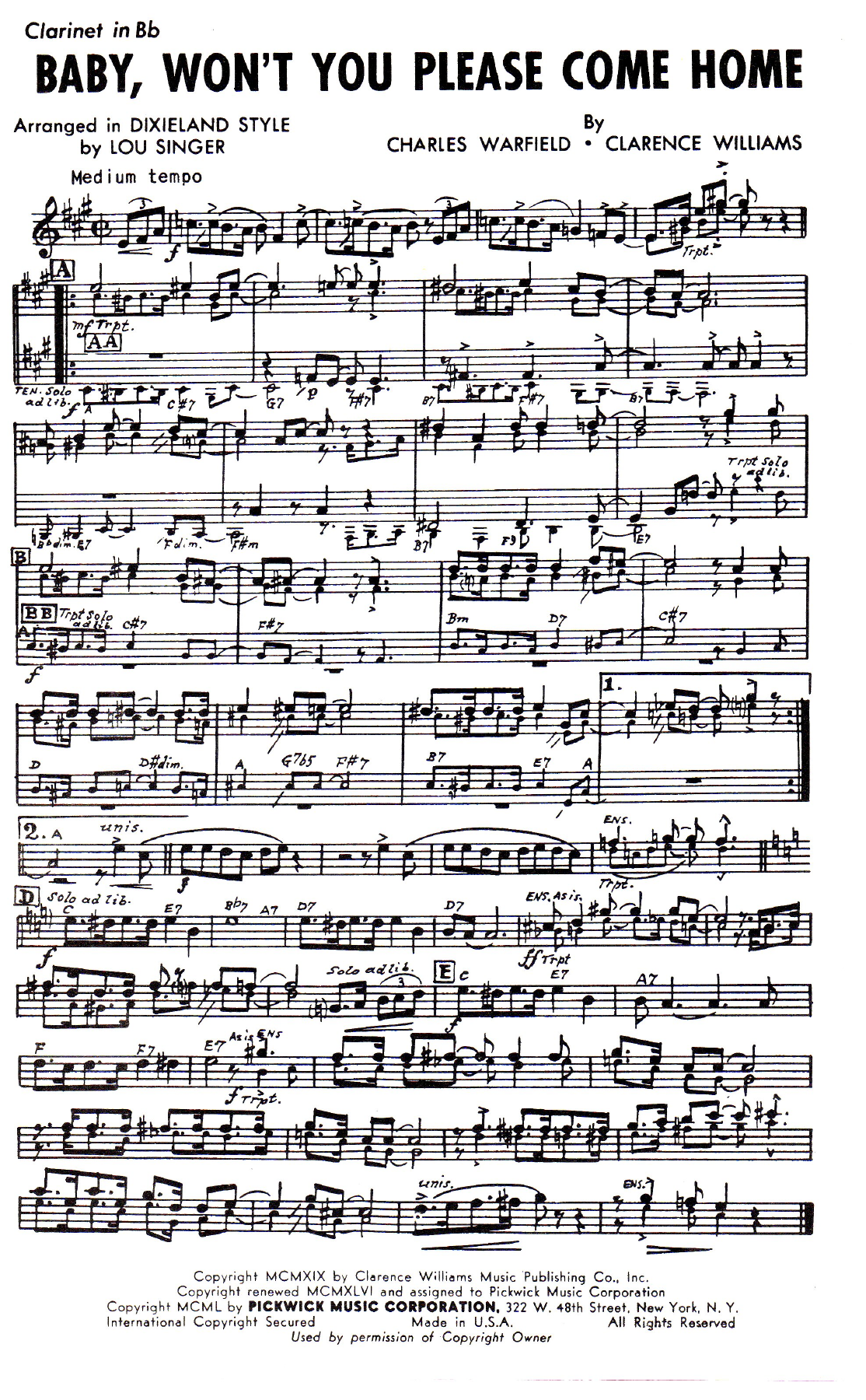
Baby, Won't You Please Come Home (L.Singer)
Composed by Clarence Williams
Arranged by L.Singer
- Ensemble: Dixieland Band
- Style: Blues
- Pages: 9
- Difficulty: easy
- Content: Sheet Music
- Format: PDF Download (Instant)
- Price: $18.99
"Baby, Won't You Please Come Home," penned in 1919 by Charles Warfield and Clarence Williams, emerged from the vibrant crucible of early 20th-century American music, quickly becoming a foundational blues and jazz standard. Though authorship has been historically disputed, both Warfield and Williams are widely credited for this enduring composition. The song gained widespread fame through Bessie Smith's iconic 1923 recording, which charted for four weeks and peaked at number 6, solidifying its place in the jazz canon. Its poignant lyrics, a plea for a lost love's return, resonate with the melancholic yet hopeful spirit characteristic of the blues, a genre that deeply influenced early jazz. This piece embodies the transition from ragtime and early blues into the burgeoning jazz sound, making it a timeless selection for bands exploring the roots of the genre. This Dixieland arrangement by L.Singer captures the authentic, spirited essence of the original while tailoring it for the classic Dixieland ensemble. The musical character is a medium swing, typically performed in a major key, evoking a mood of wistful longing tempered by an underlying rhythmic drive. L.Singer's approach is distinguished by a faithful adherence to the polyphonic improvisation style central to Dixieland, where the trumpet carries the main melody, the clarinet embellishes it with florid countermelodies, and the trombone provides rhythmic and harmonic support with slides and smears. Expect rich, interwoven voicings in the front line, creating a vibrant tapestry of sound rather than relying solely on individual solos. The arrangement balances ensemble sections with opportunities for featured instrumentalists, ensuring a cohesive yet expressive performance. L.Singer's signature technique in this style involves crafting intricate, yet playable, counterpoint for the front line, ensuring that each voice contributes meaningfully to the overall texture without overwhelming the others. Specific musical moments that stand out include the call-and-response passages between the brass and reeds, and a carefully constructed shout chorus that builds excitement towards the final statement of the theme. While the collective improvisation demands attentive listening and musical maturity, the arrangement is structured to guide musicians through these sections, making it rewarding for bands to perform. The technical challenges lie in maintaining rhythmic precision within the collective improvisation and executing the characteristic Dixieland articulations and stylistic nuances. This arrangement is ideally suited for high school, college, and community jazz ensembles looking to delve into the historical authenticity and joyous energy of traditional Dixieland jazz. Its clear structure and stylistic integrity make it an excellent educational tool for understanding early jazz ensemble playing. This arrangement of "Baby, Won't You Please Come Home" should be approached with a medium swing feel, maintaining a steady, relaxed pulse around 120-140 BPM. The key technical challenge lies in the collective improvisation sections, particularly for the front line (trumpet, clarinet, trombone). Encourage musicians to listen intently to each other, allowing the trumpet to lead the melody while the clarinet weaves a higher counter-melody and the trombone provides a lower harmonic and rhythmic foundation with characteristic smears and glissandos. Avoid overplaying; the goal is a conversational polyphony, not a cacophony. Articulations are crucial: emphasize short, crisp notes for rhythmic drive and expressive falls and doits where indicated to capture the bluesy inflection. Rehearsal should focus on developing a unified ensemble sound in the collective passages and ensuring rhythmic tightness in the rhythm section to support the front line's melodic interplay. **Q: What instruments are included in this arrangement?** A: This Dixieland arrangement typically includes parts for trumpet (or cornet), clarinet, trombone, banjo (or guitar), piano, bass (or tuba), and drums, reflecting the standard instrumentation of a traditional Dixieland band. **Q: What is the difficulty level of this arrangement?** A: This arrangement is suitable for high school, college, and community jazz ensembles. While it presents challenges in collective improvisation and stylistic authenticity, it is structured to be accessible and rewarding for musicians with intermediate to advanced playing skills. **Q: What is the musical style and historical context of "Baby, Won't You Please Come Home"?** A: "Baby, Won't You Please Come Home" is a blues standard from 1919, popularized by Bessie Smith in 1923, and is presented here in a traditional Dixieland style, characterized by its early jazz polyphonic improvisation and medium swing feel. **Q: What makes L.Singer's arrangement of this piece unique?** A: L.Singer's arrangement stands out for its authentic capture of Dixieland collective improvisation, carefully crafted counterpoint for the front line, and a balanced approach that provides both ensemble cohesion and opportunities for individual expression within the traditional style. **Q: What is the approximate performance duration of this arrangement?** A: Given its medium swing tempo and typical Dixieland structure, a performance of this arrangement would likely range from approximately 3 to 4 minutes, depending on the inclusion and length of improvised solos.
Musicians Also Search For
Baby, Won't You Please Come Home L.Singer PDF • Baby, Won't You Please Come Home L.Singer sheet music • Baby, Won't You Please Come Home arranged by L.Singer • L.Singer dixieland band charts • L.Singer jazz arrangements PDF • Baby, Won't You Please Come Home Clarence Williams sheet music • Baby, Won't You Please Come Home Clarence Williams dixieland band arrangement • Clarence Williams dixieland band charts • Baby, Won't You Please Come Home dixieland band arrangement • Baby, Won't You Please Come Home dixieland band PDF download • Baby, Won't You Please Come Home jazz ensemble sheet music • dixieland band sheet music instant download • Baby, Won't You Please Come Home sheet music with parts • Baby, Won't You Please Come Home Blues chart • Blues dixieland band arrangements • buy Baby, Won't You Please Come Home sheet music online • download Baby, Won't You Please Come Home PDF • Baby, Won't You Please Come Home jazz chart • best L.Singer dixieland band arrangements • Clarence Williams songs arranged by L.Singer • Baby, Won't You Please Come Home printable sheet music • dixieland band repertoire PDF