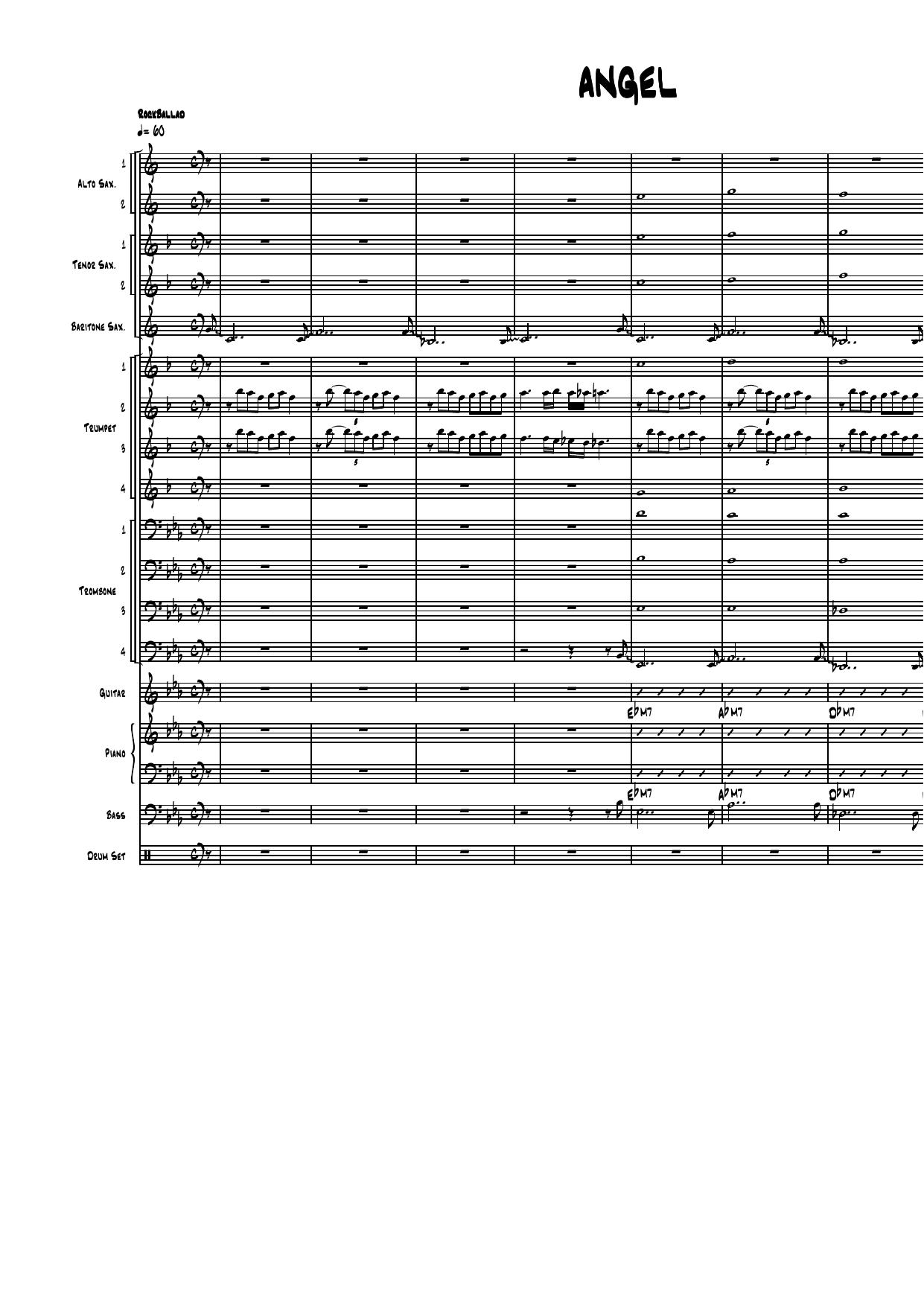
Angel (G.Evans)
Composed by Gil Evans
Arranged by Gil Evans
- Ensemble: Big Band
- Pages: 25
- Instruments (17): Alto Saxophone 1, Alto Saxophone 2, Tenor Saxophone 1, Tenor Saxophone 2, Baritone Saxophone, Trumpet 1, Trumpet 2, Trumpet 3, Trumpet 4, Trombone 1, Trombone 2, Trombone 3, Trombone 4, Guitar, Piano, Bass, Drum Set
- Difficulty: medium
- Content: Individual Parts
- Format: PDF Download (Instant)
- Price: $24.99
Gil Evans’ masterful writing for ensemble reaches a sublime pinnacle in "Angel," a work that encapsulates the cool jazz sophistication and lush harmonic palette of the legendary arranger's mid-century aesthetic. Originally conceived within the broader ecosystem of Evans’ revolutionary orchestral explorations—hallmarked by his landmark collaborations with Miles Davis—this composition showcases Evans' peerless ability to blur the lines between traditional big band swing and modern classical impressionism. Rather than relying on standard, predictable section writing, Evans treats the 11-instrument ensemble as a unified, fluid organism where colors bleed into one another, creating a shimmering sonic texture that feels both intimate and vast. The sonic landscape of "Angel" is defined by a slow, contemplative pulse and an expansive modal atmosphere. Moving at a relaxed, introspective tempo, the piece unfolds in a rich harmonic key center characterized by extended dominant chords, suspended voicings, and unexpected chromatic mediant shifts. The mood is deeply evocative, transitioning seamlessly from melancholic tenderness to soaring, cinematic grandeur. Evans avoids heavy-handed percussion in favor of a subtler rhythmic undercurrent, allowing the horns and woodwinds to weave intricate countermelodies that create an overwhelming sense of suspension and timelessness. At the heart of this arrangement is Evans' signature approach to unconventional instrumentation and voicing. By blending the airy timbre of the flute with the reedy warmth of the saxophones (alto, tenor, and baritone) and the muted brilliance of the trumpet, Evans achieves a pastel-like spectrum of sound. The arrangement eschews a standard high-energy shout chorus in favor of a gradual, panoramic crescendo, where secondary counter-lines slowly rise to the surface before dissolving back into the mist. Woodwind doublings and dense, cluster-based chord voicings require an extraordinary degree of intonation control and stylistic restraint from every player on the bandstand. Executing this score demands a mature ensemble capable of exceptional blend, dynamic sensitivity, and deep stylistic cohesion. While the technical demands on individual finger-technique are modest, the cognitive and artistic challenges are formidable; players must listen across sections to balance shifting chordal weights and maintain a consistent micro-tempo feel. Advanced high school, collegiate, and professional jazz ensembles will find this arrangement an invaluable masterclass in texture, orchestration, and emotional restraint. Performing "Angel" offers a rare opportunity to step inside the mind of one of jazz history’s greatest sonic architects, rewarding both the performers and the audience with a profoundly moving musical experience. Conductors approaching "Angel" must prioritize balance and dynamic discipline above all else. Because Gil Evans utilizes dense, closely-spaced chord voicings, an overzealous player in any section can easily muddy the harmonic clarity. Establish a relaxed, unhurried tempo feel from the outset, ensuring the rhythm section maintains a subtle, breathing pulse rather than a rigid mechanical beat. Woodwind players must firmly project their upper-register lines when doubling, while the brass should focus on warm, round tones, utilizing cup or harmon mutes where indicated to achieve that signature Evans velvet texture. Intonation rehearsals should be conducted slowly, isolating chord clusters to train the ensemble to hear the beating frequencies within Evans' complex harmonies. Encourage soloists and section leaders to treat their phrases with vocal-like inflection, mirroring the flowing, lyrical quality of a human voice rather than treating the charts as purely instrumental exercises. Q: What instruments and parts are included in this 11-instrument arrangement of "Angel"? A: The instrumentation features an 11-piece ensemble configuration specifically scored for flute, alto saxophone, tenor saxophone, baritone saxophone, trumpet, and a supporting rhythm and horn complement across its 25-page manuscript. Q: What is the difficulty level of this Gil Evans arrangement? A: This arrangement is best suited for advanced high school, collegiate, and professional jazz ensembles due to its heavy reliance on intricate intonation, sophisticated reading skills, and delicate dynamic control. Q: What is the historical style and context of "Angel"? A: Written in the signature style of master arranger Gil Evans, this piece reflects the sophisticated, impressionistic cool jazz movement of the mid-20th century, emphasizing orchestral color and rich harmonic textures over traditional big band shouting. Q: What makes this specific arrangement of "Angel" unique? A: It showcases Evans' unmistakable arranging thumbprint—utilizing non-traditional woodwind doublings, cluster voicings, and a panoramic approach to form that treats the 11-instrument ensemble as a singular, shimmering acoustic palette. Q: What is the recommended performance duration and tempo for this piece? A: "Angel" is designed as a slow, atmospheric ballad performed at an unhurried, contemplative tempo, with a typical duration lasting approximately 4 to 5 minutes depending on the ensemble's rubato interpretation.
Questions and answers
- What is included in the Angel (G.Evans) PDF?
- The verified current file contains a conductor score and individual parts across 25 pages.
- How many instruments or parts are listed for Angel (G.Evans)?
- The verified instrumentation list contains 17 entries for this Big Band arrangement.
- Who is credited for Angel (G.Evans)?
- Composer: Gil Evans. Arranger: Gil Evans.
- What difficulty is listed for Angel (G.Evans)?
- The verified difficulty level is medium.
- Can I preview Angel (G.Evans) before buying?
- Yes. The product page provides a preview generated from the current PDF file.
- How is Angel (G.Evans) delivered?
- After successful payment, the digital PDF is made available for download. The displayed price is $24.99.
Musicians Also Search For
Angel Gil Evans PDF • Angel Gil Evans sheet music • Angel arranged by Gil Evans • Gil Evans big band charts • Gil Evans jazz arrangements PDF • Angel Gil Evans big band arrangements • Angel big band arrangements • Angel big band PDF download • Angel jazz sheet music • big band sheet music download • Angel conductor score PDF • Angel individual parts download • Angel sheet music PDF • buy Angel sheet music • download Angel PDF • Angel jazz charts • best Gil Evans big band arrangements • Angel printable sheet music • big band repertoire PDF