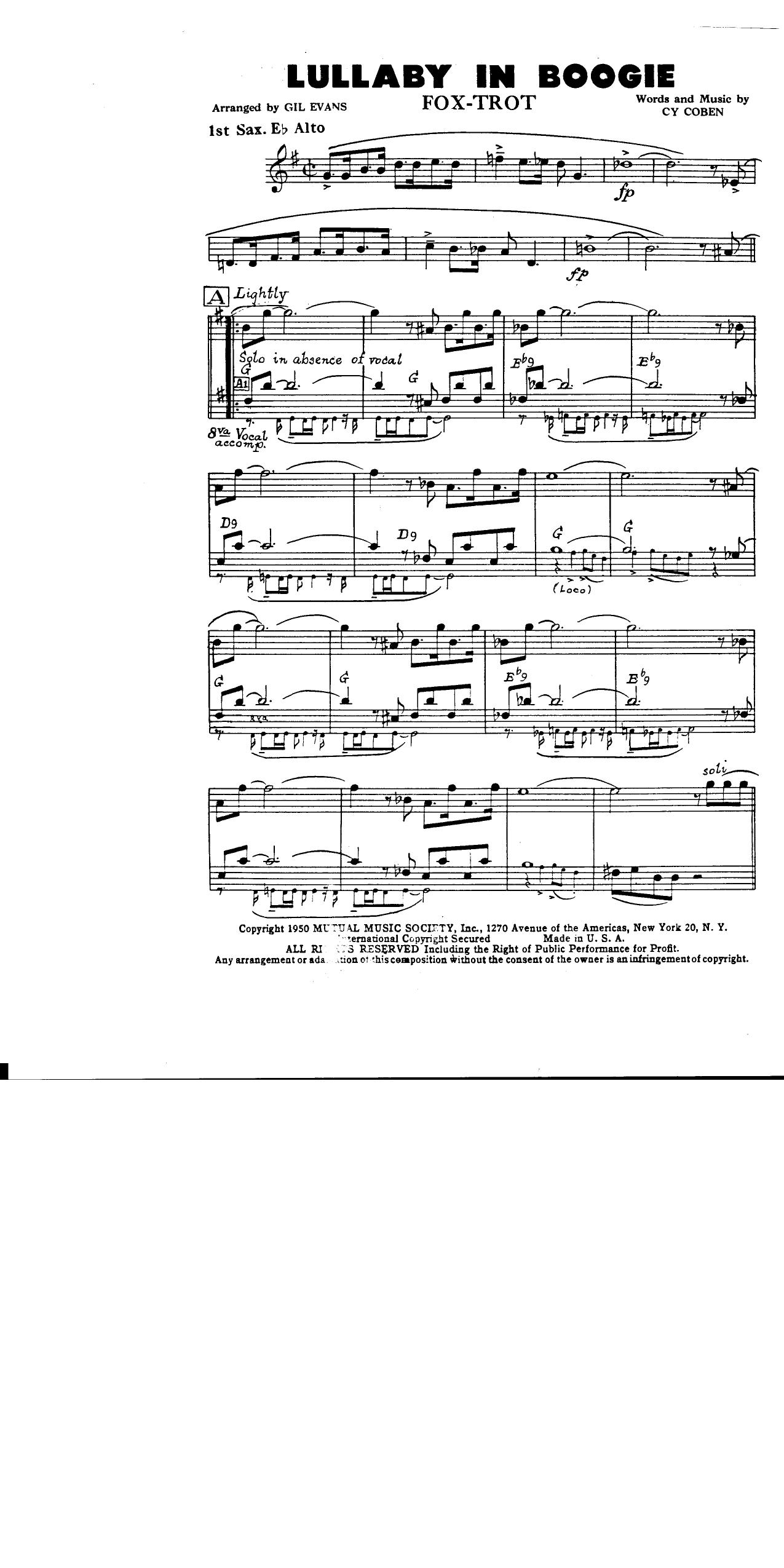
Lullaby In Boogie (G.Evans)
Composed by Gil Evans
Arranged by Gil Evans
- Ensemble: Big Band
- Pages: 41
- Instruments (15): 1st Sax. Eb Alto, 2nd Sax. Bb Tenor, 3rd Sax. Eb Alto, 4th Sax. Bb Tenor, 5th Sax. Eb Baritone, 1st Trumpet in Bb, 2nd Trumpet in Bb, 3rd Trumpet in Bb, 1st Trombone, 2nd Trombone, 3rd Trombone, Drums, Bass, Guitar, Piano
- Difficulty: medium
- Content: Individual Parts
- Format: PDF Download (Instant)
- Price: $24.99
Gil Evans stands towering as one of the most visionary orchestrators in jazz history, famously reshaping the sonic landscape of the modern big band through his work with Miles Davis and his own experimental ensembles. "Lullaby in Boogie" captures Evans during a fascinating formative period where the swinging, blues-drenched vitality of the late-swing and jump-blues era collided with his burgeoning interest in sophisticated, impressionistic chordal extensions and unconventional instrumental textures. While Evans is most frequently celebrated for his lush, sprawling orchestrations for large ensembles, this composition brilliantly demonstrates his ability to pack immense harmonic nuance and textural variety into a leaner, more agile instrumentation. Pulsing with an infectious, driving momentum, this arrangement marries the heavy backbeat and infectious groove of boogie-woogie piano styles with sophisticated jazz harmony. The tempo sits comfortably in a greasy, medium-up groove that compels physical movement, yet beneath the toe-tapping surface lies a bed of shimmering dissonances, sliding chromatic lines, and clever counterpoint. The mood shifts effortlessly from playful, blues-inflected swagger to moments of breathtaking harmonic suspension, evoking the smoky atmosphere of a late-night Harlem club fused with the forward-thinking modernism of 1940s progressive jazz. Evans avoids predictable block-chord writing, instead distributing melodic fragments across the ensemble in a conversational manner that keeps both performers and listeners on edge. True to the arranger’s signature style, the eight-instrument scoring functions with the contrapuntal clarity of a chamber orchestra while retaining the raw power of a full big band. The frontline—comprising alto, tenor, and baritone saxophones alongside trumpet and trombone—is utilized with maximum economy and maximum impact. Evans employs dense, polychordal voicings and subtle dynamic shifts, allowing the inner voices to move with independent linear freedom. Solos are seamlessly integrated into the structural fabric of the arrangement, growing organically out of the ensemble backgrounds rather than feeling like tacked-on interludes. The interplay between the reed section and the brass creates a rich sonic tapestry where shifting timbres define the form just as much as melody and harmony. Advanced high school, collegiate, and professional chamber jazz ensembles will find this 41-page manuscript to be an intellectually stimulating and deeply rewarding addition to their repertoire. Because of the lean instrumentation, individual players cannot hide behind a massed section; every musician must possess strong intonation, stylistic versatility, and a refined sense of balance. The technical demands lie less in breakneck execution and more in stylistic cohesion—specifically, marrying the rustic energy of boogie-woogie with Evans' notoriously delicate, translucent harmonic palette. For ensembles seeking to stretch beyond standard swing-era clichés while exploring the roots of modern jazz orchestration, this chart offers a masterclass in texture, groove, and invention. Unlocking the authentic character of "Lullaby in Boogie" requires striking a delicate balance between rhythmic grit and harmonic refinement. The conductor must ensure that the foundational boogie-woogie groove remains locked in tightly, avoiding any tendency to rush the tempo as the harmonic complexity thickens. Swing eighth notes should be interpreted with an even, driving articulation in the medium tempo range, keeping the quarter-note pulse prominent. Technically, the primary challenge rests in intonation and balance across the non-traditional eight-instrument voicing. Because Evans utilizes close-position cluster voicings and suspended harmonies, players must listen down intently to the chord roots and adjust their pitch center dynamically. Watch for sudden dynamic shifts; crescendos into accented backbeats must be explosive yet controlled so they do not obscure the inner-voice counterlines carried by the saxophones and trombone. Rehearsals should begin by isolating the rhythm section to cement the stylistic ostinato before layering the horn harmonies measure by measure. Encourage the soloists to lean heavily into the blues tradition while acknowledging the modern harmonic framework surrounding them. Q: What instruments and parts are included in this arrangement? A: This arrangement is scored for an eight-instrument ensemble featuring alto saxophone, tenor saxophone, baritone saxophone, trumpet, trombone, and a standard rhythm section framework, spanning a comprehensive 41-page manuscript. Q: What is the difficulty level of this Gil Evans chart? A: It is best suited for advanced high school, collegiate, and professional chamber jazz ensembles that possess strong reading skills, precise intonation, and mature stylistic versatility. Q: What is the historical style and musical context of "Lullaby in Boogie"? A: Composed and arranged by Gil Evans, the piece represents a brilliant fusion of late-swing/boogie-woogie rhythmic vitality and the sophisticated, impressionistic harmonic language that defined Evans' early modern jazz evolution. Q: What makes this specific arrangement unique? A: Unlike massive wall-of-sound big band charts, this arrangement utilizes a leaner eight-piece instrumentation to achieve chamber-like contrapuntal clarity while retaining deep blues-infused groove and rich, polychordal textures. Q: What is the recommended tempo and approximate performance duration? A: The arrangement is performed at a driving, medium-up groove typical of jump-blues and boogie styles, providing an engaging, high-energy feature that generally runs between three and five minutes depending on the chosen solo extensions.
Questions and answers
- What is included in the Lullaby In Boogie (G.Evans) PDF?
- The verified current file contains individual parts across 41 pages.
- How many instruments or parts are listed for Lullaby In Boogie (G.Evans)?
- The verified instrumentation list contains 15 entries for this Big Band arrangement.
- Who is credited for Lullaby In Boogie (G.Evans)?
- Composer: Gil Evans. Arranger: Gil Evans.
- What difficulty is listed for Lullaby In Boogie (G.Evans)?
- The verified difficulty level is medium.
- Can I preview Lullaby In Boogie (G.Evans) before buying?
- Yes. The product page provides a preview generated from the current PDF file.
- How is Lullaby In Boogie (G.Evans) delivered?
- After successful payment, the digital PDF is made available for download. The displayed price is $24.99.
Musicians Also Search For
Lullaby In Boogie Gil Evans PDF • Lullaby In Boogie Gil Evans sheet music • Lullaby In Boogie arranged by Gil Evans • Gil Evans big band charts • Gil Evans jazz arrangements PDF • Lullaby In Boogie Gil Evans big band arrangements • Lullaby In Boogie big band arrangements • Lullaby In Boogie big band PDF download • Lullaby In Boogie jazz sheet music • big band sheet music download • Lullaby In Boogie individual parts download • Lullaby In Boogie sheet music PDF • buy Lullaby In Boogie sheet music • download Lullaby In Boogie PDF • Lullaby In Boogie jazz charts • best Gil Evans big band arrangements • Lullaby In Boogie printable sheet music • big band repertoire PDF