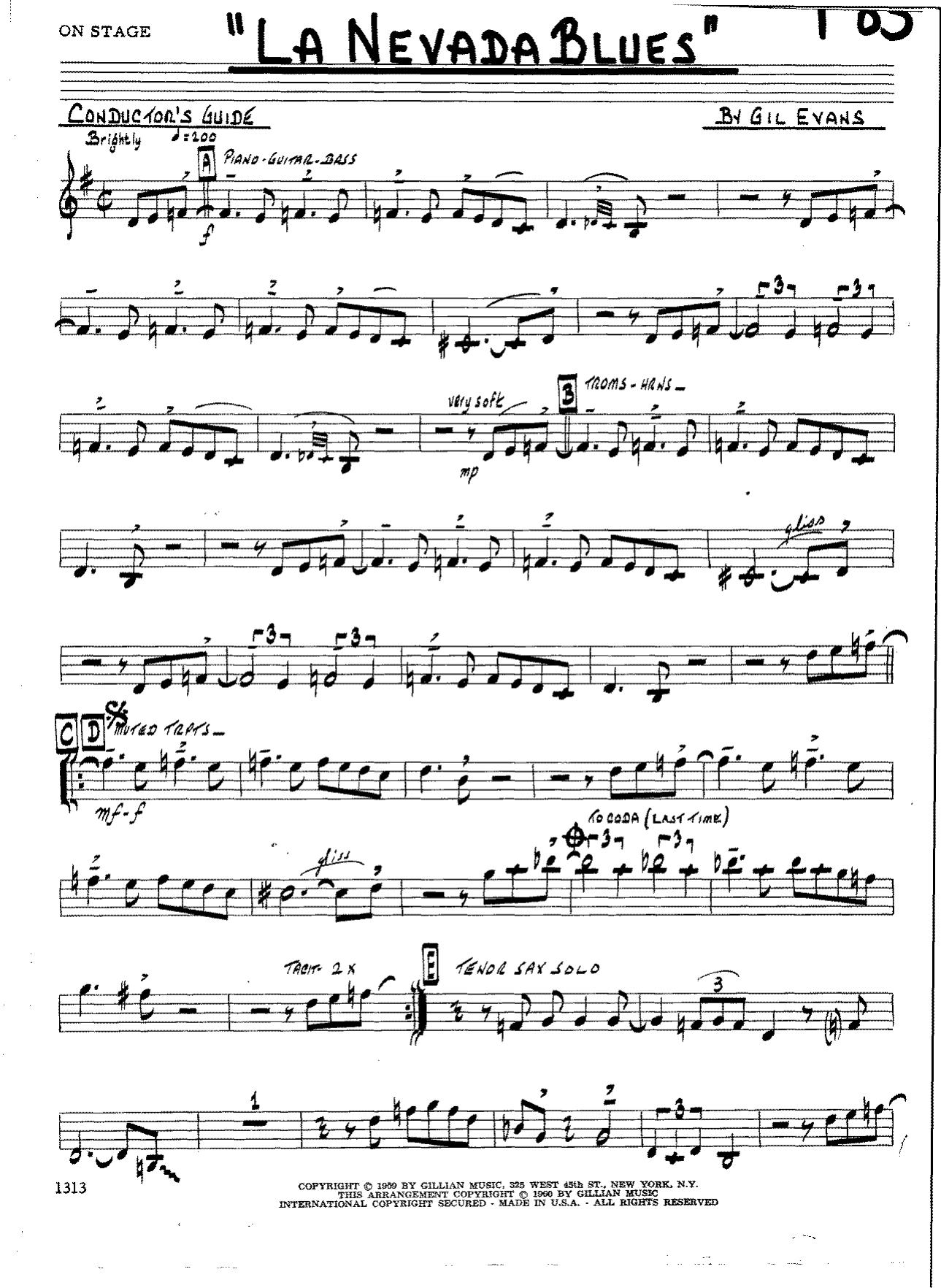
La Nevada Blues (G.Evans)
Composed by Gil Evans
Arranged by Gil Evans
- Ensemble: Big Band
- Pages: 40
- Instruments (17): 1st Eb Alto Saxophone, 3rd Eb Alto Saxophone, 2nd Bb Tenor Saxophone, 4th Bb Tenor Saxophone, 5th Eb Baritone Saxophone, 1st Bb Trumpet, 2nd Bb Trumpet, 3rd Bb Trumpet, 4th Bb Trumpet, 1st Trombone, 2nd Trombone, 3rd Trombone, 4th Trombone, Piano, Guitar, String Bass, Drums
- Difficulty: medium
- Content: Individual Parts
- Format: PDF Download (Instant)
- Price: $24.99
Originally recorded for Gil Evans’ landmark 1959 Pacific Jazz album *Great Jazz Standards*, "La Nevada" stands as one of the composer-arranger's most mesmerizing studies in texture, space, and incremental tension. Unlike conventional head-chart big band arrangements of the era, Evans treats the 12-bar blues framework not as a vehicle for rapid-fire bebop pyrotechnics, but as a vast sonic canvas. The composition reflects Evans’ revolutionary approach to modern jazz orchestration, where traditional section boundaries dissolve into an impressionistic palette of shifting tonal colors, subtle dynamic swells, and advanced harmonic extensions. Built upon a hypnotic, mid-tempo groove with an infectious shuffle-swing feel, the piece opens with a deceptively simple, haunting vamp that establishes an expansive, cinematic mood. The atmosphere is simultaneously laid-back and electric, evoking the vast, sun-baked expanse of the American West filtered through a sophisticated urban jazz lens. Evans utilizes sparse textures at the onset, gradually layering muted brass and revoiced woodwinds until the ensemble achieves a rich, shimmering density. The emotional trajectory moves from cool, contemplative introspection to a roaring, multi-layered intensity without ever sacrificing the underlying blues pulse. Evans’ signature harmonic thumbprint is stamped across every measure, utilizing tight cluster voicings, unusual woodwind doublings, and fluid counterpoint that avoids standard block-chord writing. Instead of a predictable shout chorus, the arrangement unfolds through a series of interlocking ensemble textures where the melody is passed seamlessly between the saxophone section and muted brass. The arrangement features open solo sections over the blues form, allowing featured improvisers in the alto saxophone and trumpet chairs to stretch out over Evans' shifting, modal-leaning background figures. The technical demands lie less in breakneck speed and much more in intonation, dynamic control, balance, and the precise execution of subtle articulation markings. Advanced college ensembles, cutting-edge community big bands, and professional repertory orchestras will find this chart an exceptional vehicle for developing sophisticated listening skills and stylistic maturity. Because the instrumentation is tailored for a streamlined 10-piece ensemble, every player functions as a crucial solo voice within the chamber-jazz framework, making individual accountability and section blending paramount. Bringing this masterpiece to life requires musicians who can master the delicate balance between relaxed swing phrasing and precise, modernist harmonic execution, resulting in a profoundly rewarding experience for both performers and audiences alike. Achieving the authentic Gil Evans sound on "La Nevada Blues" demands meticulous attention to dynamic nuance and a relaxed, unhurried swing feel. The tempo should remain a steady, medium-tempo groove; rushing the beat instantly destroys the spacious, cinematic atmosphere Evans meticulously constructs. Conductors must ensure that background figures under the soloists never overpower the improviser, as Evans' counterlines are designed to converse with the soloist rather than compete. Technically, the primary challenges involve intonation within close-interval horn voicings and maintaining consistent air support during extended sustained passages. Brass players should utilize specific mutes (such as harmon and cup mutes) as indicated in the score to achieve the characteristic dry, veiled timbre central to Evans' mid-century aesthetic. Rehearsals should begin with section-only balance checks, ensuring that the inner voices of the harmony are heard clearly beneath the melody. Emphasize a smooth, horizontal phrasing style rather than punchy, aggressive accents, allowing the blues-soaked harmonies to bloom organically. Q: What instruments and parts are included in this 10-instrument arrangement? A: The arrangement is scored for a specialized 10-piece ensemble comprising Alto Saxophone, Tenor Saxophone, Baritone Saxophone, Trumpet, Trombone, and a complete rhythm section framework, optimized for a compact yet full-sounding jazz orchestra. Q: What is the difficulty level of this arrangement? A: This piece is graded as advanced/professional, primarily due to the intricate ensemble intonation required, the advanced harmonic language, and the demand for refined dynamic control rather than sheer technical speed. Q: What is the historical style and context of "La Nevada"? A: Originally arranged by Gil Evans for his 1959 album *Great Jazz Standards*, the piece reimagines the traditional 12-bar blues through an impressionistic, modal-leaning modern jazz lens that defined the cool jazz movement. Q: What makes this specific arrangement unique compared to standard big band blues charts? A: Unlike predictable head arrangements with standard shout choruses, this chart relies on Evans' signature transparent textures, shifting modal backgrounds, and chamber-jazz voicings that treat the 10-piece ensemble like an impressionistic palette. Q: What is the recommended tempo and performance duration for this piece? A: The piece is anchored by a relaxed, medium-tempo shuffle-swing groove, with a typical performance duration of approximately 5 to 7 minutes depending on the number and length of open solo choruses.
Questions and answers
- What is included in the La Nevada Blues (G.Evans) PDF?
- The verified current file contains a conductor score and individual parts across 40 pages.
- How many instruments or parts are listed for La Nevada Blues (G.Evans)?
- The verified instrumentation list contains 17 entries for this Big Band arrangement.
- Who is credited for La Nevada Blues (G.Evans)?
- Composer: Gil Evans. Arranger: Gil Evans.
- What difficulty is listed for La Nevada Blues (G.Evans)?
- The verified difficulty level is medium.
- Can I preview La Nevada Blues (G.Evans) before buying?
- Yes. The product page provides a preview generated from the current PDF file.
- How is La Nevada Blues (G.Evans) delivered?
- After successful payment, the digital PDF is made available for download. The displayed price is $24.99.
Musicians Also Search For
La Nevada Blues Gil Evans PDF • La Nevada Blues Gil Evans sheet music • La Nevada Blues arranged by Gil Evans • Gil Evans big band charts • Gil Evans jazz arrangements PDF • La Nevada Blues Gil Evans big band arrangements • La Nevada Blues big band arrangements • La Nevada Blues big band PDF download • La Nevada Blues jazz sheet music • big band sheet music download • La Nevada Blues conductor score PDF • La Nevada Blues individual parts download • La Nevada Blues sheet music PDF • buy La Nevada Blues sheet music • download La Nevada Blues PDF • La Nevada Blues jazz charts • best Gil Evans big band arrangements • La Nevada Blues printable sheet music • big band repertoire PDF