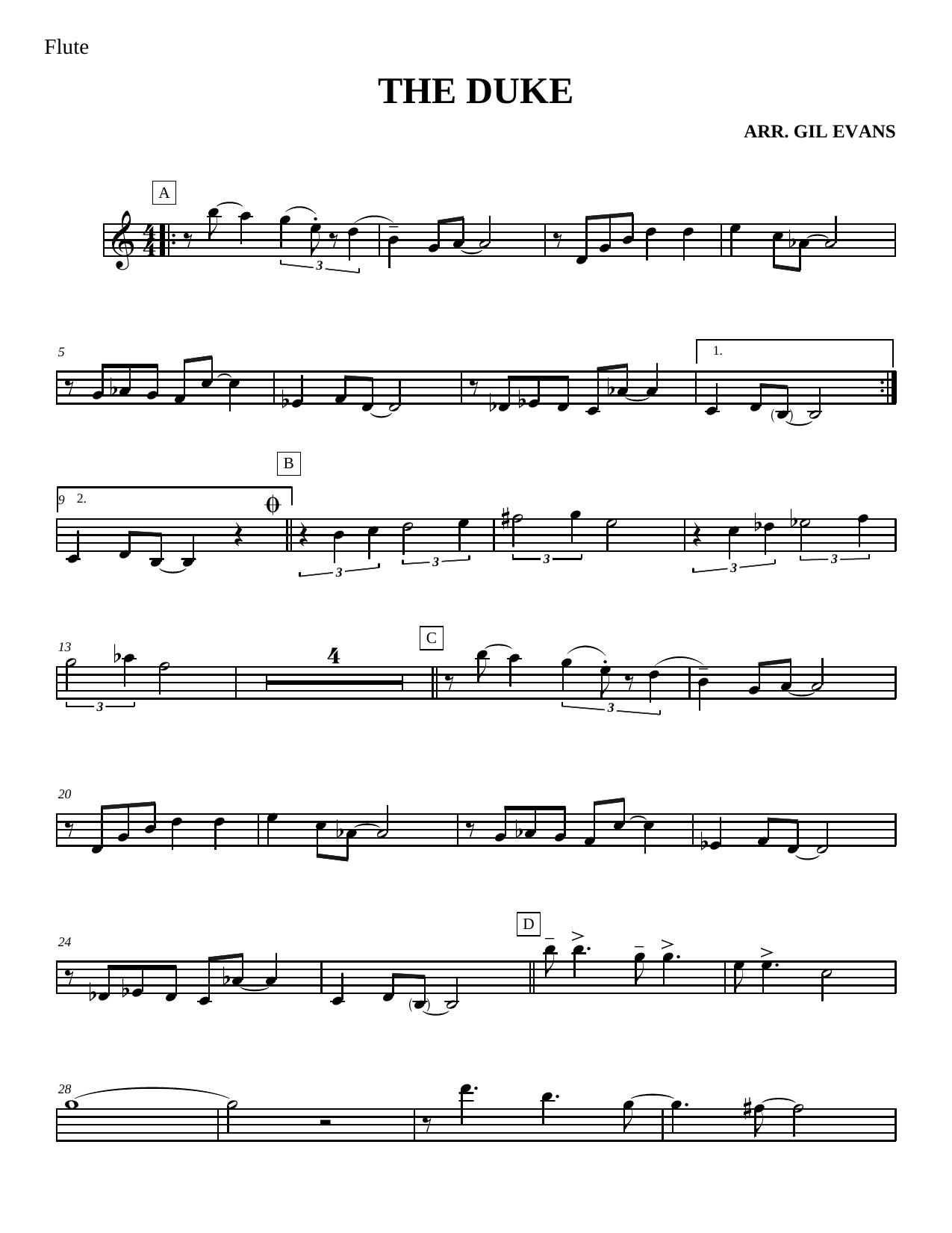
The Duke (G.Evans)
Composed by Gil Evans
Arranged by Gil Evans
- Ensemble: Big Band
- Pages: 30
- Instruments (16): Flute, Alto Sax, Tenor Sax 1, Tenor Sax 2, Baritone Sax, Trumpet in Bb 1, Trumpet in Bb 2, Trumpet in Bb 3, Trumpet in Bb 4, Trombone 1, Trombone 2, Trombone 3, Tuba, Piano, Bass, Drum Set
- Difficulty: medium
- Content: Individual Parts
- Format: PDF Download (Instant)
- Price: $24.99
Dave Brubeck’s composition "The Duke" gained its status as a timeless jazz standard largely through its immortalization on the landmark 1957 Columbia album *Miles Ahead*, featuring the legendary collaboration between trumpeter Miles Davis and arranger Gil Evans. Originally written as a clever, slightly quirky showcase for Brubeck’s quartet, the piece was transformed by Evans into a masterclass of impressionistic jazz orchestration. Representing the pinnacle of cool jazz and jazz studio arranging, this work bridges the gap between sophisticated third-stream textures and accessible melodic swing, making it one of the most studied and revered scores in the modern orchestral jazz canon. Musically, the piece operates on a medium swing feel anchored by a standard 32-bar AABA form, though Evans’s harmonic lens infuses it with shimmering, unexpected colors and a relaxed, sophisticated groove. The mood shifts fluidly between playful, light-hearted wit and deep, brooding atmospheric tension. Evans utilizes subtle dynamic contrasts and sophisticated voicings to evoke a sophisticated urban nighttime atmosphere, trading conventional big band bombast for a rich tapestry of pastel-hued harmonies, transparent textures, and lingering, reflective emotional resonance. Gil Evans’s signature approach is defined here by his brilliant use of instrumental counterpoint and specialized tonal palettes. Rather than treating the ensemble as monolithic blocks, Evans alternates between a delicate, small-group chamber texture—frequently pairing flugelhorn, alto saxophone, trombone, and tuba—and full, rich orchestral tutti blasts. The A sections of the melody are often assigned to this nimble sub-ensemble, while the bridge sections open up into lush, full-ensemble voicings. Evans avoids predictable shout choruses, instead favoring intricate background figures, low-register woodwind blendings, and deep, resonant pedal points that expand the harmonic framework of Brubeck's original theme. Performance-wise, the work demands exceptional stylistic versatility and blend. The lead voice—traditionally featured on flugelhorn—carries the primary lyrical narrative, requiring an effortless, warm tone capable of floating above the dense orchestrations. Technical challenges lie primarily in intonation, balance between the contrasting chamber and tutti sections, and maintaining a relaxed, buoyant swing feel without rushing. Woodwind doublings and the integration of low brass require players to listen across sections carefully. Advanced college, community, and professional jazz orchestras will find this arrangement profoundly rewarding, as it offers a masterclass in subtlety, nuance, and sophisticated ensemble interaction far beyond standard swing-era charts. Conductors approaching this arrangement must prioritize transparency, dynamic control, and stylistic unity across the ensemble. The tempo should settle comfortably into a relaxed, driving medium swing; avoid pushing the quarter note, as rushing destroys the airy, floating quality characteristic of the Gil Evans style. Pay meticulous attention to the contrast between the intimate small-group passages and the full ensemble climaxes—the dynamic drop-offs must be stark and immediate to preserve the architectural design of the score. The lead flugelhorn or trumpet player needs an agile, warm sound that projects without forcing. Intonation in the saxophones and low brass requires rigorous attention, particularly during dense chordal suspensions and cluster voicings. Rehearsals should begin with section-only work to balance the woodwind sub-parts (including flutes and bass clarinet) and lower brass before integrating the full ensemble. Emphasize horizontal phrasing over vertical punchiness to capture the impressionistic, modal-adjacent warmth of the arrangement. Q: What instruments and parts are included in this arrangement? A: This arrangement is scored for an 11-instrument ensemble featuring a solo flugelhorn/trumpet, multiple woodwinds (including flutes, alto saxophone, and bass clarinet), horns, trombones, tuba, bass, and drums. Q: What is the difficulty level of this arrangement? A: It is classified as an advanced/difficult piece (Grade 5+), best suited for collegiate, professional, or elite community jazz orchestras capable of handling sophisticated ensemble blending and subtle dynamic shading. Q: What is the historical background of this specific version of "The Duke"? A: Originally composed by Dave Brubeck, this iconic arrangement was created by Gil Evans for Miles Davis's historic 1957 studio album *Miles Ahead*, effectively redefining how a jazz orchestra could interpret a modern standard. Q: What makes this Gil Evans arrangement unique compared to standard big band charts? A: Instead of relying on traditional, full-ensemble shout choruses, Evans constantly shifts colors by contrasting a nimble, small-group chamber sound against lush, impressionistic orchestral voicings and unique woodwind textures. Q: What is the approximate performance tempo and duration of the piece? A: The arrangement is set to a relaxed medium swing feel, running approximately 3 to 4 minutes in duration depending on the pacing of the improvised solo sections.
Questions and answers
- What is included in the The Duke (G.Evans) PDF?
- The verified current file contains a conductor score and individual parts across 30 pages.
- How many instruments or parts are listed for The Duke (G.Evans)?
- The verified instrumentation list contains 16 entries for this Big Band arrangement.
- Who is credited for The Duke (G.Evans)?
- Composer: Gil Evans. Arranger: Gil Evans.
- What difficulty is listed for The Duke (G.Evans)?
- The verified difficulty level is medium.
- Can I preview The Duke (G.Evans) before buying?
- Yes. The product page provides a preview generated from the current PDF file.
- How is The Duke (G.Evans) delivered?
- After successful payment, the digital PDF is made available for download. The displayed price is $24.99.
Musicians Also Search For
The Duke Gil Evans PDF • The Duke Gil Evans sheet music • The Duke arranged by Gil Evans • Gil Evans big band charts • Gil Evans jazz arrangements PDF • The Duke Gil Evans big band arrangements • The Duke big band arrangements • The Duke big band PDF download • The Duke jazz sheet music • big band sheet music download • The Duke conductor score PDF • The Duke individual parts download • The Duke sheet music PDF • buy The Duke sheet music • download The Duke PDF • The Duke jazz charts • best Gil Evans big band arrangements • The Duke printable sheet music • big band repertoire PDF