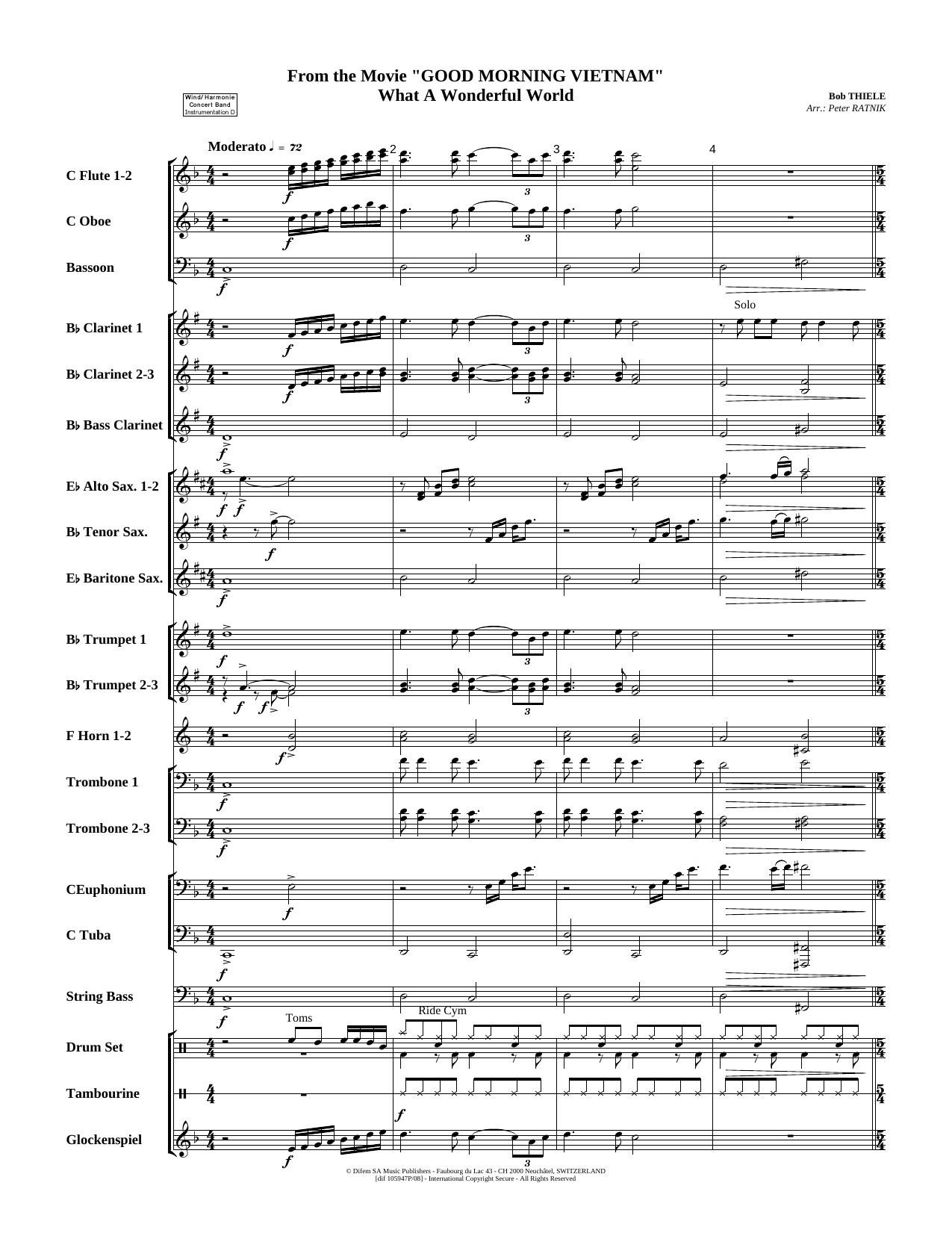
What A Wonderful World (Score & (P.RATNIK)
Composed by Bob THIELE
Arranged by Peter RATNIK
- Ensemble: Concert Band
- Style: Jazz Standard
- Pages: 37
- Instruments (26): C Flute 1, C Flute 2, C Oboe, Bassoon, Bb Clarinet 1, Bb Clarinet 2, Bb Clarinet 3, Bb Bass Clarinet, Eb Alto Sax. 1, Eb Alto Sax. 2, Bb Tenor Sax., Eb Baritone Sax., Bb Trumpet 1, Bb Trumpet 2, Bb Trumpet 3, F Horn 1, F Horn 2, Trombone 1, Trombone 2, Trombone 3, C Euphonium, C Tuba, String Bass, Drum Set, Tambourine, Glockenspiel
- Difficulty: medium
- Content: Individual Parts
- Format: PDF Download (Instant)
- Price: $22.99
"What A Wonderful World," co-written by Bob Thiele (initially credited as George Douglas) and George David Weiss, was first recorded by the legendary Louis Armstrong on August 16, 1967. Released during a turbulent period marked by the Vietnam War and civil rights protests, the song offered a poignant message of hope and appreciation for life's simple beauties, a stark contrast to the social unrest of the era. While it initially performed poorly in the United States due to a lack of promotion, it topped the charts in the United Kingdom in 1968 and gained renewed international recognition after its inclusion in the 1987 film *Good Morning, Vietnam*. Armstrong's gravelly, expressive vocal delivery, combined with the lush orchestral backing, cemented its status as a beloved jazz standard, inducted into the Grammy Hall of Fame in 1999. The original recording is predominantly in the key of F major and features a slow, ballad tempo, evoking a sense of calm reflection and profound optimism. Peter Ratnik's arrangement for concert band masterfully reimagines this timeless ballad, retaining its inherent warmth while expanding its emotional and dynamic scope for a larger ensemble. Ratnik, an acclaimed Australian conductor, composer, and educator known for his extensive work with wind and brass bands, brings his signature blend of rich harmony and thoughtful orchestration to this piece. His approach often involves creating arrangements that are both accessible and musically engaging, drawing on his deep understanding of wind ensemble sonorities. This particular arrangement likely features carefully crafted voicings that allow the concert band's diverse timbres to shine, perhaps with flowing woodwind lines complementing sustained brass harmonies, and a prominent role for the flugelhorn, an instrument often featured in his concert band arrangements. The arrangement is designed to evoke the original's gentle, reflective mood, likely maintaining a slow, expressive ballad tempo with a focus on lyrical phrasing and dynamic control. Expect the melody to be artfully distributed among various sections, offering opportunities for featured soloists (such as flugelhorn or alto saxophone) to carry the iconic tune, interspersed with full ensemble statements that build emotional intensity. Technical challenges will likely center on achieving precise balance, blend, and expressive shaping within the ensemble, particularly in sustained passages and delicate melodic lines. The reward lies in performing a universally cherished piece with depth and sensitivity, allowing the band to convey its powerful message of hope and beauty. This arrangement is ideally suited for high school, college, community, and professional concert bands capable of nuanced musicality and expressive ensemble playing, providing a fulfilling performance experience for both musicians and audience. This arrangement of "What A Wonderful World" thrives on expressive musicality and careful dynamic control. The primary technical challenge lies in achieving a unified, sustained tone and precise intonation, especially during the slow, reflective ballad tempo (approximately 84 BPM, as per the original). Conductors should emphasize long, singing phrases across all sections, avoiding any sense of rushed articulation. Encourage woodwinds to play with a warm, round tone, while brass should focus on blend and controlled vibrato, particularly in sustained chords. Special attention should be given to any featured solo lines, ensuring they are lyrical and imbued with the song's inherent optimism. Rehearsal time should be dedicated to balancing the rich harmonies, ensuring that inner voices are clear but supportive, and that the overall sound remains transparent. Dynamic contrasts, from delicate pianissimos to warm, full-bodied fortissos, are crucial for conveying the emotional arc of the piece. **Q: What instruments/parts are included in this arrangement?** A: This arrangement is for concert band and includes a full conductor score along with individual parts for standard concert band instrumentation. While specific part listings are not detailed, it is designed for a complete wind ensemble. **Q: What is the difficulty level of this arrangement?** A: This arrangement is suitable for high school, college, community, and professional concert bands. Its demands lie in expressive musicality, precise intonation, and dynamic control rather than extreme technical virtuosity. **Q: What is the musical style and historical context of "What A Wonderful World"?** A: "What A Wonderful World" is a jazz standard, originally recorded by Louis Armstrong in 1967. It is a reflective ballad known for its optimistic message, set against the turbulent social backdrop of the late 1960s. **Q: What makes Peter Ratnik's arrangement unique?** A: Peter Ratnik's arrangement for concert band is noted for its ability to retain the original's warmth and emotional depth while expanding its scope for a large wind ensemble, often featuring rich harmonies and thoughtful orchestration, with potential for a prominent flugelhorn feature. **Q: What is the approximate performance duration and tempo of this arrangement?** A: While the exact duration may vary based on interpretation, the original piece is a slow ballad, typically around 2-3 minutes. This arrangement maintains a slow, expressive tempo, approximately 84 BPM, reflecting the original's contemplative mood.
Questions and answers
- What is included in the What A Wonderful World (Score & (P.RATNIK) PDF?
- The verified current file contains a conductor score and individual parts across 37 pages.
- How many instruments or parts are listed for What A Wonderful World (Score & (P.RATNIK)?
- The verified instrumentation list contains 26 entries for this Concert Band arrangement.
- Who is credited for What A Wonderful World (Score & (P.RATNIK)?
- Composer: Bob THIELE. Arranger: Peter RATNIK.
- What difficulty is listed for What A Wonderful World (Score & (P.RATNIK)?
- The verified difficulty level is medium.
- What style is listed for What A Wonderful World (Score & (P.RATNIK)?
- The catalog lists the style as Jazz Standard.
- Can I preview What A Wonderful World (Score & (P.RATNIK) before buying?
- Yes. The product page provides a preview generated from the current PDF file.
- How is What A Wonderful World (Score & (P.RATNIK) delivered?
- After successful payment, the digital PDF is made available for download. The displayed price is $22.99.
Musicians Also Search For
What A Wonderful World Peter RATNIK PDF • What A Wonderful World Peter RATNIK sheet music • What A Wonderful World arranged by Peter RATNIK • Peter RATNIK concert band charts • Peter RATNIK jazz arrangements PDF • What A Wonderful World Bob THIELE sheet music • What A Wonderful World Bob THIELE concert band arrangements • Bob THIELE concert band charts • What A Wonderful World concert band arrangements • What A Wonderful World concert band PDF download • What A Wonderful World jazz sheet music • concert band sheet music download • What A Wonderful World conductor score PDF • What A Wonderful World individual parts download • What A Wonderful World sheet music PDF • What A Wonderful World Jazz Standard charts • Jazz Standard concert band arrangements • buy What A Wonderful World sheet music • download What A Wonderful World PDF • What A Wonderful World jazz charts • best Peter RATNIK concert band arrangements • Bob THIELE arranged by Peter RATNIK • What A Wonderful World printable sheet music • concert band repertoire PDF