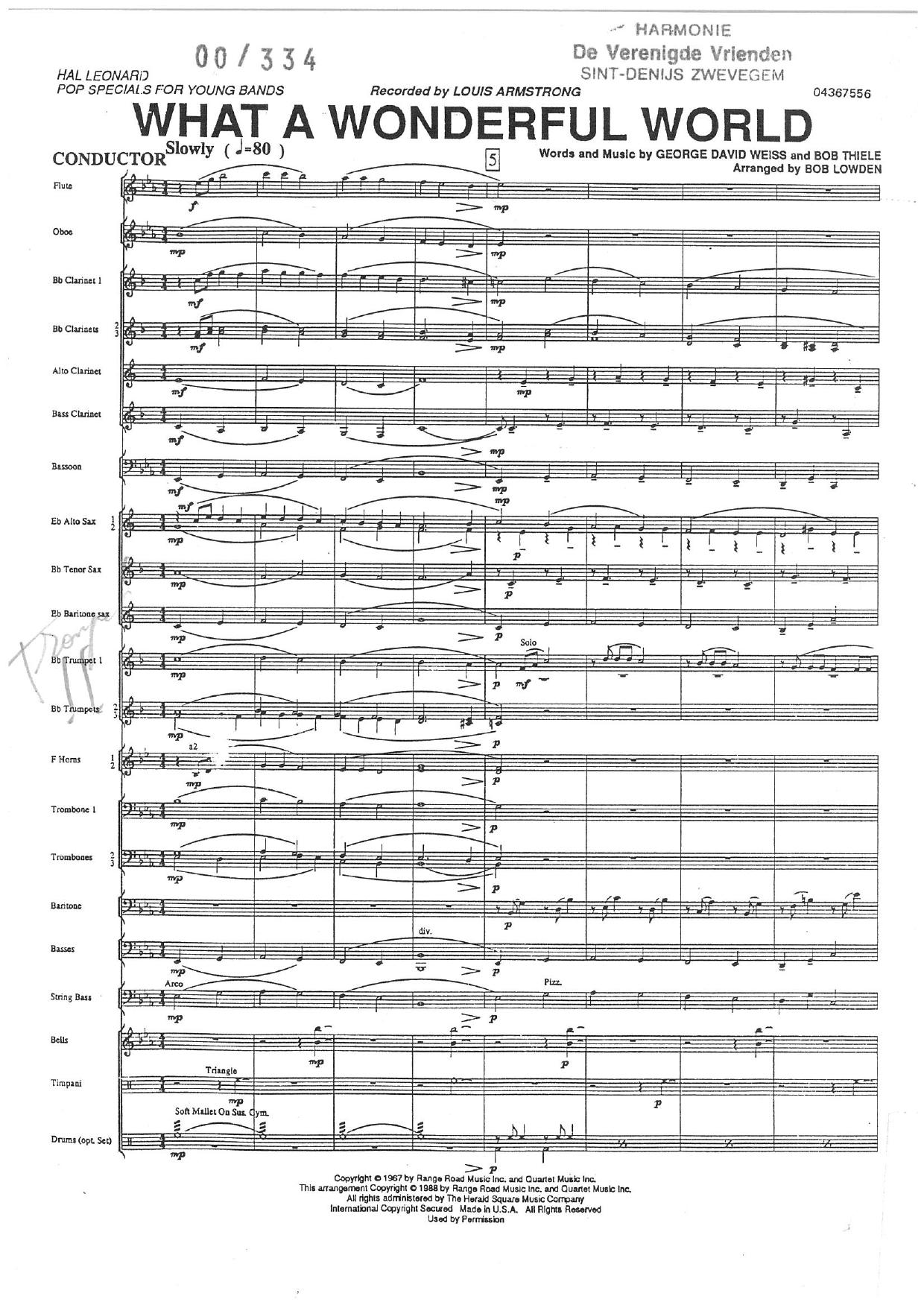
What A Wonderful World (B.Lowden)
Composed by Bob Thiele
Arranged by Bob Lowden
- Ensemble: Concert Band
- Style: Jazz Standard
- Pages: 40
- Instruments (33): Flute, Oboe, Bassoon, Bb Clarinet 1, Bb Clarinet 2, Bb Clarinet 3, Bass Clarinet, Eb Alto Saxophone 1, Eb Alto Saxophone 2, Tenor Saxophone, Baritone Saxophone, Bb Cornet/Trumpet 1, Bb Cornet/Trumpet 2, Bb Cornet/Trumpet 3, F Horn 1, F Horn 2, Eb Horn 1 (handwritten), Eb Horn 2 (handwritten), Trombone 1 (UT), Trombone 2 (UT), Trombone 3 (UT), Baritone T.C., Baritone B.C., Bb Tuba (Treble Clef, handwritten), Eb Tuba (Bass Clef, handwritten), Bb Tuba (Bass Clef), Basses, String Bass, Timpani, Triangle, Mallets (Bells, opt. Vibes), Drums, Soprano Saxophone (handwritten)
- Difficulty: medium
- Content: Individual Parts
- Format: PDF Download (Instant)
- Price: $22.99
Originally recorded and made immortal by Louis Armstrong in 1967, "What a Wonderful World"—composed by Bob Thiele (writing as George Douglas) and George David Weiss—stands as one of the most enduring and universally recognized anthems of the twentieth century. Emerging during a turbulent era in American history, the song was crafted as an antidote to social unrest, offering a message of gentle optimism and appreciation for daily beauty. While not a traditional bebop or swing-era tune from the Great American Songbook, its warm, reflective melody and accessible harmonic structure quickly invited interpretation across genres, cementing its status as a modern jazz and pop standard performed by everyone from Tony Bennett to Joey DeFrancesco. Bob Lowden’s sophisticated concert band adaptation captures the poignant lyricism and uplifting spirit of the original while expanding its palette for a full wind ensemble. Opening with a gentle, expressive rubato feel that gradually settles into a warm, flowing ballad tempo in 4/4 time, the arrangement balances rich, diatonic harmonies with subtle chromatic colorations. The emotional arc moves from intimate, pastoral woodwind reflections to a lush, full-ensemble climax that radiates profound warmth. Lowden avoids heavy-handed sentimentality, instead relying on transparent scoring, rich chord extensions, and lyrical countermelodies in the horns to evoke a deep sense of peace and communal reflection. Throughout the 40-page score and parts set, Lowden distributes thematic material thoughtfully across the entire ensemble, ensuring that every section shares in the narrative. The woodwinds—particularly the flutes and clarinets—handle the initial delicate statements of the melody with flowing scalar passages, while the low brass and tenor voices provide a warm, supportive cushion. Rather than relying on virtuosic improvised solos, the arrangement highlights ensemble blend, phrasing, and dynamic contrast, culminating in a soaring, majestic chordal peak before gracefully subsiding into a serene, quiet coda. Advanced middle school, high school, and community concert bands will find this arrangement highly accessible yet musically rewarding. The primary technical demands center on breath control, sustained tone production, and balance rather than digital dexterity or complex polyrhythms. Directors will appreciate how naturally the scoring addresses common balance issues in developing bands, making it an exceptional vehicle for teaching expressive phrasing, tone blending, and emotional communication through music. Achieving a successful performance of Bob Lowden’s setting begins with establishing a fluid, unhurried tempo that honors the vocal origins of the melody. Conductors should encourage a flowing, legato approach, avoiding rhythmic stiffness even as the ensemble settles into a steady meter. Balance is paramount: the accompanying voices must maintain a soft dynamic floor (around piano to mezzo-piano) to allow the primary melodic lines in the upper woodwinds or muted brass to project effortlessly. Pay close attention to tuning in the chordal clusters during the transitional modulations; because Lowden utilizes rich suspended and extended harmonies, any pitch deviation will obscure the intended warmth. Breath support is critical during the extended phrase structures, and players should stagger breathing where necessary to maintain an unbroken line. Finally, shape the climactic peak with restraint—let the natural acoustics of the full ensemble provide the volume rather than forcing the tone—and ensure the concluding measures fade away to a whisper. Q: What instruments and parts are included in this publication? A: This 40-page publication includes a comprehensive full conductor score alongside standard instrumentation parts for a full concert band, featuring expanded woodwind, brass, and percussion scoring. Q: What is the difficulty level of this arrangement? A: It is graded as medium-easy to medium, making it well-suited for proficient high school concert bands, community bands, and advanced middle school ensembles looking for expressive lyrical material. Q: What musical style and historical era does this piece represent? A: It is a jazz-influenced ballad adaptation of the 1967 pop-standard classic famously recorded by Louis Armstrong during an era of profound social transition. Q: What makes Bob Lowden’s arrangement unique? A: Lowden brilliantly translates a vocal ballad into a rich wind ensemble piece by utilizing transparent woodwind scoring, lush extended harmonies, and an absence of required improvised solos in favor of ensemble-driven emotional expression. Q: What is the performance duration and tempo feel of the piece? A: The arrangement typically runs between 3 to 4 minutes and is performed at a relaxed, flowing ballad tempo with a lyrical, open feel in 4/4 time.
Questions and answers
- What is included in the What A Wonderful World (B.Lowden) PDF?
- The verified current file contains a conductor score and individual parts across 40 pages.
- How many instruments or parts are listed for What A Wonderful World (B.Lowden)?
- The verified instrumentation list contains 33 entries for this Concert Band arrangement.
- Who is credited for What A Wonderful World (B.Lowden)?
- Composer: Bob Thiele. Arranger: Bob Lowden.
- What difficulty is listed for What A Wonderful World (B.Lowden)?
- The verified difficulty level is medium.
- What style is listed for What A Wonderful World (B.Lowden)?
- The catalog lists the style as Jazz Standard.
- Can I preview What A Wonderful World (B.Lowden) before buying?
- Yes. The product page provides a preview generated from the current PDF file.
- How is What A Wonderful World (B.Lowden) delivered?
- After successful payment, the digital PDF is made available for download. The displayed price is $22.99.
Musicians Also Search For
What A Wonderful World Bob Lowden PDF • What A Wonderful World Bob Lowden sheet music • What A Wonderful World arranged by Bob Lowden • Bob Lowden concert band charts • Bob Lowden jazz arrangements PDF • What A Wonderful World Bob Thiele sheet music • What A Wonderful World Bob Thiele concert band arrangements • Bob Thiele concert band charts • What A Wonderful World concert band arrangements • What A Wonderful World concert band PDF download • What A Wonderful World jazz sheet music • concert band sheet music download • What A Wonderful World conductor score PDF • What A Wonderful World individual parts download • What A Wonderful World sheet music PDF • What A Wonderful World Jazz Standard charts • Jazz Standard concert band arrangements • buy What A Wonderful World sheet music • download What A Wonderful World PDF • What A Wonderful World jazz charts • best Bob Lowden concert band arrangements • Bob Thiele arranged by Bob Lowden • What A Wonderful World printable sheet music • concert band repertoire PDF