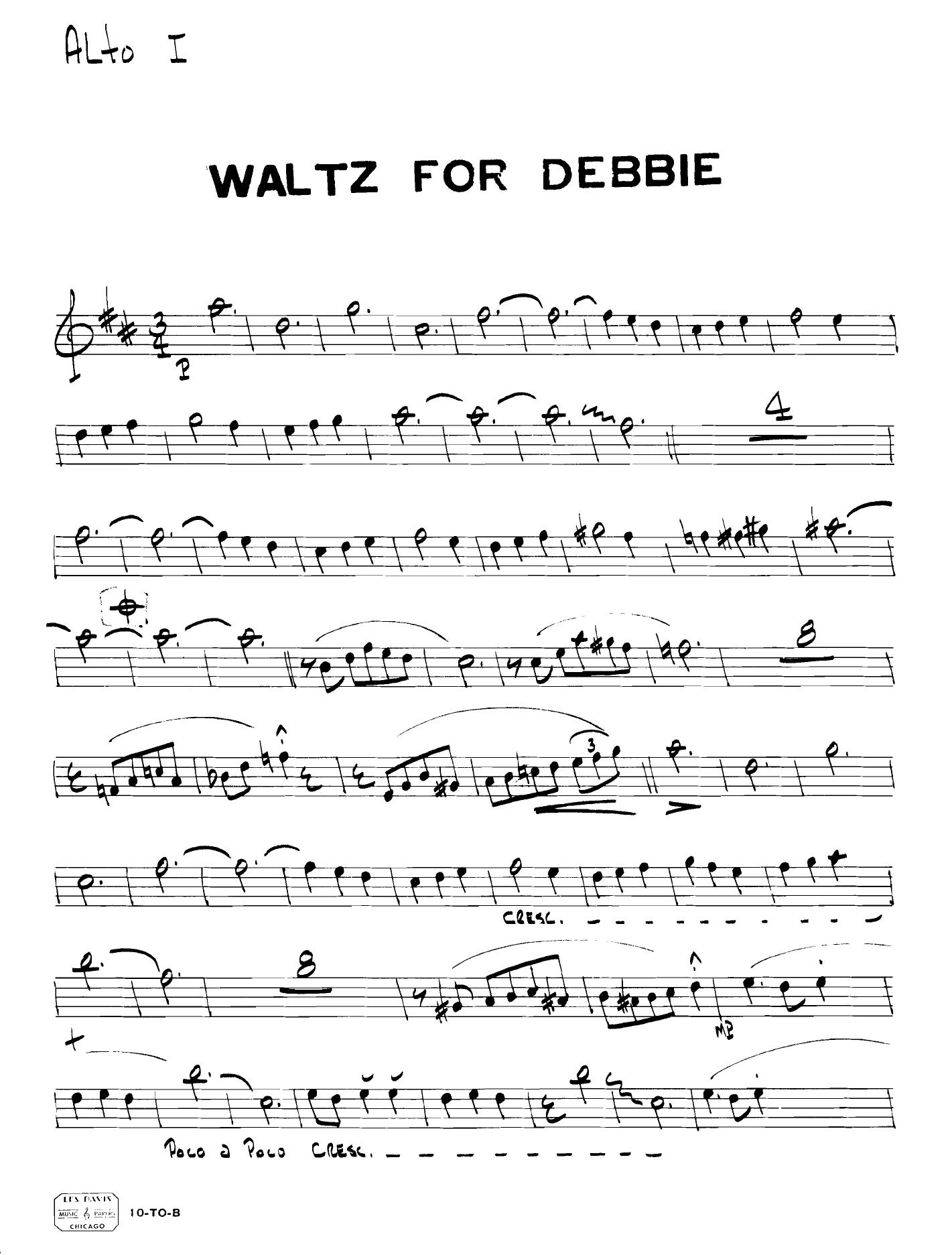
Waltz For Debby (L.Hooper)
Composed by Bill Evans
Arranged by Les Hooper
- Ensemble: Big Band
- Pages: 40
- Instruments (15): Alto I, Alto II, Tenor I, Tenor II, Baritone, Trumpet I, Trumpet II, Trumpet III, Trumpet IV, Trombone I, Trombone II, Trombone III, Piano, Bass, Drums
- Difficulty: medium
- Content: Individual Parts
- Format: PDF Download (Instant)
- Price: $24.99
Bill Evans first drafted "Waltz for Debby" in 1956 as a tribute to his young niece, capturing a profound sense of childlike innocence interwoven with sophisticated harmonic melancholy. Originally recorded as a solo piano piece before receiving lyrics by Gene Lees, it attained legendary status on the landmark 1961 Village Vanguard sessions with Evans's iconic trio featuring Scott LaFaro and Paul Motian. Over the decades, this waltz has transcended its origins to become a cornerstone of the modern jazz standard repertoire, celebrated for its elusive ¾ time feel and bittersweet emotional resonance. Translating a historically intimate piano masterpiece into a full-scale big band canvas is a formidable task, yet it remains one of the most revered exercises in modern jazz arranging. Les Hooper approaches this definitive standard not as a fragile ballad, but as a sweeping, dynamically shifting canvas that leverages the full textural palette of a modern 15-piece jazz orchestra. Moving gracefully between flowing ¾ waltz meters and expressive rubato passages, the arrangement evokes a warm, contemplative mood that gradually builds into moments of lush, cinematic intensity. Hooper utilizes rich, contemporary extended harmonies in the brass and interlocking woodwind counterlines to replicate the conversational interplay of Evans’s original trio voicings, avoiding predictable clichés in favor of sophisticated reharmonizations and unexpected tonal shifts. The melodic narrative unfolds through carefully balanced sections, giving prominent voice to the saxophones before expanding into full ensemble textures. Featured solo space allows a lead instrumentalist—ideally an expressive alto saxophonist or pianist—to stretch out over sophisticated changes that demand a mature harmonic vocabulary. Technical challenges lie primarily in maintaining a light, buoyant swing feel in ¾ time without rushing, as well as executing subtle dynamic control during dense, harmonically complex chord clusters. The rhythm section bears a significant responsibility, requiring a drummer adept at navigating modern jazz waltz phrasing without reverting to heavy, predictable downbeat patterns. Advanced high school ensembles with strong section players, college jazz orchestras, and professional big bands will find this chart an exceptional vehicle for developing ensemble sensitivity and lyrical phrasing. Because it relies heavily on nuance, balance, and rubato pacing rather than sheer velocity, it offers an invaluable masterclass in ensemble listening. Performing this arrangement rewards an audience with a fresh, orchestral perspective on a timeless jazz masterpiece, making it a standout selection for festival programs and formal concert settings alike. Navigating Les Hooper’s sophisticated setting of "Waltz for Debby" requires meticulous attention to balance, intonation, and rhythmic fluidity in ¾ meter. The primary technical hurdle involves maintaining a relaxed, driving pulse without letting the tempo push, particularly during the transition between rubato ensemble phrases and strict tempo sections. Conductors should emphasize horizontal linear movement rather than vertical chord-bashing, ensuring that the rich, extended chord voicings breathe naturally. The rhythm section must approach the groove with subtlety; the bassist should avoid heavy one-beat-per-bar pulsing in favor of a melodic, two-feel or rolling three-feel that honors the spirit of Scott LaFaro, while the drummer utilizes tasteful cymbal work and light snare placement. Saxophone sections must blend tightly during the cascading soli passages, paying close attention to dynamic swells marked in the score. Rehearsals should begin by isolating the rhythm section and horns separately to lock in the harmonic voicings before integrating the dynamic shifts that give this chart its cinematic depth. Q: What instruments and parts are included in this 15-instrument big band arrangement? A: The instrumentation comprises a 15-piece configuration featuring two alto saxophones, two tenor saxophones, a baritone saxophone, standard brass, and a full rhythm section. Full score and individual instrument parts are fully accounted for across the 40-page publication. Q: What is the difficulty level of Les Hooper’s "Waltz for Debby"? A: This arrangement is tailored for advanced high school, collegiate, and professional big bands due to its complex harmonic language, intricate metric phrasing, and high demands on ensemble blend and dynamic control. Q: How does this arrangement fit into the historical legacy of Bill Evans's composition? A: While staying true to the introspective, lyrical mood of Evans's 1961 classic, Les Hooper reimagines the tune through a modern compositional lens, translating intimate piano voicings into lush, expansive big band orchestrations. Q: What makes this specific arrangement unique compared to other big band charts of the same standard? A: Hooper avoids standard swing-era clichés by employing contemporary extended harmonies, fluid metric shifts between ¾ groove and rubato styling, and masterclass-level woodwind counterlines that mirror the interplay of a jazz piano trio. Q: What is the performance duration and recommended tempo feel for this chart? A: The piece is performed at a flowing, moderate jazz waltz tempo (around dotted quarter note = 112–120 BPM), resulting in a duration of approximately 5 to 6 minutes depending on the length of the improvised solos.
Questions and answers
- What is included in the Waltz For Debby (L.Hooper) PDF?
- The verified current file contains individual parts across 40 pages.
- How many instruments or parts are listed for Waltz For Debby (L.Hooper)?
- The verified instrumentation list contains 15 entries for this Big Band arrangement.
- Who is credited for Waltz For Debby (L.Hooper)?
- Composer: Bill Evans. Arranger: Les Hooper.
- What difficulty is listed for Waltz For Debby (L.Hooper)?
- The verified difficulty level is medium.
- Can I preview Waltz For Debby (L.Hooper) before buying?
- Yes. The product page provides a preview generated from the current PDF file.
- How is Waltz For Debby (L.Hooper) delivered?
- After successful payment, the digital PDF is made available for download. The displayed price is $24.99.
Musicians Also Search For
Waltz For Debby Les Hooper PDF • Waltz For Debby Les Hooper sheet music • Waltz For Debby arranged by Les Hooper • Les Hooper big band charts • Les Hooper jazz arrangements PDF • Waltz For Debby Bill Evans sheet music • Waltz For Debby Bill Evans big band arrangements • Bill Evans big band charts • Waltz For Debby big band arrangements • Waltz For Debby big band PDF download • Waltz For Debby jazz sheet music • big band sheet music download • Waltz For Debby individual parts download • Waltz For Debby sheet music PDF • buy Waltz For Debby sheet music • download Waltz For Debby PDF • Waltz For Debby jazz charts • best Les Hooper big band arrangements • Bill Evans arranged by Les Hooper • Waltz For Debby printable sheet music • big band repertoire PDF