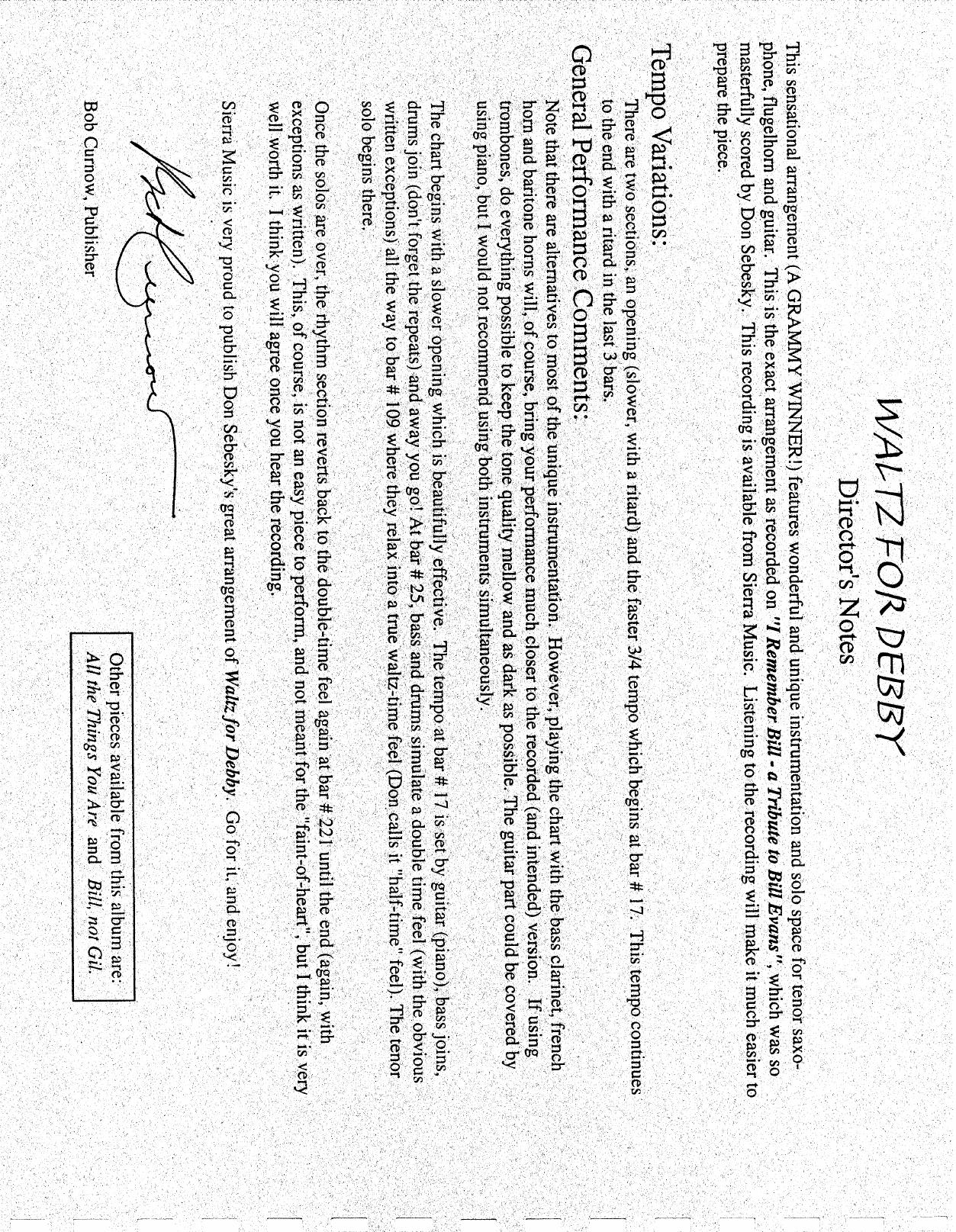
Waltz For Debby (D.Sebesky) sheet music preview

Waltz For Debby (D.Sebesky)

Composed by Bill Evans

Arranged by Don Sebesky

  • Ensemble: Big Band
  • Pages: 135
  • Instruments (19): Clarinet, Alto Saxophone, Tenor Saxophone 1 (Solo), Tenor Saxophone 2, Baritone Saxophone, Bass Clarinet, Flugel Horn 1, Flugel Horn 2, Flugel Horn 3 (Solo), Flugel Horn 4, Flugel Horn 5, French Horn, Baritone Horn 1, Baritone Horn 2, Baritone Horn 3, Baritone Horn 4 (Tuba), Guitar (Solo), Bass, Drums
  • Difficulty: advanced
  • Content: Individual Parts
  • Format: PDF Download (Instant)
  • Price: $24.99

Bill Evans first drafted "Waltz for Debby" in 1956 as a nostalgic piano solo dedicated to his young niece, later recording its definitive trio iterations on Riverside Records that cemented its status as one of the most revered jazz waltzes in the modern canon. Capturing a delicate, bittersweet balance of childlike innocence and sophisticated harmonic melancholy, the tune transitions from an intimate piano-bass-drum conversation into a towering orchestral canvas through the masterful pen of arranger Don Sebesky. As a foundational pillar of the modern jazz standard repertoire, the composition challenges arrangers to translate its rubato-adjacent intimacy and intricate modal/extended harmonies into a cohesive large-ensemble language without losing the fragile grace of Evans's original conception. Don Sebesky approaches this timeless classic with his signature lush impressionistic voicings, utilizing sophisticated woodwind doubling, rich brass texturing, and dynamic shifting meters that elevate the 3/4 jazz waltz feel into a cinematic sonic journey. The arrangement opens with a hauntingly atmospheric intro before settling into a fluid, graceful medium-tempo swing-waltz groove. Sebesky masterfully balances transparent, chamber-like ensemble passages with sweeping, cinematic tuttis that evoke the sophisticated arranger's work with CTI Records and the Evans estate. The harmonic palette features gorgeous chord extensions, upper-structure triads, and chromatic voice leading that require a mature ear for intonation and balance across the entire big band. Throughout the chart, the melodic weight shifts fluidly between evocative sax-led solis and soaring brass counter-lines, creating a rich tapestry of textures. Featured solo space allows a sensitive lead instrumentalist to explore the sophisticated changes, backed by subtle, undulating background figures that react organically to the soloist's phrasing. Technical demands center primarily on blend, intonation in extreme registers, and maintaining a buoyant, unforced 3/4 rhythmic pulse rather than sheer velocity. The emotional climax arrives via a tastefully restrained development section that builds in intensity before receding back into the poignant, introspective mood of the opening statement, rewarding both the performers and the discerning listener with its emotional depth. Advanced high school ensembles with strong section players, as well as collegiate, community, and professional jazz orchestras, will find this chart an exceptional vehicle for developing lyrical phrasing, dynamic control, and sophisticated ensemble listening. Because the difficulty lies less in mechanical pyrotechnics and more in interpretive maturity, subtone timbre control, and expressive rubato pacing, it serves as a masterclass in modern big band artistry for conductors seeking to stretch their ensemble's stylistic boundaries beyond standard swing-era fare. Navigating this arrangement successfully requires an ensemble-wide commitment to a flowing, unlabored 3/4 jazz waltz feel where the downbeat is anchored without feeling heavy. The conductor should emphasize horizontal phrasing over vertical time-keeping, ensuring that multi-measure melodic lines breathe naturally. Key technical challenges include maintaining immaculate intonation during dense, modern chord clusters in the brass and executing delicate dynamic swells from a whisper to a resonant mezzo-forte without distorting the tone quality. Woodwind doublings demand crisp execution and seamless blending with the brass choir. Rhythm section players must approach the time with subtlety; the drummer should utilize brush work or a light ride-cymbal palette that privileges crisp triplet subdivisions over heavy backbeats, while the bassist outlines the root-fifth or root-tenth movements with a lyrical, pulsing two-feel that propels the waltz rhythm forward effortlessly. Rehearsal time is best spent isolating individual choir balances before combining sections. Q: What instruments and parts are included in this arrangement? A: This chart is scored for an 8-instrument ensemble comprising Alto Saxophone, Tenor Saxophone, Baritone Saxophone, Trumpet, and Trombone, alongside a complete rhythm section, spanning a comprehensive 135-page full score and part set. Q: What is the difficulty level of this Don Sebesky arrangement? A: It is pitched at an advanced level, best suited for collegiate, professional, and top-tier high school jazz bands that possess strong reading skills and advanced ensemble intonation. Q: What is the historical style and musical context of the piece? A: It is rooted in the modern jazz waltz tradition pioneered by Bill Evans, reimagined through Sebesky's sophisticated, impressionistic big band arranging style that bridges traditional post-bop and cinematic orchestral jazz. Q: What makes this specific arrangement unique compared to standard big band charts? A: Sebesky's arrangement stands out due to its lush, extended harmonic voicings, transparent wind textures, and cinematic approach to the 3/4 meter, transforming an intimate piano trio standard into a rich orchestral tapestry. Q: What is the performance duration and recommended tempo? A: The arrangement is designed as a medium-tempo jazz waltz—typically performed around quarter note = 120–132 BPM—with a duration of approximately 5 to 6 minutes depending on soloist extensions.

Questions and answers

What is included in the Waltz For Debby (D.Sebesky) PDF?
The verified current file contains a conductor score and individual parts across 135 pages.
How many instruments or parts are listed for Waltz For Debby (D.Sebesky)?
The verified instrumentation list contains 19 entries for this Big Band arrangement.
Who is credited for Waltz For Debby (D.Sebesky)?
Composer: Bill Evans. Arranger: Don Sebesky.
What difficulty is listed for Waltz For Debby (D.Sebesky)?
The verified difficulty level is advanced.
Can I preview Waltz For Debby (D.Sebesky) before buying?
Yes. The product page provides a preview generated from the current PDF file.
How is Waltz For Debby (D.Sebesky) delivered?
After successful payment, the digital PDF is made available for download. The displayed price is $24.99.

Musicians Also Search For

Waltz For Debby Don Sebesky PDFWaltz For Debby Don Sebesky sheet musicWaltz For Debby arranged by Don SebeskyDon Sebesky big band chartsDon Sebesky jazz arrangements PDFWaltz For Debby Bill Evans sheet musicWaltz For Debby Bill Evans big band arrangementsBill Evans big band chartsWaltz For Debby big band arrangementsWaltz For Debby big band PDF downloadWaltz For Debby jazz sheet musicbig band sheet music downloadWaltz For Debby conductor score PDFWaltz For Debby individual parts downloadWaltz For Debby sheet music PDFbuy Waltz For Debby sheet musicdownload Waltz For Debby PDFWaltz For Debby jazz chartsbest Don Sebesky big band arrangementsBill Evans arranged by Don SebeskyWaltz For Debby printable sheet musicbig band repertoire PDF

All arrangements by Don Sebesky All Bill Evans sheet music