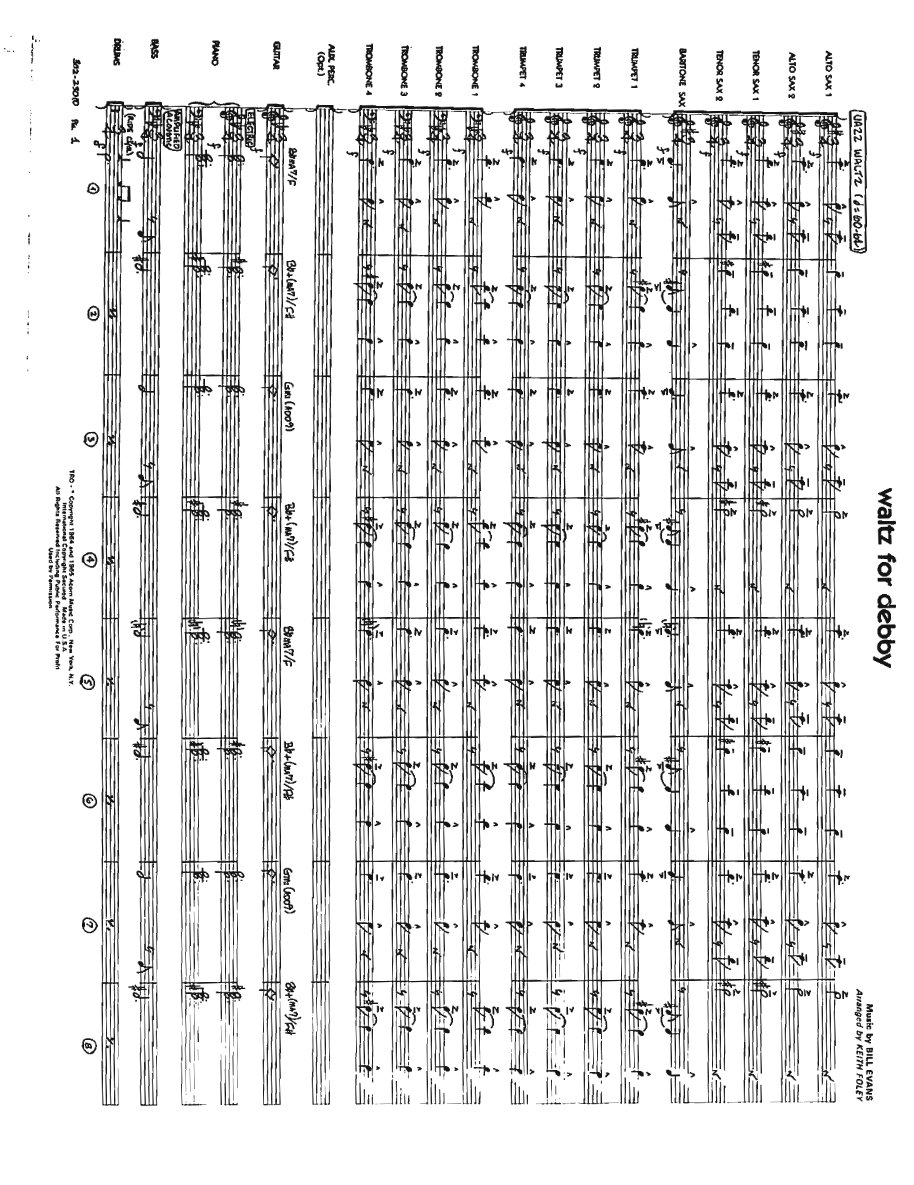
Waltz For Debby (K.Foley) sheet music preview

Waltz For Debby (K.Foley)

Composed by Bill Evans

Arranged by K. Foley

  • Ensemble: Big Band Dance
  • Style: Waltz
  • Pages: 71
  • Instruments (18): Alto Saxophone 1, Alto Saxophone 2, Tenor Saxophone 1, Tenor Saxophone 2, Baritone Saxophone, Trumpet 1, Trumpet 2, Trumpet 3, Trumpet 4, Trombone 1, Trombone 2, Trombone 3, Trombone 4, Auxiliary Percussion (Optional), Guitar, Piano, Bass, Drum Set
  • Difficulty: advanced
  • Content: Individual Parts
  • Format: PDF Download (Instant)
  • Price: $24.99

Bill Evans's iconic composition, "Waltz For Debby," emerged from the fertile ground of the late 1950s and early 1960s, a period that saw jazz piano trios redefine intimacy and harmonic sophistication. First recorded in 1956 and famously featured on the live 1961 Village Vanguard albums, this piece quickly transcended its origins to become a cornerstone of the jazz repertoire. Its delicate, lyrical melody, coupled with Evans's revolutionary harmonic language and fluid waltz feel, cemented its status as a timeless standard. The original trio recordings, particularly with Scott LaFaro and Paul Motian, showcased an unprecedented level of interactive improvisation and melodic development, establishing "Waltz For Debby" as a benchmark for expressive jazz performance and a profoundly personal dedication to Evans's niece. K. Foley's big band arrangement masterfully translates the intimate charm of this waltz into a rich, full-ensemble tapestry while retaining its inherent grace and melodic integrity. The piece maintains a medium-slow waltz tempo, emphasizing a flowing, legato feel rather than a strict, metronomic pulse. Foley's signature approach to voicings is immediately apparent, employing lush, often extended harmonies that shimmer through the saxophones and brass, creating a warm, enveloping soundscape. The arrangement opens with the melody presented by the lead alto saxophone, echoing the original's lyrical piano introduction, before being taken up by various sections, ensuring melodic clarity and expressive phrasing throughout. This arrangement is characterized by its sophisticated yet accessible treatment of the original material. Foley skillfully weaves through the familiar melody, often presenting it in layered soli sections that build in intensity and harmonic depth. There are thoughtfully crafted solo opportunities for both tenor saxophone and trumpet, allowing individual voices to shine within the ensemble's supportive framework. Technical challenges are primarily centered around achieving precise balance and blend within the intricate voicings, maintaining the consistent, flowing waltz feel, and executing dynamic contrasts with sensitivity. The arrangement culminates in a beautifully orchestrated final chorus, showcasing Foley's ability to build emotional resonance, making it an incredibly rewarding piece for musicians to perform and audiences to experience. "Waltz For Debby (K. Foley)" is ideally suited for college-level jazz ensembles, advanced community bands, and professional groups seeking a sophisticated yet deeply moving addition to their repertoire. While high school bands with strong lead players and a dedicated rhythm section could tackle this, the nuanced harmonic language and demands for expressive phrasing make it particularly rewarding for ensembles capable of a higher degree of musical subtlety. Its blend of historical reverence and contemporary big band arranging makes it a standout piece for concerts, festivals, and educational settings. Achieving the authentic "Waltz For Debby" feel requires a consistent, flowing medium-slow waltz tempo (approx. quarter note = 140-152 bpm), emphasizing the natural lilt of the 3/4 meter rather than a rigid, march-like pulse. The rhythm section must establish a delicate yet firm foundation, with the bass providing a lyrical walking line and drums offering subtle brushwork or light cymbal patterns to support the melodic flow. The primary technical challenge lies in the precise execution of K. Foley's intricate voicings, particularly in the saxophone and brass sections, demanding careful attention to blend, balance, and intonation to allow the extended harmonies to resonate clearly. Phrasing should be legato and expressive, with particular emphasis on shaping the melodic lines. Dynamics are crucial; subtle crescendos and decrescendos should be carefully rehearsed to enhance the emotional arc of the piece. Encourage soloists to embrace the lyrical nature of the original, focusing on melodic development and harmonic sensitivity over purely technical display. Q: What instruments are included in this arrangement? A: This arrangement is scored for a full big band, including five saxophones (Alto 1, Alto 2, Tenor 1, Tenor 2, Baritone), four trumpets, four trombones, and a complete rhythm section (piano, bass, drums, guitar). Q: What is the difficulty level of "Waltz For Debby (K. Foley)"? A: This arrangement is considered advanced intermediate to advanced. It requires strong lead players, a cohesive rhythm section, and an ensemble capable of nuanced dynamics and precise execution of complex voicings and lyrical phrasing. Q: How does this arrangement honor the original "Waltz For Debby" by Bill Evans? A: K. Foley's arrangement respects the original's lyrical melody and harmonic sophistication, translating its intimate waltz feel and emotional depth to a big band setting through lush voicings and sensitive orchestration, while providing fresh ensemble textures. Q: What makes K. Foley's arrangement of "Waltz For Debby" unique? A: Foley's distinctive approach lies in his use of rich, extended harmonies, carefully layered soli sections that build melodic intensity, and thoughtful solo opportunities, all while maintaining the delicate, flowing character of the original waltz. Q: What is the typical performance duration and tempo for this piece? A: "Waltz For Debby (K. Foley)" typically performs for approximately 4-5 minutes, maintaining a medium-slow waltz tempo, usually around quarter note = 140-152 beats per minute, to allow for expressive phrasing and harmonic resonance.

Musicians Also Search For

Waltz For Debby K. Foley PDFWaltz For Debby K. Foley sheet musicWaltz For Debby arranged by K. FoleyK. Foley big band dance chartsK. Foley jazz arrangements PDFWaltz For Debby Bill Evans sheet musicWaltz For Debby Bill Evans big band dance arrangementBill Evans big band dance chartsWaltz For Debby big band dance arrangementWaltz For Debby big band dance PDF downloadWaltz For Debby jazz ensemble sheet musicbig band dance sheet music instant downloadWaltz For Debby individual parts downloadWaltz For Debby sheet music with partsWaltz For Debby Waltz chartWaltz big band dance arrangementsbuy Waltz For Debby sheet music onlinedownload Waltz For Debby PDFWaltz For Debby jazz chartbest K. Foley big band dance arrangementsBill Evans songs arranged by K. FoleyWaltz For Debby printable sheet musicbig band dance repertoire PDF

All arrangements by K. Foley All Bill Evans sheet music