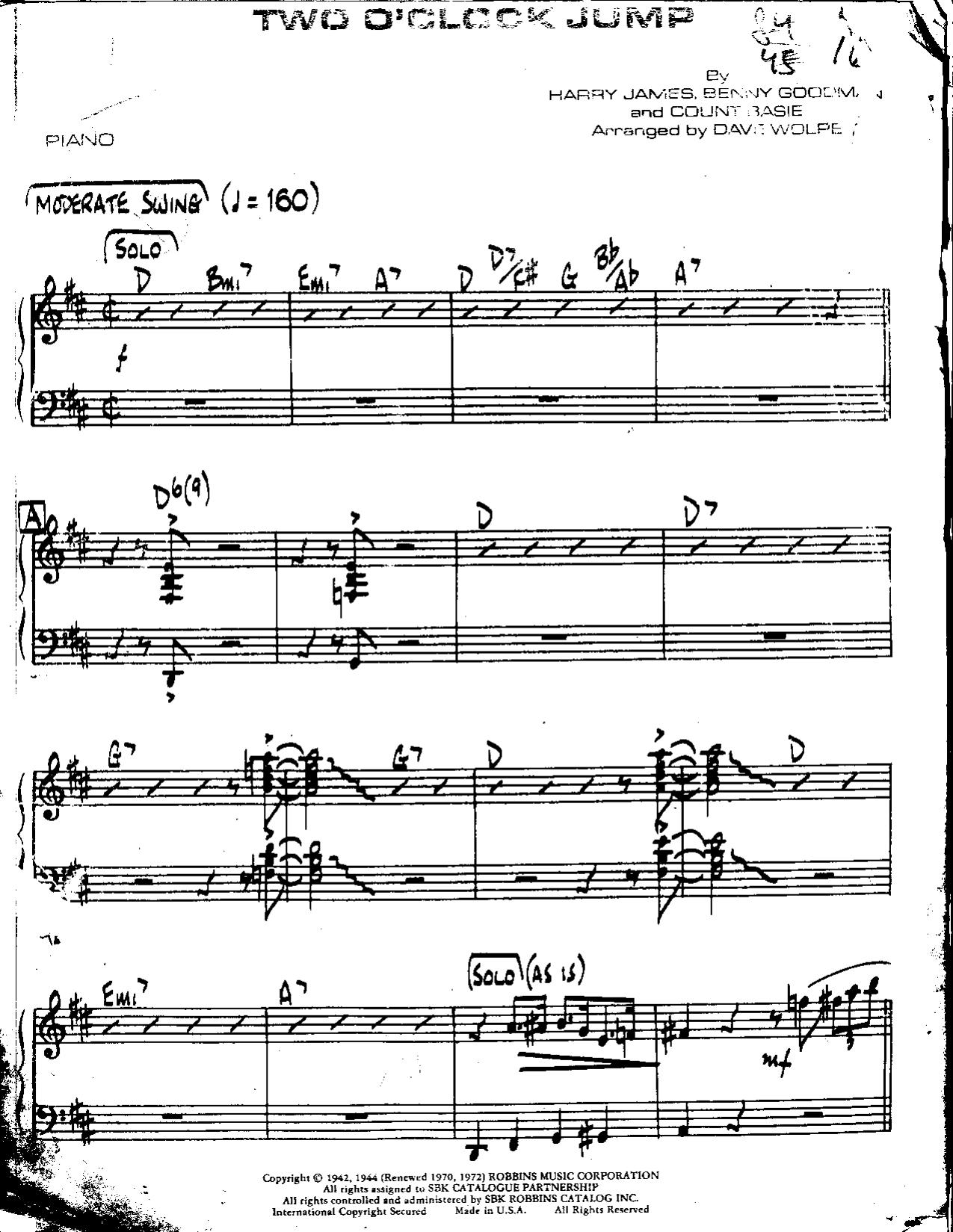
Two O'clock Jump (D.Wolpe)
Composed by Harry James, Benny Goodman and Count Basie
Arranged by Dave Wolpe
- Ensemble: Small Ensemble
- Style: SWING
- Pages: 52
- Instruments (16): Alto Sax 1, Alto Sax 2, Tenor Sax 1, Tenor Sax 2, Bari Sax, Trumpet 1, Trumpet 2, Trumpet 3, Trumpet 4, Trombone 1, Trombone 2, Trombone 3, Trombone 4, Piano, Electric Bass, Set Drums
- Difficulty: easy
- Content: Individual Parts
- Format: PDF Download (Instant)
- Price: $12.99
Collaborative brilliance defines "Two O'Clock Jump," a legendary swing-era powerhouse originally conceived by the triumvirate of Harry James, Benny Goodman, and Count Basie. Emerging from the height of the 1930s and 1940s big band phenomenon, this infectious blues-based riff tune captures the unbridled energy and high-stakes excitement of late-night jam sessions where swing royalty traded ideas. While multiple iterations cemented its place in jazz history, the composition remains a definitive anthem of driving four-to-the-bar swing, characterized by infectious head arrangements and an irresistible momentum that electrifies audiences from the opening downbeat. Driving medium-up swing defines this chart, radiating high-octane energy, playful bravado, and relentless rhythmic propulsion. Dave Wolpe’s masterful adaptation captures the classic Kansas City and Benny Goodman propulsion, translating the expansive sonic footprint of a full big band into a tight, highly effective small ensemble format. The arrangement thrives on crisp articulation, dynamic contrast, and a buoyant groove that demands tight ensemble interplay. Wolpe expertly balances rich, traditional horn voicings with clever counterpoint, ensuring that every section punches through the texture with authentic period flavor while maintaining modern clarity. Tailored specifically for flexible small jazz ensembles, this 23-page publication distributes melodic and harmonic responsibilities evenly, allowing smaller horn sections to sound full and commanding. The melody is shared fluidly across the front line, supported by clever background riffs that emulate the classic call-and-response dynamism of the Basie and Goodman libraries. Solos are framed by supportive, swinging accompaniment figures that inspire improvisers to stretch out, while the arrangement builds organically toward an exhilarating shout chorus. Technical demands center on clean swing articulation, accurate stylistic phrasing, and maintaining a steady, driving macro-tempo without rushing. Advanced high school, collegiate, and professional gigging groups will find this chart an ideal centerpiece for concert programs, festival performances, and club dates. Because it scales down a monumental swing artifact into an accessible format without sacrificing harmonic depth or stylistic integrity, it serves as an exceptional vehicle for teaching authentic swing feel to developing players while offering seasoned professionals a crowd-pleasing classic that never fails to ignite a room. Unlocking the authentic drive of this arrangement requires absolute precision in swing eighth-note interpretation, where eighth notes must be played with a natural, triplet-based feel rather than straight or overly articulated. The rhythm section serves as the engine room; the drummer should lock in a steady ride cymbal pattern with crisp hi-hat chicks on beats two and four, while the bassist walks a buoyant, connected line that avoids heavy-handed accents on the downbeats. Horn players must pay close attention to dynamic markings, treating background riffs as subtle cushions rather than competing forces when soloists are featured. Articulation is paramount—short notes must be crisp and dry, while longer notes require a warm, supported vibrato appropriate for the swing era. Rehearsal should initially focus on sectional blend and intonation during the harmonized soli passages before integrating the rhythm section to cement the groove at the target tempo. Q: What instrumentation and parts are included in this 23-page publication? A: The arrangement is scored for a flexible small ensemble format, typically accommodating a front line of horns (such as alto sax, tenor sax, trumpet, and trombone) alongside a full rhythm section consisting of piano, bass, guitar, and drums. Q: What is the difficulty level of Dave Wolpe's arrangement of "Two O'Clock Jump"? A: This chart is graded as intermediate to advanced (approximately Grade 3.5 to 4), making it well-suited for proficient high school groups, college ensembles, and professional pick-up bands looking for a reliable crowd-pleaser. Q: How does this piece fit into jazz history? A: "Two O'Clock Jump" is a classic swing-era blues head co-written by jazz icons Harry James, Benny Goodman, and Count Basie, representing the collaborative, high-energy spirit of late-night jam sessions from the 1930s and 1940s. Q: What makes Dave Wolpe's treatment unique for small ensembles? A: Wolpe successfully distills the massive, roaring power of a full 17-piece big band chart into an agile small-group arrangement, retaining authentic shout choruses and rich harmonic voicings without cluttering the texture. Q: What is the recommended tempo and performance duration for this arrangement? A: The chart is performed at a brisk, driving medium-up swing tempo (around 160–172 BPM), resulting in a performance duration of approximately 3 to 4 minutes depending on the number and length of improvised solos.
Questions and answers
- What is included in the Two O'clock Jump (D.Wolpe) PDF?
- The verified current file contains individual parts across 52 pages.
- How many instruments or parts are listed for Two O'clock Jump (D.Wolpe)?
- The verified instrumentation list contains 16 entries for this Small Ensemble arrangement.
- Who is credited for Two O'clock Jump (D.Wolpe)?
- Composer: Harry James, Benny Goodman and Count Basie. Arranger: Dave Wolpe.
- What difficulty is listed for Two O'clock Jump (D.Wolpe)?
- The verified difficulty level is easy.
- What style is listed for Two O'clock Jump (D.Wolpe)?
- The catalog lists the style as SWING.
- Can I preview Two O'clock Jump (D.Wolpe) before buying?
- Yes. The product page provides a preview generated from the current PDF file.
- How is Two O'clock Jump (D.Wolpe) delivered?
- After successful payment, the digital PDF is made available for download. The displayed price is $12.99.
Musicians Also Search For
Two O'clock Jump Dave Wolpe PDF • Two O'clock Jump Dave Wolpe sheet music • Two O'clock Jump arranged by Dave Wolpe • Dave Wolpe small ensemble charts • Dave Wolpe jazz arrangements PDF • Two O'clock Jump Harry James, Benny Goodman and Count Basie sheet music • Two O'clock Jump Harry James, Benny Goodman and Count Basie small ensemble arrangements • Harry James, Benny Goodman and Count Basie small ensemble charts • Two O'clock Jump small ensemble arrangements • Two O'clock Jump small ensemble PDF download • Two O'clock Jump jazz sheet music • small ensemble sheet music download • Two O'clock Jump individual parts download • Two O'clock Jump sheet music PDF • Two O'clock Jump SWING charts • SWING small ensemble arrangements • buy Two O'clock Jump sheet music • download Two O'clock Jump PDF • Two O'clock Jump jazz charts • best Dave Wolpe small ensemble arrangements • Harry James, Benny Goodman and Count Basie arranged by Dave Wolpe • Two O'clock Jump printable sheet music • small ensemble repertoire PDF