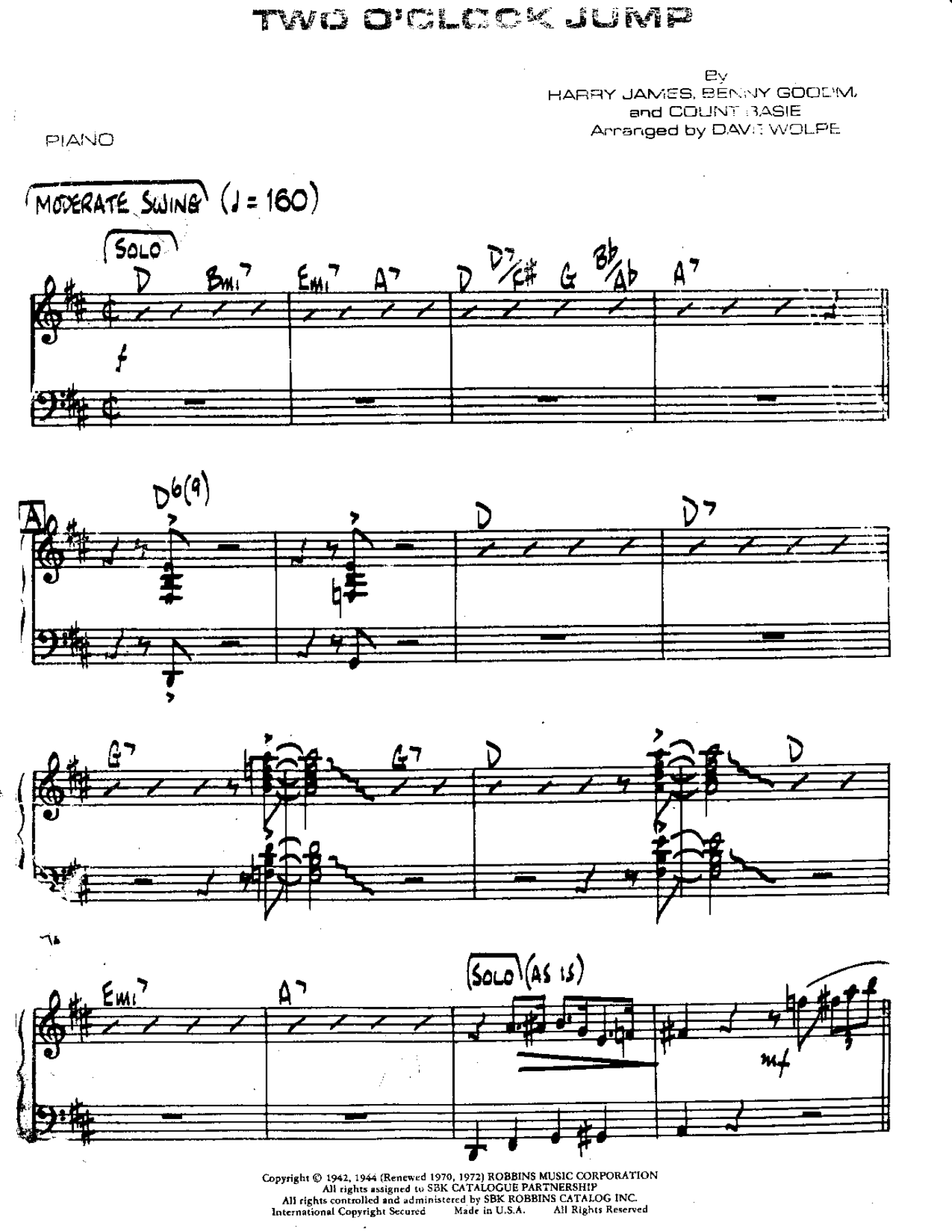
Two O'Clock Jump (D.Wolpe)
Composed by Harry James, Benny Goodman and Count Basie
Arranged by Dave Wolpe
- Ensemble: Small Ensemble
- Style: Jazz Standard
- Pages: 52
- Instruments (16): Alto Sax 1, Alto Sax 2, Tenor Sax 1, Tenor Sax 2, Bari Sax, Trumpet 1, Trumpet 2, Trumpet 3, Trumpet 4, Trombone 1, Trombone 2, Trombone 3, Trombone 4, Piano, Electric Bass, Set Drums
- Difficulty: easy
- Content: Individual Parts
- Format: PDF Download (Instant)
- Price: $12.99
"Two O'Clock Jump" stands as an enduring emblem of the Swing Era, a vibrant period in American music history spanning the 1930s and 1940s. While often attributed to Harry James, Benny Goodman, and Count Basie, its origins are deeply rooted in the Count Basie Orchestra's iconic 1937 standard, "One O'Clock Jump." Basie's original was a quintessential example of a "head arrangement," born from collective improvisation and riff-based structures, which became his band's theme song. Harry James later penned "Two O'Clock Jump" in 1939, developing it as his own signature theme, building upon the twelve-bar blues structure and energetic spirit of Basie's tune, notably incorporating his distinctive brass triplet figures. The piece quickly became a staple for top swing bands and remains a celebrated jazz standard, synonymous with the high-energy, dance-inducing big band sound of the era. This Dave Wolpe arrangement captures the exhilarating, up-tempo swing feel that defines "Two O'Clock Jump." Wolpe's treatment maintains the piece's characteristic bright tempo and driving rhythm, designed to evoke the infectious energy of a classic big band dance number. The arrangement is typically set in a bright, accessible key, allowing for clarity in the brass and saxophone sections while maintaining a powerful, full ensemble sound. It radiates a joyous and celebratory mood, perfect for igniting an audience with the irrepressible spirit of swing. Wolpe’s mastery lies in translating the raw power of a full big band into a dynamic small ensemble setting, ensuring that the essence of the original's robust sound is preserved without sacrificing any of its punch or excitement. Dave Wolpe, renowned for his prolific contributions to jazz arranging, particularly for ensembles like the Glenn Miller Orchestra, approaches "Two O'Clock Jump" with his signature blend of authenticity and playability. His arrangements are celebrated for their clear voicings, intelligent use of soli sections, and powerful shout choruses that build excitement. In this small ensemble version, Wolpe expertly crafts the interplay between instruments, often assigning the iconic melodic lines and counter-melodies to various sections, ensuring each part is engaging and contributes to the overall texture. While specific modulations may be subtle to maintain the blues-based foundation, Wolpe's harmonic language is rich yet accessible, providing a solid framework for the piece's energetic character. His arrangements are known for being well-written and effective, making them a favorite among educators and performers. Performance of this arrangement is a rewarding experience, offering both ensemble cohesion and individual expression. The melody is primarily carried by the trumpet section, often featuring Harry James's iconic triplet riffs, with strong support and counterpoint from the saxophones and trombones. While this small ensemble arrangement is tailored to feature the entire trumpet section, opportunities for featured solos are typically present, allowing instrumentalists to improvise over the familiar blues changes, echoing the tradition of the original "head arrangements." Technical challenges may include maintaining precise articulation and dynamic control at a brisk tempo, particularly in the brass triplet figures and tight ensemble rhythms. The reward lies in delivering a historically significant and undeniably fun piece that connects performers and audiences to the golden age of swing. This arrangement is well-suited for high school, college, and community jazz ensembles looking to program an authentic, high-energy swing standard that is both challenging and highly gratifying to perform. This arrangement of "Two O'Clock Jump" thrives on a bright, driving swing feel, typically around a tempo of quarter note = 160-180 BPM. Conductors should emphasize a strong, consistent rhythmic pulse, ensuring the ensemble locks into the characteristic "jump" rhythm. Articulation is paramount; crisp brass attacks and sustained, singing saxophone lines are essential for capturing the authentic swing sound. Pay close attention to dynamic contrasts, particularly in the soli sections and the build-up to the shout chorus, to create a compelling narrative arc. While specific techniques like plunger mutes are not explicitly required for the core arrangement, their tasteful addition in solo sections can enhance stylistic authenticity. Rehearsal time should focus on rhythmic precision, especially in the brass triplet figures, and balancing the ensemble to ensure clarity of melodic lines and harmonic voicings. Encourage soloists to embrace the blues-based improvisation inherent in the piece, drawing inspiration from the original recordings while developing their unique voice. Q: What instruments/parts are included in this small ensemble arrangement? A: This arrangement is designed for a small jazz ensemble, typically including standard instrumentation such as trumpets, trombones, saxophones (alto, tenor, baritone), piano, bass, and drums. The specific voicing for small ensemble will be detailed in the score. Q: What is the difficulty level of this arrangement? A: This arrangement is generally considered suitable for intermediate to advanced high school, college, and community jazz ensembles. It offers engaging parts for all sections and provides appropriate challenges in terms of tempo, articulation, and ensemble precision. Q: What is the musical style and historical context of "Two O'Clock Jump"? A: "Two O'Clock Jump" is a classic jazz standard from the Swing Era (1930s-1940s), known for its up-tempo, driving swing feel and blues-based structure. It was made famous by Harry James, building on the foundation of Count Basie's "One O'Clock Jump." Q: What makes Dave Wolpe's arrangement of "Two O'Clock Jump" unique? A: Dave Wolpe's arrangement is distinguished by its authentic capture of the original's energetic swing feel within a small ensemble setting. It features his characteristic clear voicings, dynamic soli sections, and powerful shout choruses, making it both playable and exciting. Q: What is the typical performance duration or tempo for this piece? A: "Two O'Clock Jump" is an up-tempo swing number, usually performed at a brisk pace, often around 160-180 beats per minute. The performance duration will vary slightly based on tempo and the number of improvised solos, but typically ranges from 3 to 4 minutes.
Questions and answers
- What is included in the Two O'Clock Jump (D.Wolpe) PDF?
- The verified current file contains individual parts across 52 pages.
- How many instruments or parts are listed for Two O'Clock Jump (D.Wolpe)?
- The verified instrumentation list contains 16 entries for this Small Ensemble arrangement.
- Who is credited for Two O'Clock Jump (D.Wolpe)?
- Composer: Harry James, Benny Goodman and Count Basie. Arranger: Dave Wolpe.
- What difficulty is listed for Two O'Clock Jump (D.Wolpe)?
- The verified difficulty level is easy.
- What style is listed for Two O'Clock Jump (D.Wolpe)?
- The catalog lists the style as Jazz Standard.
- Can I preview Two O'Clock Jump (D.Wolpe) before buying?
- Yes. The product page provides a preview generated from the current PDF file.
- How is Two O'Clock Jump (D.Wolpe) delivered?
- After successful payment, the digital PDF is made available for download. The displayed price is $12.99.
Musicians Also Search For
Two O'Clock Jump Dave Wolpe PDF • Two O'Clock Jump Dave Wolpe sheet music • Two O'Clock Jump arranged by Dave Wolpe • Dave Wolpe small ensemble charts • Dave Wolpe jazz arrangements PDF • Two O'Clock Jump Harry James, Benny Goodman and Count Basie sheet music • Two O'Clock Jump Harry James, Benny Goodman and Count Basie small ensemble arrangements • Harry James, Benny Goodman and Count Basie small ensemble charts • Two O'Clock Jump small ensemble arrangements • Two O'Clock Jump small ensemble PDF download • Two O'Clock Jump jazz sheet music • small ensemble sheet music download • Two O'Clock Jump individual parts download • Two O'Clock Jump sheet music PDF • Two O'Clock Jump Jazz Standard charts • Jazz Standard small ensemble arrangements • buy Two O'Clock Jump sheet music • download Two O'Clock Jump PDF • Two O'Clock Jump jazz charts • best Dave Wolpe small ensemble arrangements • Harry James, Benny Goodman and Count Basie arranged by Dave Wolpe • Two O'Clock Jump printable sheet music • small ensemble repertoire PDF