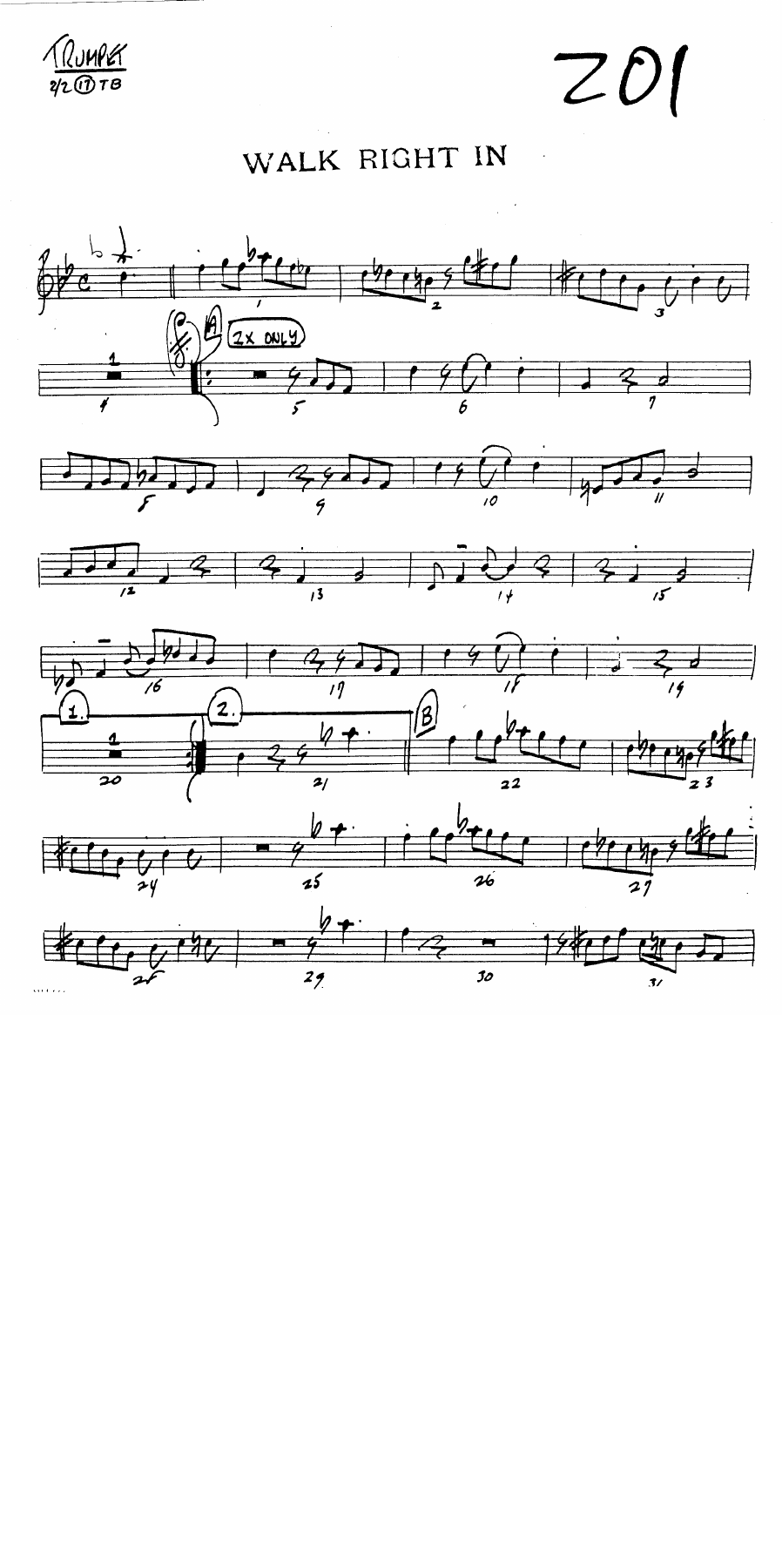
Walk Right In (M.Paich) sheet music preview

Walk Right In (M.Paich)

Composed by Gus Cannon, Hosea Woods

Arranged by M. Paich - Dave Pell Octet - Ts,Bs,Trp,Trb+Rhythm

  • Ensemble: Small Ensemble
  • Style: Jazz Standard
  • Pages: 17
  • Difficulty: easy
  • Content: Sheet Music
  • Format: PDF Download (Instant)
  • Price: $12.99

"Walk Right In," originally penned by Gus Cannon and Hosea Woods, stands as a foundational piece in American folk and blues music, first recorded in 1929 by Cannon's Jug Stompers. It gained widespread recognition and became a global sensation in 1963 with The Rooftop Singers' Grammy-winning rendition, transforming it into a quintessential folk-pop anthem. This enduring appeal across genres and generations firmly establishes its status as a jazz standard, offering a rich melodic and harmonic canvas for interpretation. Its simple, yet infectious, melodic line and uplifting lyrical theme of welcome and joy provide a timeless foundation that adapts beautifully to diverse musical settings. This specific arrangement by Marty Paich, crafted for the Dave Pell Octet, reimagines "Walk Right In" as a sophisticated, medium-swing jazz standard. Set in a bright, accessible key, it exudes a buoyant and optimistic mood, characteristic of the West Coast cool jazz sound of the mid-20th century. The arrangement maintains a consistent 4/4 meter with a relaxed, yet propulsive, swing feel, making it immediately engaging for both performers and listeners. The energy is consistently high, driven by the interplay between the compact horn section and the rhythm section, creating a polished and inviting sonic landscape that evokes a sense of effortless cool and rhythmic precision. Paich's distinctive arranging style is immediately evident in his treatment of "Walk Right In." Known for his meticulous voicings and sophisticated harmonic palettes, he utilizes the unique instrumentation of the Dave Pell Octet (tenor saxophone, baritone saxophone, trumpet, trombone, plus rhythm section) to create a rich, yet transparent, texture. Expect tightly voiced soli sections that showcase the horns' blend, often employing close harmony and subtle counterpoint that are hallmarks of Paich's writing. The arrangement features a clear head-solos-head structure, with the melody initially carried by the full horn section in unison or octaves, then passing to individual soloists, likely the tenor saxophone and trumpet, allowing for expressive improvisation over the established chord changes. There are no dramatic modulations, but rather subtle harmonic embellishments that keep the piece fresh and engaging without straying from its melodic core. Performing this arrangement is a rewarding experience, offering opportunities for both ensemble precision and individual expression. The technical challenges lie primarily in achieving a cohesive blend and intonation within the close voicings, particularly in the soli passages. The rhythm section provides a steady, swinging foundation, requiring a strong sense of time and dynamic sensitivity. Featured solos present a chance for improvisers to explore the bluesy, yet harmonically refined, landscape Paich has created. This arrangement is ideally suited for advanced high school, college, community, and professional jazz ensembles seeking to explore classic West Coast jazz repertoire. Its accessible form, combined with Paich's sophisticated harmonic and melodic treatment, makes it an excellent vehicle for developing ensemble tightness, stylistic authenticity, and improvisational confidence within a small group setting. The clarity of the arrangement and its inherent swing make it a joy to rehearse and perform, offering a polished sound that is both historically informed and universally appealing. Conductors should emphasize a relaxed, medium-swing feel throughout, ensuring the rhythm section lays down a solid, unhurried groove. The primary technical challenge for the horn section lies in achieving precise intonation and blend within Paich's characteristic close voicings, particularly in the unison and soli passages. Encourage musicians to listen across the section and match articulations for a cohesive sound. The trumpet and tenor saxophone solos should be approached with a melodic sensibility, drawing from the cool jazz aesthetic rather than an overly aggressive bebop style. Dynamics are crucial; ensure the ensemble observes the subtle swells and decays to bring out the nuanced phrasing. Rehearsal time should focus on balancing the horn section against the rhythm section, ensuring the bass and drums provide a strong, yet supportive, foundation without overpowering the melodic lines. No special techniques like plunger mutes or falls are explicitly notated, allowing for a clean, pure tone. Q: What instruments are included in this arrangement? A: This arrangement is scored for a small ensemble, specifically featuring tenor saxophone, baritone saxophone, trumpet, trombone, and a standard rhythm section (piano, bass, drums). Q: What is the difficulty level of this arrangement? A: This arrangement is suitable for advanced high school, college, community, and professional jazz ensembles, requiring solid instrumental technique and an understanding of cool jazz stylistic nuances. Q: What musical style and historical context does "Walk Right In (M.Paich)" represent? A: This arrangement transforms the classic folk/blues standard "Walk Right In" into a medium-swing jazz piece, embodying the sophisticated, melodically driven West Coast cool jazz style popularized in the mid-20th century. Q: What makes Marty Paich's arrangement of "Walk Right In" unique? A: Paich's signature approach includes meticulously crafted close voicings for the horn section, sophisticated harmonic embellishments, and a focus on ensemble blend and precision, all within the framework of a relaxed, swinging groove. Q: What is the typical performance duration and tempo for this piece? A: While exact duration can vary with solo lengths, this medium-swing arrangement typically performs between 3-5 minutes, at a comfortable, unhurried tempo that allows for melodic clarity and rhythmic precision.

Musicians Also Search For

Walk Right In M. Paich - Dave Pell Octet - Ts,Bs,Trp,Trb+Rhythm PDFWalk Right In M. Paich - Dave Pell Octet - Ts,Bs,Trp,Trb+Rhythm sheet musicWalk Right In arranged by M. Paich - Dave Pell Octet - Ts,Bs,Trp,Trb+RhythmM. Paich - Dave Pell Octet - Ts,Bs,Trp,Trb+Rhythm small ensemble chartsM. Paich - Dave Pell Octet - Ts,Bs,Trp,Trb+Rhythm jazz arrangements PDFWalk Right In Gus Cannon, Hosea Woods sheet musicWalk Right In Gus Cannon, Hosea Woods small ensemble arrangementGus Cannon, Hosea Woods small ensemble chartsWalk Right In small ensemble arrangementWalk Right In small ensemble PDF downloadWalk Right In jazz ensemble sheet musicsmall ensemble sheet music instant downloadWalk Right In sheet music with partsWalk Right In Jazz Standard chartJazz Standard small ensemble arrangementsbuy Walk Right In sheet music onlinedownload Walk Right In PDFWalk Right In jazz chartbest M. Paich - Dave Pell Octet - Ts,Bs,Trp,Trb+Rhythm small ensemble arrangementsGus Cannon, Hosea Woods songs arranged by M. Paich - Dave Pell Octet - Ts,Bs,Trp,Trb+RhythmWalk Right In printable sheet musicsmall ensemble repertoire PDF

All arrangements by M. Paich - Dave Pell Octet - Ts,Bs,Trp,Trb+Rhythm All Gus Cannon, Hosea Woods sheet music