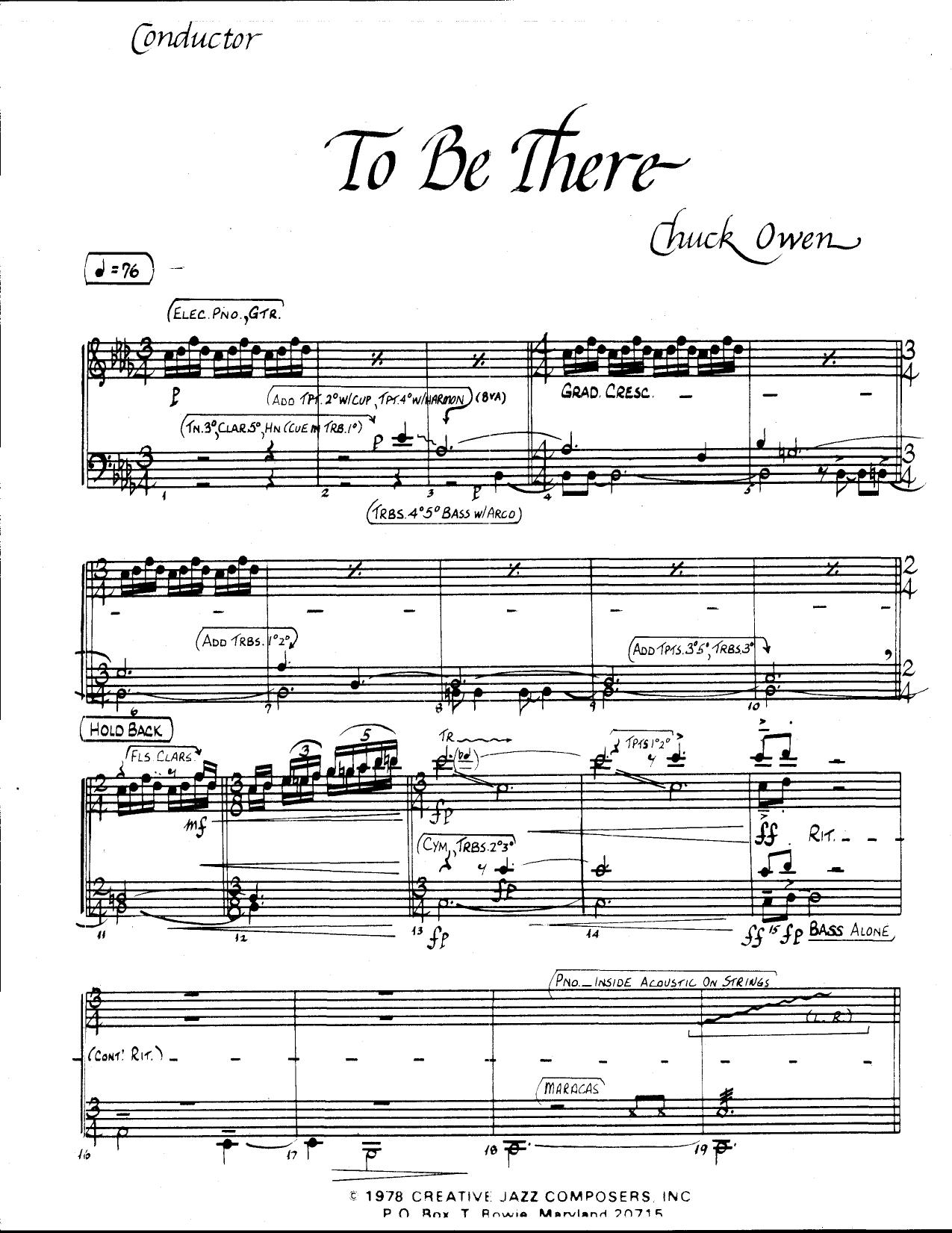
To Be There (C.Owen) sheet music preview

To Be There (C.Owen)

Composed by C. Owen

Arranged by C.Owen

  • Ensemble: Big Band
  • Style: Jazz Standard
  • Pages: 66
  • Instruments (21): Reed 1 (Flute), Reed 2 (Flute), Reed 3 (Tenor Sax, Clarinet), Reed 4 (Clarinet, Tenor Sax), Reed 5 (Clarinet, Bari Sax), Trumpet 1, Trumpet 2, Trumpet 3, Trumpet 4, Trumpet 5 (Flugelhorn), Horn, Trombone 1, Trombone 2, Trombone 3, Trombone 4, Trombone 5, Bass, Drums, Percussion (Triangle, Maracas, Vibes, Wind Chimes, Orch. Bells, Bell Tree), Piano (Electric, Acoustic), Guitar
  • Difficulty: advanced
  • Content: Individual Parts
  • Format: PDF Download (Instant)
  • Price: $24.99

Capturing the sophisticated harmonic language and evocative melodic contour of modern acoustic jazz, "To Be There," composed and arranged by C. Owen, stands out as a compelling contribution to the contemporary big band repertoire. Rooted in the rich tradition of post-bop and modal jazz orchestration, the work reflects the introspective yet driving aesthetic popularized by late-twentieth-century jazz masters. Owen originally conceived the piece as a vehicle for harmonic exploration and dynamic contrast, translating the intimate dialogue of a small jazz combo into a sprawling, multi-layered canvas for a standard 18-piece big band. The resulting composition bridges the gap between classic swing-era sectional writing and modern harmonic complexity, making it an engaging study in ensemble cohesion and textural variety. Musically, the piece unfolds at a contemplative medium-up swing tempo (approx. quarter note = 168 BPM), anchored by a resilient walking bassline and an understated, conversational drum groove. Written in a shifting harmonic landscape that moves deftly between modal colorations and extended functional harmony, the mood fluctuates from hushed, nocturnal reflection to exhilarating, brass-heavy vitality. The opening statement introduces the core thematic material through a delicate woodwind-heavy texture—utilizing flute and clarinet doublings—before gradually expanding to incorporate muted trumpets and warm trombone pads. As the chart develops, it builds toward a ferocious, structurally unified shout chorus that showcases Owen’s penchant for dense, upper-structure triad voicings and intricate cross-rhythms between the reeds and brass. Owen’s arrangement distinguishes itself through meticulous voice-leading and a democratic distribution of melodic material across all sections. Rather than relying solely on traditional tutti block chords, the arranger employs transparent, contrapuntal textures where saxophones and brass interweave in counter-melody. A standout feature of the chart is a dynamic tenor saxophone soli that pays homage to the classic modal blowing vehicles of the 1960s, framed by subtle background figures in the trumpets. The technical demands require precision in articulation and breath control, particularly during the exposed, quiet dynamic passages in the first half of the chart. The rhythm section acts as the primary architectural engine, requiring a sophisticated drummer capable of shading the form without overplaying, and a bassist comfortable navigating modal vamps and chromatic passing tones. Advanced collegiate ensembles, top-tier high school jazz bands, and professional community big bands will find "To Be There" an exceptionally rewarding addition to their concert programs. The arrangement offers educational value in teaching modern swing phrasing, odd-interval intonation, and dynamic restraint, while providing seasoned performers ample room for expressive interpretation. With its sophisticated balance of lush harmonic beauty and high-energy release, this chart leaves a lasting impression on audiences and challenges players to elevate their collective musicianship. Conductors should approach "To Be There" with a primary focus on dynamic control and transparent balance, particularly during the delicate woodwind-heavy exposition. The medium-up swing feel must remain relaxed yet forward-moving; avoid rushing the tempo during unconducted rhythm section transitions. Articulation is paramount: ensure that eighth-note lines maintain a proper jazz articulation where offbeats are slightly accented and sustained, avoiding overly clipped staccatos unless specifically marked. Brass players should utilize cup and harmon mutes with stems out where indicated to achieve the intended warm, breathy timbre during the transitional background figures. During the tenor saxophone soli, the accompanying brass and reeds must drop significantly in volume, treating their background figures as whispering counter-melodies rather than static pad chords. Finally, rehearse the shout chorus slowly, locking in the syncopated cross-rhythms between the low brass and percussion before bringing the ensemble up to performance speed. Q: What specific instruments and parts are included in this 18-instrument big band arrangement? A: The instrumentation includes a full standard big band setup: 5 saxophones (with required doublings for flute and clarinet), 4 trumpets, 4 trombones, guitar, piano, bass, and drums, accompanied by a comprehensive conductor score spanning 132 total pages. Q: What is the official difficulty level of this arrangement? A: This arrangement is graded as advanced (Level 4/5), making it best suited for college jazz ensembles, advanced high school bands, and professional community big bands with strong section leaders and experienced soloists. Q: What musical style and historical era does "To Be There" represent? A: Composed in the style of a modern post-bop and modal jazz standard, the piece channels the sophisticated arranging aesthetics of the 1960s and 70s jazz tradition, blending linear counterpoint with contemporary extended harmonies. Q: What makes C.Owen’s arrangement unique compared to standard big band charts? A: The arrangement is distinguished by its unconventional use of woodwind doublings (flute and clarinet) in the sax section, transparent counterpoint instead of constant tutti block voicing, and a deeply integrated tenor saxophone soli. Q: What is the approximate performance duration and tempo of the piece? A: The piece performs at approximately 6 to 7 minutes in duration, set to a medium-up swing tempo of around 168 beats per minute.

Questions and answers

What is included in the To Be There (C.Owen) PDF?
The verified current file contains a conductor score and individual parts across 66 pages.
How many instruments or parts are listed for To Be There (C.Owen)?
The verified instrumentation list contains 21 entries for this Big Band arrangement.
Who is credited for To Be There (C.Owen)?
Composer: C. Owen. Arranger: C.Owen.
What difficulty is listed for To Be There (C.Owen)?
The verified difficulty level is advanced.
What style is listed for To Be There (C.Owen)?
The catalog lists the style as Jazz Standard.
Can I preview To Be There (C.Owen) before buying?
Yes. The product page provides a preview generated from the current PDF file.
How is To Be There (C.Owen) delivered?
After successful payment, the digital PDF is made available for download. The displayed price is $24.99.

Musicians Also Search For

To Be There C.Owen PDFTo Be There C.Owen sheet musicTo Be There arranged by C.OwenC.Owen big band chartsC.Owen jazz arrangements PDFTo Be There C. Owen sheet musicTo Be There C. Owen big band arrangementsC. Owen big band chartsTo Be There big band arrangementsTo Be There big band PDF downloadTo Be There jazz sheet musicbig band sheet music downloadTo Be There conductor score PDFTo Be There individual parts downloadTo Be There sheet music PDFTo Be There Jazz Standard chartsJazz Standard big band arrangementsbuy To Be There sheet musicdownload To Be There PDFTo Be There jazz chartsbest C.Owen big band arrangementsC. Owen arranged by C.OwenTo Be There printable sheet musicbig band repertoire PDF

All arrangements by C.Owen All C. Owen sheet music