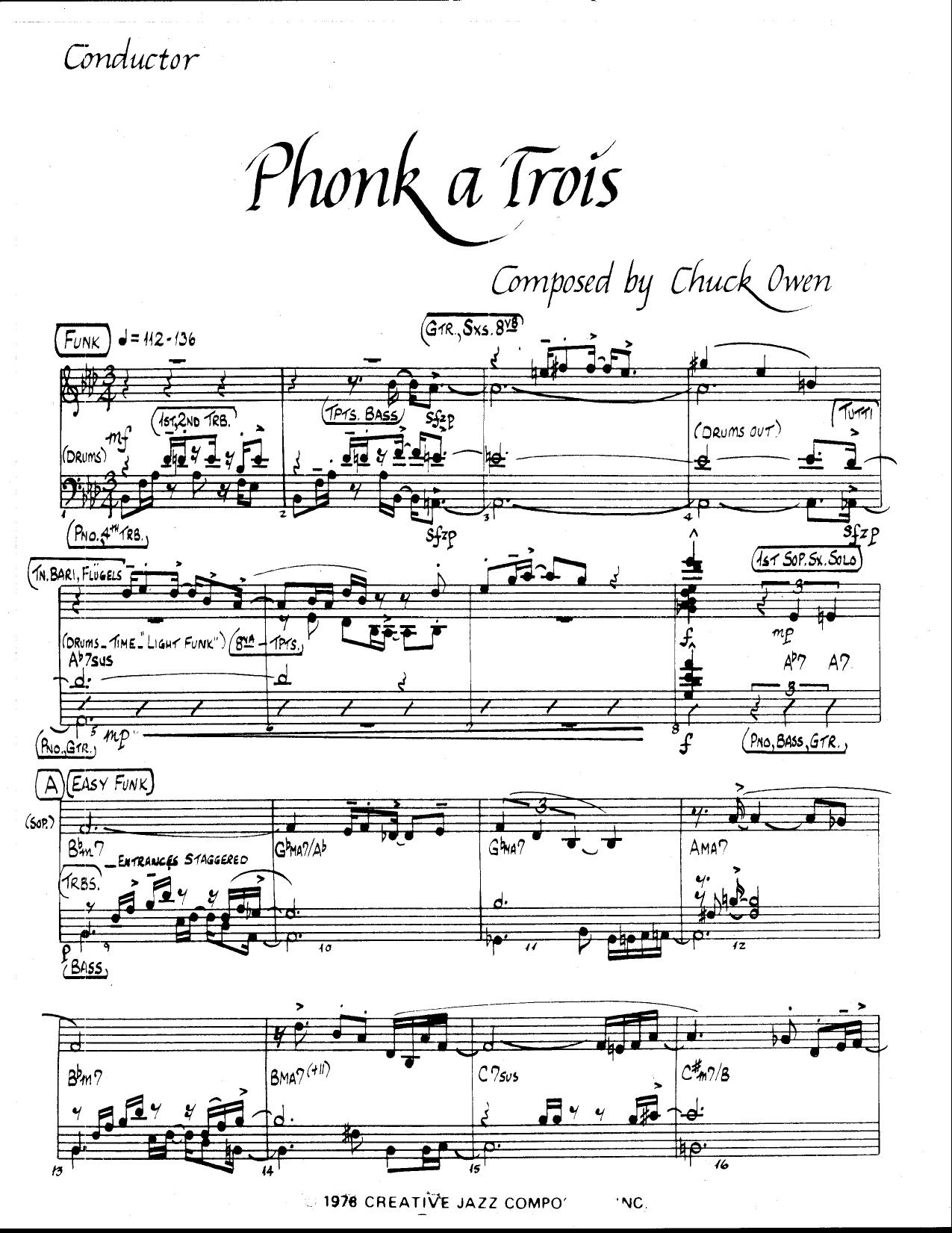
Phonk A Trois (C.Owen)
Composed by C. Owen
Arranged by C.Owen
- Ensemble: Big Band
- Style: Jazz Standard
- Pages: 80
- Instruments (20): Reed 1 (Soprano Sax), Reed 2 (Soprano Sax), Reed 3 (Flute, Tenor Sax), Reed 4 (Flute, Tenor Sax), Reed 5 (Flute, Bari Sax), Trumpet 1, Trumpet 2, Trumpet 3, Trumpet 4 (Flügelhorn), Trumpet 5 (Flügelhorn), Trombone 1, Trombone 2, Trombone 3, Trombone 4, Trombone 5 (Bass), Bass, Drums, Aux. Percussion, Piano (Electric), Guitar
- Difficulty: advanced
- Content: Individual Parts
- Format: PDF Download (Instant)
- Price: $24.99
Bridging the gap between contemporary beat-driven production and traditional acoustic jazz sensibilities, "Phonk A Trois" represents a fascinating modern evolution within the big band repertoire. Originally conceived by composer and arranger C.Owen, this composition translates the gritty, hypnotic basslines and atmospheric textures of modern phonk music into the sophisticated acoustic palette of a 19-piece jazz orchestra. While drawing heavily on the driving momentum of urban groove culture, the piece firmly anchors itself in the rich harmonic vocabulary of modern post-bop and contemporary large ensemble writing, creating a compelling hybrid style that resonates with younger audiences while challenging seasoned big band veterans. Driving forward with an infectious, head-nodding half-time hip-hop groove infused with relentless swing eighth-note subdivisions, the piece establishes a dark, brooding, yet high-energy atmosphere from the downbeat. The modal harmonic framework utilizes suspended voicings and chromatic cluster chords to evoke a sense of urban tension, which periodically resolves into expansive, cinematic brass swells. C.Owen’s distinctive arrangement style shines through the meticulous voice-leading and unconventional instrumentation choices—notably utilizing dual soprano saxophones and flute alongside traditional reeds to create an airy, piercing high-end timbre that cuts effortlessly through the thick, low-end brass pads and aggressive baritone saxophone ostinatos. The melodic narrative is primarily driven by the soprano and tenor saxophones, which weave intricate, modal lines over shifting rhythmic backdrops. An extended interactive soli section showcases the woodwinds in a tightly knit, cascading counterpoint before giving way to an open blowing section designed for flexible soloist placement. The climax of the chart is anchored by a ferocious, modern shout chorus that builds relentless rhythmic dissonance before resolving on an unexpected, shimmering extended chord. Technical challenges primarily lie in the precise execution of the tight rhythmic unisons between the rhythm section and horns, as well as navigating the contemporary modal harmonies at a brisk, unrelenting tempo. Advanced college ensembles, top-tier high school bands, and professional cutting-edge jazz orchestras will find "Phonka Trois" an exhilarating addition to their repertoire. The arrangement demands exceptional rhythmic precision, dynamic control, and an openness to contemporary stylistic idioms that depart safely from traditional swing-era orthodoxy. For ensembles looking to modernize their concert programming and engage audiences with a bold, contemporary crossover aesthetic, this chart delivers an unforgettable sonic punch. Conductors tackling "Phonk A Trois" must prioritize the subterranean groove between the drum set and acoustic bass, treating the rhythm section as the primary engine for the entire ensemble's dynamic contour. The tempo should remain locked and unyielding, capturing the mechanical precision of electronic beat production while retaining a human, swinging elasticity in the horns. Key technical hurdles include executing the interlocking sixteenth-note figures cleanly at speed; clean articulation and strict adherence to marked accents are mandatory. Brass players should utilize controlled, modern flutter-tonguing and subtle, dry falls rather than exaggerated big-band rips to preserve the stark, urban aesthetic of the genre. Rehearsal should begin by isolating the rhythm section to lock in the hypnotic underlying groove before layering in the low-register woodwinds and brass pads. Ensure the dynamic balance favors the inner-voice countermelodies during the central development section so that C.Owen's intricate harmonic movement does not get buried beneath the heavier brass scoring. Q: What instruments and specific parts are included in this big band arrangement? A: The 19-instrument orchestration includes Soprano Saxophone 1, Soprano Saxophone 2, Flute, Tenor Saxophone, Baritone Saxophone, a full standard brass section, and a comprehensive rhythm section, complete with a 160-page score. Q: What is the overall difficulty level of "Phonk A Trois"? A: This arrangement is graded as advanced (Level 4.5/5), best suited for collegiate, professional, or elite high school jazz orchestras possessing strong rhythmic precision and modern modal reading skills. Q: How does this piece fit into the jazz repertoire style-wise? A: Composed by C.Owen, it operates as a contemporary jazz standard hybrid that merges the dark, atmospheric grooves of modern phonk production with sophisticated post-bop big band orchestration. Q: What makes this specific arrangement by C.Owen unique? A: Its distinctive character stems from unconventional reed doublings—featuring dual soprano saxophones and flute—coupled with heavy, hypnotic ostinatos that translate electronic beat culture into an acoustic jazz ensemble setting. Q: What is the performance duration and general tempo feel of the piece? A: The arrangement runs approximately 5 to 6 minutes and is anchored by a driving, mid-tempo half-time hip-hop groove blended with relentless swing subdivisions.
Questions and answers
- What is included in the Phonk A Trois (C.Owen) PDF?
- The verified current file contains a conductor score and individual parts across 80 pages.
- How many instruments or parts are listed for Phonk A Trois (C.Owen)?
- The verified instrumentation list contains 20 entries for this Big Band arrangement.
- Who is credited for Phonk A Trois (C.Owen)?
- Composer: C. Owen. Arranger: C.Owen.
- What difficulty is listed for Phonk A Trois (C.Owen)?
- The verified difficulty level is advanced.
- What style is listed for Phonk A Trois (C.Owen)?
- The catalog lists the style as Jazz Standard.
- Can I preview Phonk A Trois (C.Owen) before buying?
- Yes. The product page provides a preview generated from the current PDF file.
- How is Phonk A Trois (C.Owen) delivered?
- After successful payment, the digital PDF is made available for download. The displayed price is $24.99.
Musicians Also Search For
Phonk A Trois C.Owen PDF • Phonk A Trois C.Owen sheet music • Phonk A Trois arranged by C.Owen • C.Owen big band charts • C.Owen jazz arrangements PDF • Phonk A Trois C. Owen sheet music • Phonk A Trois C. Owen big band arrangements • C. Owen big band charts • Phonk A Trois big band arrangements • Phonk A Trois big band PDF download • Phonk A Trois jazz sheet music • big band sheet music download • Phonk A Trois conductor score PDF • Phonk A Trois individual parts download • Phonk A Trois sheet music PDF • Phonk A Trois Jazz Standard charts • Jazz Standard big band arrangements • buy Phonk A Trois sheet music • download Phonk A Trois PDF • Phonk A Trois jazz charts • best C.Owen big band arrangements • C. Owen arranged by C.Owen • Phonk A Trois printable sheet music • big band repertoire PDF