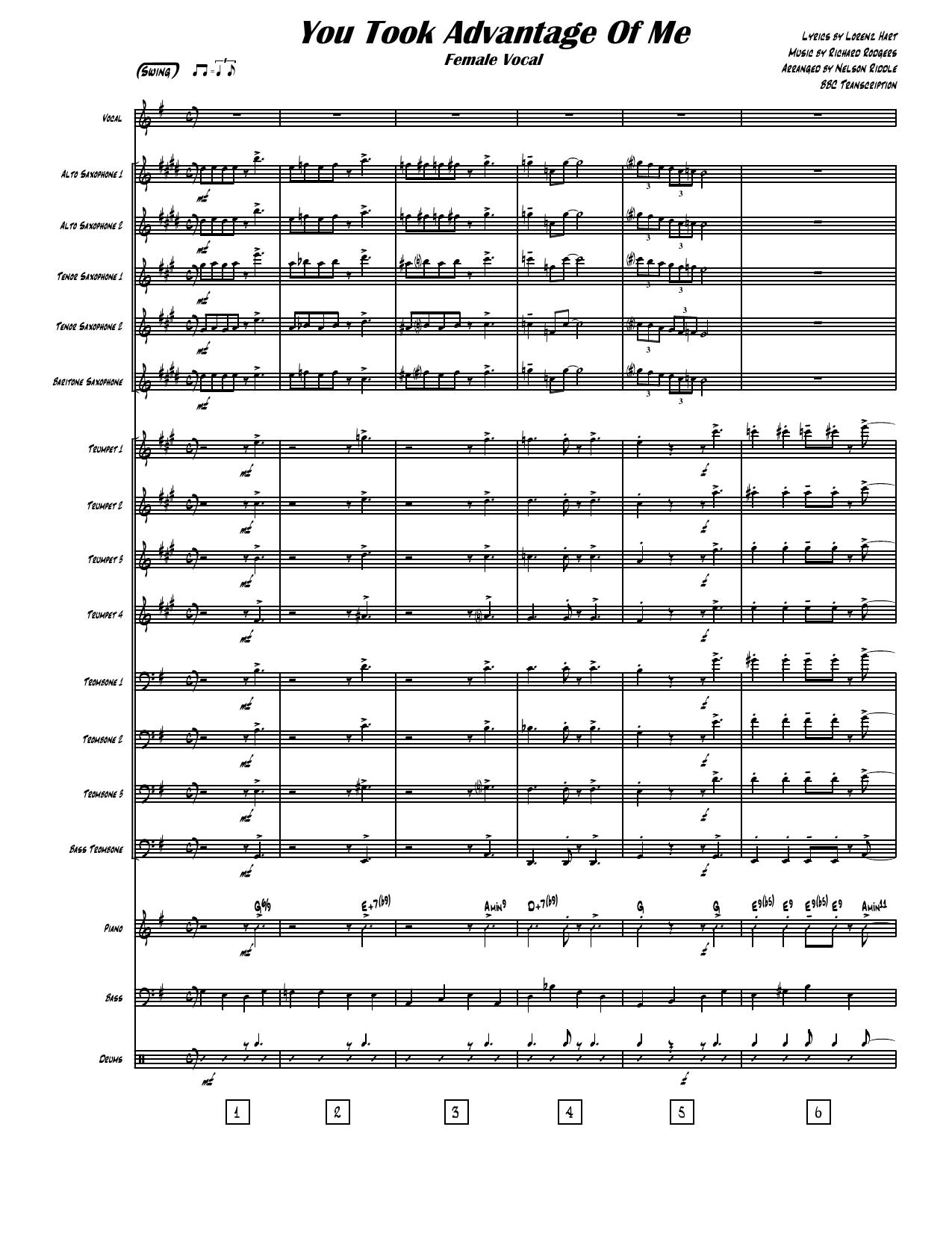
You Took Advantage Of Me (J.Farley) N.Riddle-L.Ronstadt voc
Composed by Richard Rodgers
Arranged by John Farley
- Ensemble: Big Band
- Pages: 40
- Instruments (17): Vocal, Alto Saxophone 1, Alto Saxophone 2, Tenor Saxophone 1, Tenor Saxophone 2, Baritone Saxophone, Trumpet 1, Trumpet 2, Trumpet 3, Trumpet 4, Trombone 1, Trombone 2, Trombone 3, Bass Trombone, Piano, Bass, Drums
- Difficulty: medium
- Content: Individual Parts
- Format: PDF Download (Instant)
- Price: $24.99
Richard Rodgers and Lorenz Hart’s timeless 1928 show tune "You Took Advantage of Me" achieved a legendary second life as a vocal showcase through the sophisticated arranging lens of Nelson Riddle, most notably associated with the iconic interpretations of Linda Ronstadt. This classic Great American Songbook standard captures the quintessential blend of witty, bittersweet lyricism and effervescent 1920s melody, transformed here through the lush, cinematic orchestrations characteristic of the mid-century pop-jazz crossover movement. The composition embodies the sophisticated harmonic language of Broadway combined with the swinging vitality of traditional big band jazz, making it a brilliant vehicle for a charismatic front-person backed by a punchy horn section. John Farley’s masterfully crafted arrangement for 10 instruments adapts the sprawling, string-laden Riddle-Ronstadt aesthetic into a tight, highly effective chamber big band format across its 40 comprehensive pages. Set in a bright, infectious medium-swing feel (4/4 time), the chart opens with a sparkling, playful intro that immediately establishes a buoyant, theatrical mood. Farley utilizes crisp brass stabs and fluid saxophone counterlines to frame the vocal line, maintaining a vibrant energy that swings effortlessly without ever overpowering the singer. The arrangement features rich, extended Riddle-esque chord voicings—frequent use of major sevenths, ninths, and clever chromatic passing tones—that give the harmony a lush, sophisticated sheen while keeping the foundational jazz groove locked in tightly by the rhythm section. Throughout the chart, the instrumental ensemble acts as a responsive conversational partner to the vocal soloist. The saxophone section (alto, tenor, baritone) weaves seamless harmonic tapestries beneath the vocal lines, punctuated by brass interjections that add dramatic flair and rhythmic drive. A standout feature of Farley’s treatment is a cleverly constructed, concise instrumental bridge that showcases the horn section in a tight, swinging soli before seamlessly handing the reins back to the vocalist for a high-energy final chorus. The technical demands are moderate to advanced, requiring crisp articulation, precise dynamic control, and a strong sense of swing phrasing, particularly in navigating the chromatic ensemble unisons and stylistic nuances embedded in the writing. Advanced high school ensembles, collegiate jazz combos, community big bands, and professional groups will find this arrangement an exceptional crowd-pleaser and a sophisticated stylistic exercise. It provides an ideal centerpiece for a concert program featuring a guest vocalist, offering enough harmonic and rhythmic depth to engage seasoned players while remaining entirely accessible under the baton of an experienced director. Farley’s expert scoring ensures that even with a streamlined 10-piece instrumentation, the chart punches well above its weight, delivering the rich, sweeping acoustic impact of a full 17-piece jazz orchestra. Success with this arrangement hinges on achieving a buoyant, vocal-driven medium-swing tempo that never feels rushed. The conductor should ensure the rhythm section establishes a light, conversational groove reminiscent of classic Capitol Records studio sessions, keeping the hi-hat crisp on beats two and four. Horn players must pay close attention to dynamic markings: brass figures behind the vocal should use breathy, warm tones rather than harsh, biting attacks to avoid masking the soloist. Articulation is paramount—unison lines between the saxophones and trumpet require careful sectional listening to match the exact length of staccato notes and the smooth execution of jazz slurs. Pay special attention to the dynamic swells leading into ensemble hits, ensuring they blossom naturally without forcing the tone. Rehearsal should begin with the rhythm section and vocalist locked in, followed by layering the horn sections to balance the intricate countermelodies against the central vocal line. Q: What instruments and parts are included in this arrangement? A: The chart is scored for a 10-instrument ensemble featuring a vocal soloist, alto saxophone, tenor saxophone, baritone saxophone, trumpet, and a complete rhythm section, spanning 40 pages of detailed sheet music. Q: What is the difficulty level of this chart? A: This arrangement is graded as medium-advanced, making it well-suited for collegiate musicians, advanced high school bands, and professional ensembles capable of tight stylistic phrasing and dynamic balance. Q: What is the historical style and context of this piece? A: Based on the Rodgers and Hart standard popularized by the Nelson Riddle and Linda Ronstadt vocal tradition, this arrangement captures a sophisticated mid-century pop-jazz style framed within a swinging big band aesthetic. Q: What makes John Farley's arrangement unique? A: Farley brilliantly condenses the lush, string-heavy textures of classic Riddle orchestrations into a tight 10-piece format, utilizing clever chromatic voicings, a tight horn soli, and sparkling counterlines that support the vocalist without cluttering the texture. Q: What is the performance duration and tempo feel? A: The piece is performed at a bright, infectious medium-swing tempo (approx. 120-126 BPM) with a duration of approximately 3 to 4 minutes, depending on the vocalist's stylistic phrasing.
Questions and answers
- What is included in the You Took Advantage Of Me (J.Farley) N.Riddle-L.Ronstadt voc PDF?
- The verified current file contains a conductor score and individual parts across 40 pages.
- How many instruments or parts are listed for You Took Advantage Of Me (J.Farley) N.Riddle-L.Ronstadt voc?
- The verified instrumentation list contains 17 entries for this Big Band arrangement.
- Who is credited for You Took Advantage Of Me (J.Farley) N.Riddle-L.Ronstadt voc?
- Composer: Richard Rodgers. Arranger: John Farley.
- What difficulty is listed for You Took Advantage Of Me (J.Farley) N.Riddle-L.Ronstadt voc?
- The verified difficulty level is medium.
- Can I preview You Took Advantage Of Me (J.Farley) N.Riddle-L.Ronstadt voc before buying?
- Yes. The product page provides a preview generated from the current PDF file.
- How is You Took Advantage Of Me (J.Farley) N.Riddle-L.Ronstadt voc delivered?
- After successful payment, the digital PDF is made available for download. The displayed price is $24.99.
Musicians Also Search For
You Took Advantage Of Me John Farley PDF • You Took Advantage Of Me John Farley sheet music • You Took Advantage Of Me arranged by John Farley • John Farley big band charts • John Farley jazz arrangements PDF • You Took Advantage Of Me Richard Rodgers sheet music • You Took Advantage Of Me Richard Rodgers big band arrangements • Richard Rodgers big band charts • You Took Advantage Of Me big band arrangements • You Took Advantage Of Me big band PDF download • You Took Advantage Of Me jazz sheet music • big band sheet music download • You Took Advantage Of Me conductor score PDF • You Took Advantage Of Me individual parts download • You Took Advantage Of Me sheet music PDF • buy You Took Advantage Of Me sheet music • download You Took Advantage Of Me PDF • You Took Advantage Of Me jazz charts • best John Farley big band arrangements • Richard Rodgers arranged by John Farley • You Took Advantage Of Me printable sheet music • big band repertoire PDF