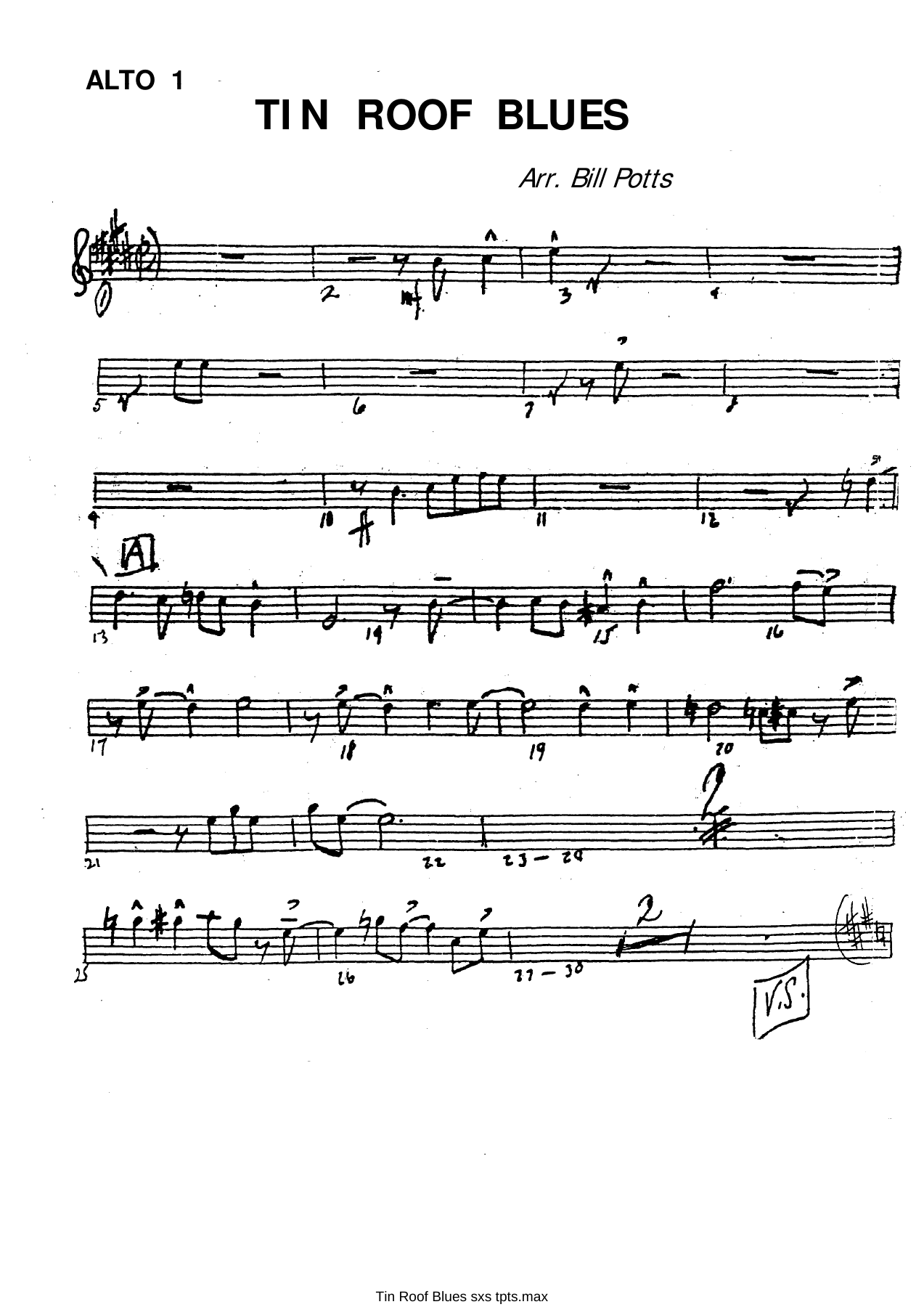
Tin Roof Blues (B.Potts)
Composed by New Orleans Rhythm Kings
Arranged by Bill Potts
- Ensemble: Big Band
- Style: Jazz Standard
- Pages: 48
- Instruments (16): Alto 1, Alto 2, Tenor 1, Tenor 2, Baritone, Trumpet 1, Trumpet 2, Trumpet 3, Trumpet 4, 'Bone 1, 'Bone 2, 'Bone 3, 'Bone 4, Piano/Guitar, Bass, Drums
- Difficulty: medium
- Content: Individual Parts
- Format: PDF Download (Instant)
- Price: $24.99
"Tin Roof Blues," a cornerstone of early jazz, was originally composed and recorded by the New Orleans Rhythm Kings in 1923, emerging from the vibrant crucible of New Orleans jazz. This instrumental piece quickly became a quintessential example of Dixieland and early Chicago jazz, characterized by its collective improvisation, polyphonic textures, and a driving, often two-beat feel. Its enduring appeal lies in its infectious melody and the historical significance it holds as one of the most frequently recorded and performed tunes from the genre's formative years, making it a true jazz standard that bridges the gap between traditional and swing eras. Bill Potts' masterful big band arrangement of "Tin Roof Blues" transforms this classic into a dynamic, medium-swing chart, retaining the original's infectious spirit while infusing it with sophisticated big band voicings and contemporary energy. Set in the key of F Major, the arrangement immediately establishes a buoyant, celebratory mood. Potts, known for his inventive harmonic language and his ability to reimagine traditional material, employs rich, often dense voicings in the brass and saxophone sections, creating a full and resonant sound. The arrangement features compelling soli sections for the saxophones, showcasing intricate counterpoint and tight ensemble work, alongside powerful brass figures that punctuate the melodic lines. The arrangement opens with the iconic melody carried initially by the brass, then transitioning to a full ensemble statement, establishing its undeniable presence. Potts skillfully weaves in featured solo opportunities, typically for trumpet and tenor saxophone, allowing for individual expression within the structured big band framework. These solos are often supported by carefully crafted ensemble backgrounds that provide harmonic interest without overwhelming the soloist. Technical challenges include precise articulation in the brass, maintaining a consistent medium-swing feel throughout, and navigating the sometimes complex rhythmic interplay within the soli sections. The reward for performers lies in experiencing the evolution of a classic tune, delivered with the power and precision only a big band can achieve, culminating in a driving shout chorus that builds to an exhilarating finish. This arrangement is ideally suited for college and advanced high school jazz ensembles, as well as community and professional big bands seeking a challenging yet accessible chart with historical depth. Its blend of traditional melody with sophisticated big band writing offers an excellent educational opportunity for exploring jazz history and ensemble dynamics. The chart's inherent musicality and the arranger's thoughtful treatment make it a rewarding piece to rehearse and perform, offering both historical homage and contemporary big band excitement. Conductors should emphasize a consistent, relaxed medium-swing feel from the outset, ensuring the rhythm section lays down a solid groove without rushing. Articulation is paramount, particularly in the brass sections, where precise short notes and controlled releases are essential for clarity and punch. Pay close attention to dynamics, as Bill Potts utilizes a wide range to build tension and release, especially leading into and out of the shout choruses. Rehearsal time should be dedicated to the saxophone soli passages, focusing on blend, balance, and rhythmic accuracy to achieve the intended intricate counterpoint. Trumpet players should be prepared for some sustained upper-register playing, requiring good embouchure strength. While no special techniques like plunger mutes are explicitly notated, encouraging stylistic embellishments such as subtle falls and scoops, particularly in the brass, will enhance the authentic jazz character. The overall goal is to maintain the infectious, celebratory spirit of the original while executing the big band arrangement with precision and energy. Q: What instruments and parts are included in this arrangement? A: This arrangement is scored for a standard 16-instrument big band, including Alto Saxophone 1, Alto Saxophone 2, Tenor Saxophone 1, Tenor Saxophone 2, Baritone Saxophone, Trumpet 1, Trumpet 2, Trumpet 3, Trumpet 4, Trombone 1, Trombone 2, Trombone 3, Bass Trombone, Piano, Bass, and Drums. The full score comprises 48 pages. Q: What is the difficulty level of this arrangement? A: This arrangement is rated as medium-advanced. It presents challenges in ensemble precision, dynamic control, and rhythmic accuracy, making it suitable for college, advanced high school, and community or professional big bands. Q: What is the musical style and historical context of "Tin Roof Blues"? A: "Tin Roof Blues" is an iconic jazz standard originating from the Dixieland and early Chicago jazz eras, first recorded by the New Orleans Rhythm Kings in 1923. This Bill Potts arrangement reimagines the classic in a medium-swing big band style, blending traditional melody with sophisticated big band harmonies. Q: What makes Bill Potts' arrangement of "Tin Roof Blues" unique? A: Bill Potts' approach is distinctive for its rich, often dense voicings, inventive harmonic language, and dynamic big band scoring that transforms the traditional tune into a powerful medium-swing chart. It features compelling saxophone soli sections and a driving shout chorus, showcasing Potts' signature techniques. Q: What is the typical performance duration and tempo for this piece? A: The typical performance duration for this arrangement is approximately 3-4 minutes, depending on the length of improvised solos. It is intended to be performed at a medium-swing tempo, maintaining a buoyant and consistent rhythmic feel throughout.
Questions and answers
- What is included in the Tin Roof Blues (B.Potts) PDF?
- The verified current file contains individual parts across 48 pages.
- How many instruments or parts are listed for Tin Roof Blues (B.Potts)?
- The verified instrumentation list contains 16 entries for this Big Band arrangement.
- Who is credited for Tin Roof Blues (B.Potts)?
- Composer: New Orleans Rhythm Kings. Arranger: Bill Potts.
- What difficulty is listed for Tin Roof Blues (B.Potts)?
- The verified difficulty level is medium.
- What style is listed for Tin Roof Blues (B.Potts)?
- The catalog lists the style as Jazz Standard.
- Can I preview Tin Roof Blues (B.Potts) before buying?
- Yes. The product page provides a preview generated from the current PDF file.
- How is Tin Roof Blues (B.Potts) delivered?
- After successful payment, the digital PDF is made available for download. The displayed price is $24.99.
Musicians Also Search For
Tin Roof Blues Bill Potts PDF • Tin Roof Blues Bill Potts sheet music • Tin Roof Blues arranged by Bill Potts • Bill Potts big band charts • Bill Potts jazz arrangements PDF • Tin Roof Blues New Orleans Rhythm Kings sheet music • Tin Roof Blues New Orleans Rhythm Kings big band arrangements • New Orleans Rhythm Kings big band charts • Tin Roof Blues big band arrangements • Tin Roof Blues big band PDF download • Tin Roof Blues jazz sheet music • big band sheet music download • Tin Roof Blues individual parts download • Tin Roof Blues sheet music PDF • Tin Roof Blues Jazz Standard charts • Jazz Standard big band arrangements • buy Tin Roof Blues sheet music • download Tin Roof Blues PDF • Tin Roof Blues jazz charts • best Bill Potts big band arrangements • New Orleans Rhythm Kings arranged by Bill Potts • Tin Roof Blues printable sheet music • big band repertoire PDF