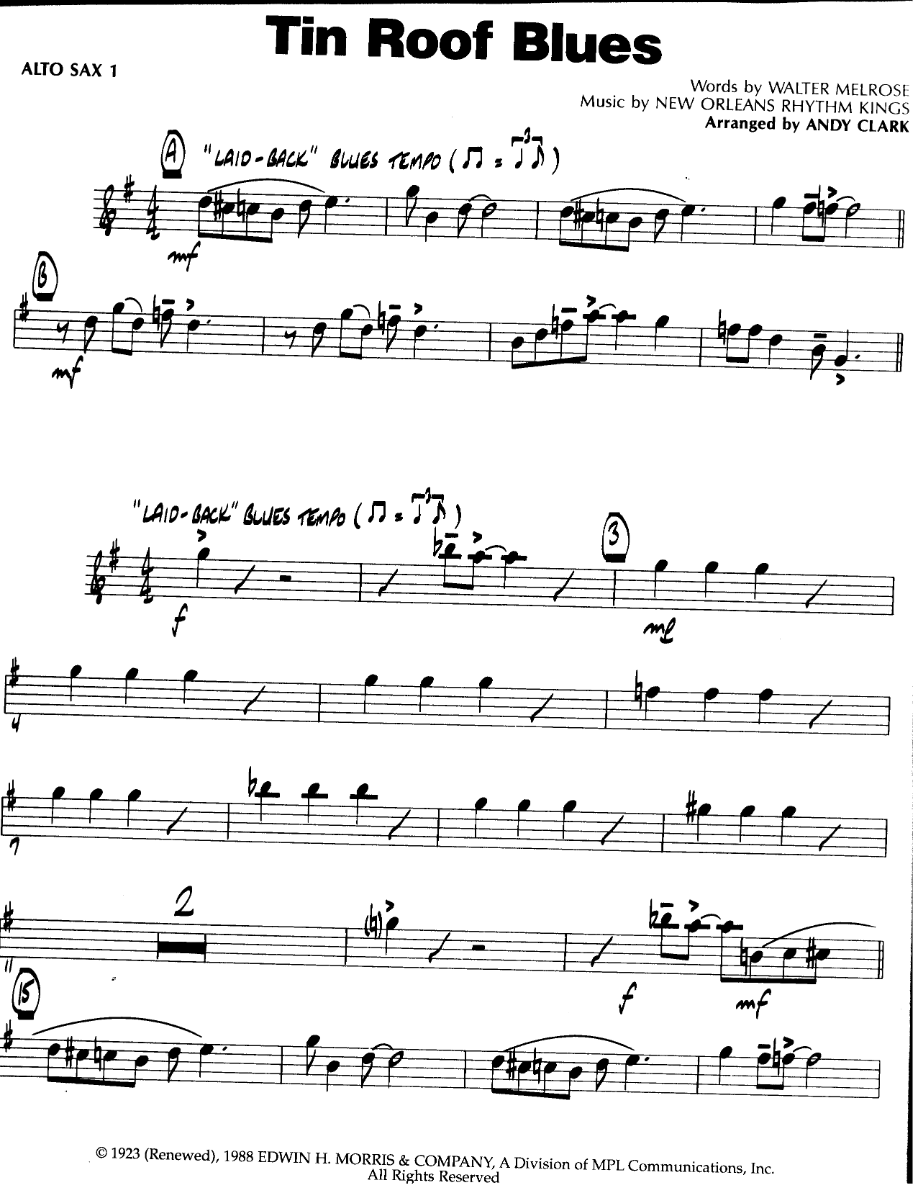
Tin Roof Blues (A.Clark) sheet music preview

Tin Roof Blues (A.Clark)

Composed by New Orleans Rhythm Kings

Arranged by A.Clark

  • Ensemble: Big Band
  • Style: Jazz Standard
  • Pages: 31
  • Instruments (17): Alto Saxophone 1, Alto Saxophone 2, Tenor Saxophone 1, Tenor Saxophone 2, Baritone Saxophone, Trumpet 1, Trumpet 2, Trumpet 3, Trumpet 4, Trombone 1, Trombone 2, Trombone 3, Bass Trombone, Guitar, Piano, Bass, Drums
  • Difficulty: easy
  • Content: Individual Parts
  • Format: PDF Download (Instant)
  • Price: $24.99

"Tin Roof Blues," originally composed by the New Orleans Rhythm Kings in 1923, stands as a foundational pillar of early jazz, epitomizing the vibrant, collective improvisation and melodic charm of the Dixieland era. Emerging from the crucible of New Orleans' burgeoning jazz scene, this piece quickly became a staple, defining the sound of the 1920s and influencing countless musicians who followed. Its enduring appeal lies in its deceptively simple, yet highly memorable melodic lines and its inherent call-and-response structure, which has made it a favorite for both performers and audiences for a century. The original recordings, characterized by their polyphonic texture and driving two-beat feel, capture a pivotal moment in jazz history when the music was transitioning from ragtime and brass band traditions into the more formalized ensemble structures that would eventually lead to the big band era. A.Clark's big band arrangement masterfully bridges this historical gap, reinterpreting the classic Dixieland standard through the lens of a modern 17-piece ensemble. While retaining the infectious, medium-swing feel and the bluesy essence of the original, Clark introduces sophisticated big band voicings and dynamic contrasts that elevate the piece without sacrificing its authentic spirit. The arrangement is set in the key of F Major, providing a bright, accessible harmonic landscape that allows the blues inflections to shine. Clark's signature approach often involves intricate counterpoint within sections, particularly in the saxophone soli passages, and a powerful, yet nuanced, brass treatment that builds energy organically. The mood is one of joyful exuberance tempered with a touch of nostalgic reflection, making it a highly engaging performance experience. The arrangement opens with a classic big band ensemble statement of the main theme, establishing the familiar melody with rich, full voicings. The melody is then passed between sections, featuring a beautifully voiced saxophone soli that captures the collective improvisation feel of the original, followed by a robust brass chorus. Featured solo opportunities are strategically placed for Trumpet 1 and Tenor Saxophone 1, allowing for creative improvisation over the standard blues form. A.Clark's arrangement is distinguished by its clever use of dynamic swells and a powerful shout chorus that builds to a thrilling climax, showcasing the full power of the big band. Technical challenges include precise articulation in the fast-moving soli sections, maintaining a consistent swing feel, and achieving balanced ensemble blend, particularly in the layered brass and sax voicings. This arrangement is ideally suited for college-level jazz ensembles, advanced high school bands, and community big bands seeking to explore the historical roots of jazz within a contemporary big band framework. Its blend of historical reverence and modern arranging techniques offers a rewarding challenge, enhancing musicians' understanding of jazz evolution while providing a highly entertaining and accessible piece for audiences. The detailed scoring ensures that every section has engaging parts, making it a fulfilling experience for all instrumentalists and a standout addition to any concert program. Conductors should emphasize a relaxed, medium-swing feel throughout, ensuring the rhythm section lays down a solid, consistent groove. The tempo marking should be adhered to, avoiding any tendency to rush, particularly in the saxophone soli sections where clean articulation is paramount. Brass players should focus on precise attacks and releases, using short, crisp articulations for rhythmic clarity, especially in the shout chorus. Mutes are not explicitly called for, allowing for the natural brass timbre to dominate. Pay close attention to dynamic contrasts; Clark's arrangement thrives on the interplay between softer, lyrical passages and powerful, full-ensemble statements. Rehearsal time should be dedicated to balancing the layered voicings, ensuring that inner parts speak clearly without overpowering the melodic lines. Encourage soloists to embrace the blues aesthetic, utilizing bent notes and expressive phrasing to capture the spirit of the original. Q: What instruments and parts are included in this arrangement? A: This arrangement is scored for a standard 17-piece big band, including Alto Saxophone 1, Alto Saxophone 2, Tenor Saxophone 1, Tenor Saxophone 2, Baritone Saxophone, Trumpet 1, Trumpet 2, Trumpet 3, Trumpet 4, Trombone 1, Trombone 2, Trombone 3, Trombone 4, Piano, Bass, Drums, and Guitar. Q: What is the difficulty level of A.Clark's "Tin Roof Blues" arrangement? A: This arrangement is rated as medium-advanced, making it suitable for college-level jazz ensembles, advanced high school bands, and experienced community big bands. It presents challenges in articulation, ensemble blend, and dynamic control. Q: What is the musical style and historical context of "Tin Roof Blues"? A: "Tin Roof Blues" is a classic jazz standard from the Dixieland era, originally composed by the New Orleans Rhythm Kings in 1923. A.Clark's arrangement reinterprets this early jazz piece for a modern big band, retaining its bluesy, medium-swing feel. Q: What makes A.Clark's arrangement of "Tin Roof Blues" unique? A: A.Clark's arrangement uniquely blends the historical charm of the Dixieland original with sophisticated big band voicings, dynamic contrasts, and modern harmonic treatments. It features intricate saxophone soli sections and powerful brass writing, offering a fresh perspective on a classic. Q: What is the approximate performance duration and tempo of this arrangement? A: The approximate performance duration is 3-4 minutes, depending on the length of improvised solos. The arrangement is intended to be performed at a medium-swing tempo, typically around 120-130 beats per minute.

Musicians Also Search For

Tin Roof Blues A.Clark PDFTin Roof Blues A.Clark sheet musicTin Roof Blues arranged by A.ClarkA.Clark big band chartsA.Clark jazz arrangements PDFTin Roof Blues New Orleans Rhythm Kings sheet musicTin Roof Blues New Orleans Rhythm Kings big band arrangementNew Orleans Rhythm Kings big band chartsTin Roof Blues big band arrangementTin Roof Blues big band PDF downloadTin Roof Blues jazz ensemble sheet musicbig band sheet music instant downloadTin Roof Blues individual parts downloadTin Roof Blues sheet music with partsTin Roof Blues Jazz Standard chartJazz Standard big band arrangementsbuy Tin Roof Blues sheet music onlinedownload Tin Roof Blues PDFTin Roof Blues jazz chartbest A.Clark big band arrangementsNew Orleans Rhythm Kings songs arranged by A.ClarkTin Roof Blues printable sheet musicbig band repertoire PDF

All arrangements by A.Clark All New Orleans Rhythm Kings sheet music