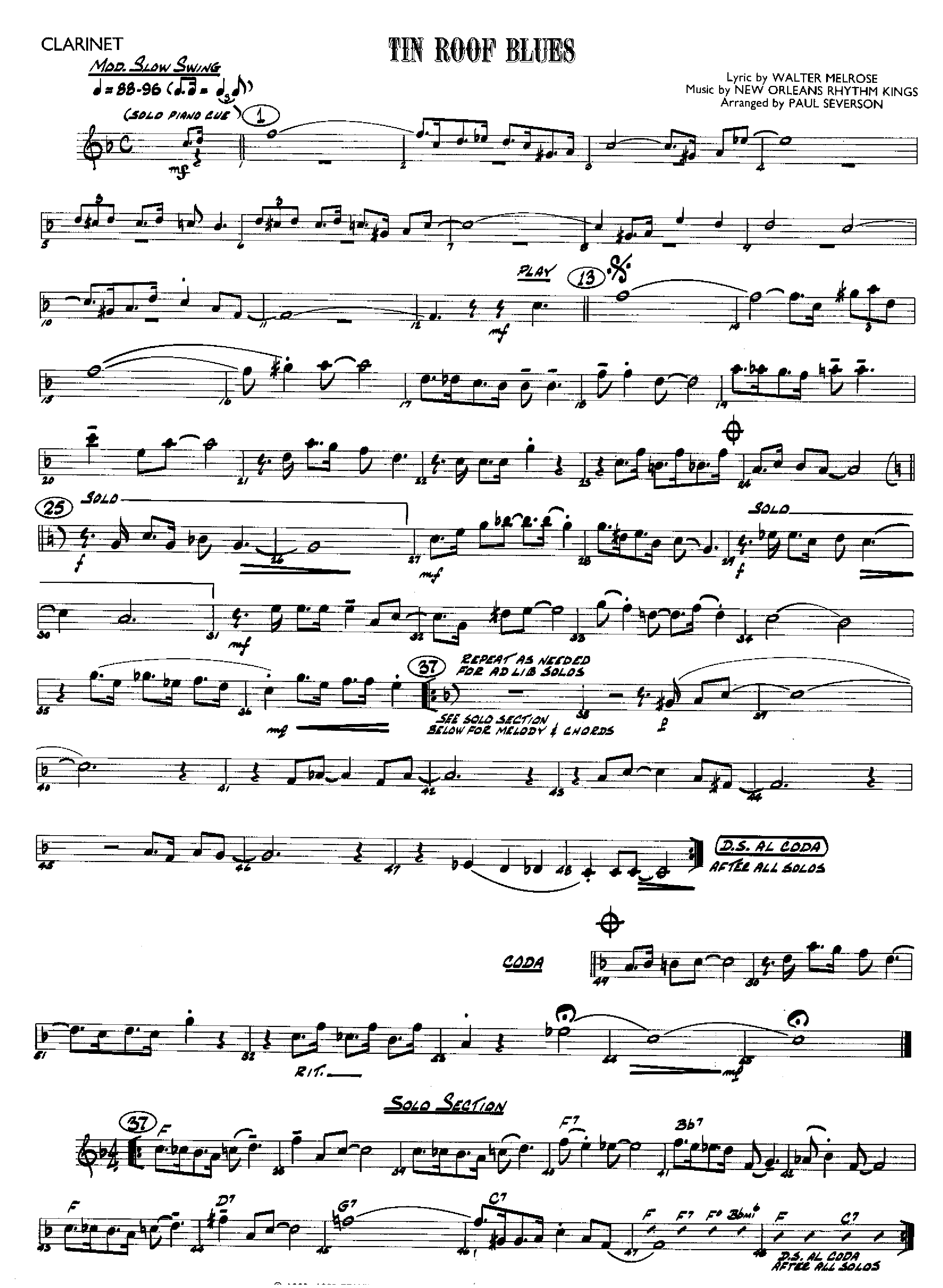
Tin Roof Blues (Severson)
Composed by New Orleans Rhythm Kings
Arranged by Severson
- Ensemble: Dixieland Band
- Style: Blues
- Pages: 10
- Instruments (8): Clarinet, Tenor Sax, Trumpet, Trombone, Bass/Tuba, Drums, Guitar/Banjo, Piano/Conductor
- Difficulty: easy
- Content: Individual Parts
- Format: PDF Download (Instant)
- Price: $18.99
Composed in 1923 by members of the legendary New Orleans Rhythm Kings—with core contributions credited to clarinetist Leon Roppolo, trumpeter Paul Mares, and pianist Mel Stitzel—"Tin Roof Blues" stands as one of the foundational pillars of early jazz and Dixieland repertoire. Recorded during the historic Gennett sessions in Richmond, Indiana, the tune quickly transitioned from a regional Chicago-style novelty into a ubiquitous international jazz standard, famously interpreted by everyone from King Oliver and Bix Beiderbecke to Louis Armstrong and countless traditional revival bands. The composition encapsulates the transition from collective polyphonic folk-jazz into structured ensemble arrangements, utilizing a classic multi-strain blues form that balances melancholy, soulful introspection with driving, freewheeling ensemble counterpoint. Severson’s classic Dixieland band treatment captures the raw, energetic spirit of the 1920s Chicago and New Orleans scenes while providing a meticulously edited, professional-grade 31-page score and parts set. Driven by an infectious, buoyant traditional two-beat or 4/4 upbeat swing feel, the arrangement opens with the iconic melancholic melody stated cleanly before dissolving into shimmering polyphonic collective improvisation. The emotional landscape shifts seamlessly from weeping, blues-drenched solo passages to roaring, high-energy ensemble polyphony. Severson masterfully balances the traditional responsibilities of the front line—trumpet, clarinet, and trombone—ensuring each voice enjoys distinct countermelodic independence without muddying the harmonic texture, all anchored by a robust rhythm section blueprint. Frontline players will find ample opportunity to showcase their stylistic fluency, particularly during structured solo rotations where the trumpet and clarinet weave intricate, interdependent lines over a steady, driving rhythm section. The technical challenges lie primarily in stylistic authenticity: achieving the right articulation, executing stylistic bends, and maintaining a lightweight, agile tone quality rather than relying on sheer physical endurance. The rhythm section is tasked with laying down an authentic, propulsive groove that avoids modern over-accompaniment, allowing the historic character of the blues form to shine. Standout moments include the dramatic strain transitions and the final ensemble chorus, where the tension built through collective counterpoint resolves into a triumphant, barn-burning coda. Advanced high school, collegiate, and professional traditional jazz ensembles will find this 31-page arrangement exceptionally rewarding. It offers students an authentic masterclass in early jazz grammar, ear training, and stylistic interplay, while giving professional bands a surefire crowd-pleaser that honors the historical integrity of the genre. Severson’s expert layout ensures seamless page turns and clear cueing, making it an indispensable addition to the traditional jazz library. Conductors and ensemble directors approaching Severson’s arrangement of "Tin Roof Blues" should first establish an authentic, relaxed 4/4 groove or traditional two-beat feel, avoiding a heavy modern swing weight. The tempo should remain steady and conversational, allowing the polyphonic lines to breathe. Frontline instrumentalists must pay close attention to dynamic balance during collective improvisation sections; the clarinet should soar cleanly in the upper register while the trumpet carries the primary thematic weight and the trombone anchors the lower harmony with traditional tailgate glissandos. Technically, brass and reed players should incorporate period-appropriate stylistic devices, such as subtle lip-slurs, expressive vibrato, and controlled plunger or cup mutes where appropriate to mimic the vocalized textures of the early 1920s masters. Rehearsals should begin by working the ensemble sections *a cappella* or at a reduced tempo to ensure every player hears their specific countermelody within the collective texture before adding the rhythm section. Pianists and banjoists must keep comping sparse and rhythmically precise, avoiding dense, modern extended chords in favor of clean, rhythmically driving triads and seventh chords that define the classic Dixieland aesthetic. Q: What instruments and parts are included in this 31-page arrangement? A: The arrangement includes a comprehensive set of transposed parts and a full conductor's score tailored for a standard Dixieland front line of trumpet, clarinet, and trombone, alongside a complete rhythm section featuring piano, bass/tuba, and drums. Q: What is the difficulty level of this arrangement? A: This piece is graded as medium-advanced, making it ideal for skilled high school, collegiate, and professional traditional jazz bands that possess strong foundational skills in collective improvisation and stylistic phrasing. Q: What is the historical style and background of "Tin Roof Blues"? A: Originally recorded in 1923 by the New Orleans Rhythm Kings, the piece is a foundational Dixieland blues standard that bridges early New Orleans collective polyphony with the punchy Chicago style of the Roaring Twenties. Q: What makes Severson’s arrangement unique compared to other versions? A: Severson provides a meticulously balanced 31-page publication that maintains authentic polyphonic texture while ensuring modern performance clarity, giving each frontline instrument distinct, well-edited countermelodies and structured solo opportunities. Q: What is the typical performance duration and tempo feel for this piece? A: The arrangement typically runs around 3 to 4 minutes and is performed at a moderate, driving tempo with a buoyant two-beat or light 4/4 jazz feel that emphasizes groove and historical authenticity.
Questions and answers
- What is included in the Tin Roof Blues (Severson) PDF?
- The verified current file contains a conductor score and individual parts across 10 pages.
- How many instruments or parts are listed for Tin Roof Blues (Severson)?
- The verified instrumentation list contains 8 entries for this Dixieland Band arrangement.
- Who is credited for Tin Roof Blues (Severson)?
- Composer: New Orleans Rhythm Kings. Arranger: Severson.
- What difficulty is listed for Tin Roof Blues (Severson)?
- The verified difficulty level is easy.
- What style is listed for Tin Roof Blues (Severson)?
- The catalog lists the style as Blues.
- Can I preview Tin Roof Blues (Severson) before buying?
- Yes. The product page provides a preview generated from the current PDF file.
- How is Tin Roof Blues (Severson) delivered?
- After successful payment, the digital PDF is made available for download. The displayed price is $18.99.
Musicians Also Search For
Tin Roof Blues Severson PDF • Tin Roof Blues Severson sheet music • Tin Roof Blues arranged by Severson • Severson dixieland band charts • Severson jazz arrangements PDF • Tin Roof Blues New Orleans Rhythm Kings sheet music • Tin Roof Blues New Orleans Rhythm Kings dixieland band arrangements • New Orleans Rhythm Kings dixieland band charts • Tin Roof Blues dixieland band arrangements • Tin Roof Blues dixieland band PDF download • Tin Roof Blues jazz sheet music • dixieland band sheet music download • Tin Roof Blues conductor score PDF • Tin Roof Blues individual parts download • Tin Roof Blues sheet music PDF • Tin Roof Blues Blues charts • Blues dixieland band arrangements • buy Tin Roof Blues sheet music • download Tin Roof Blues PDF • Tin Roof Blues jazz charts • best Severson dixieland band arrangements • New Orleans Rhythm Kings arranged by Severson • Tin Roof Blues printable sheet music • dixieland band repertoire PDF