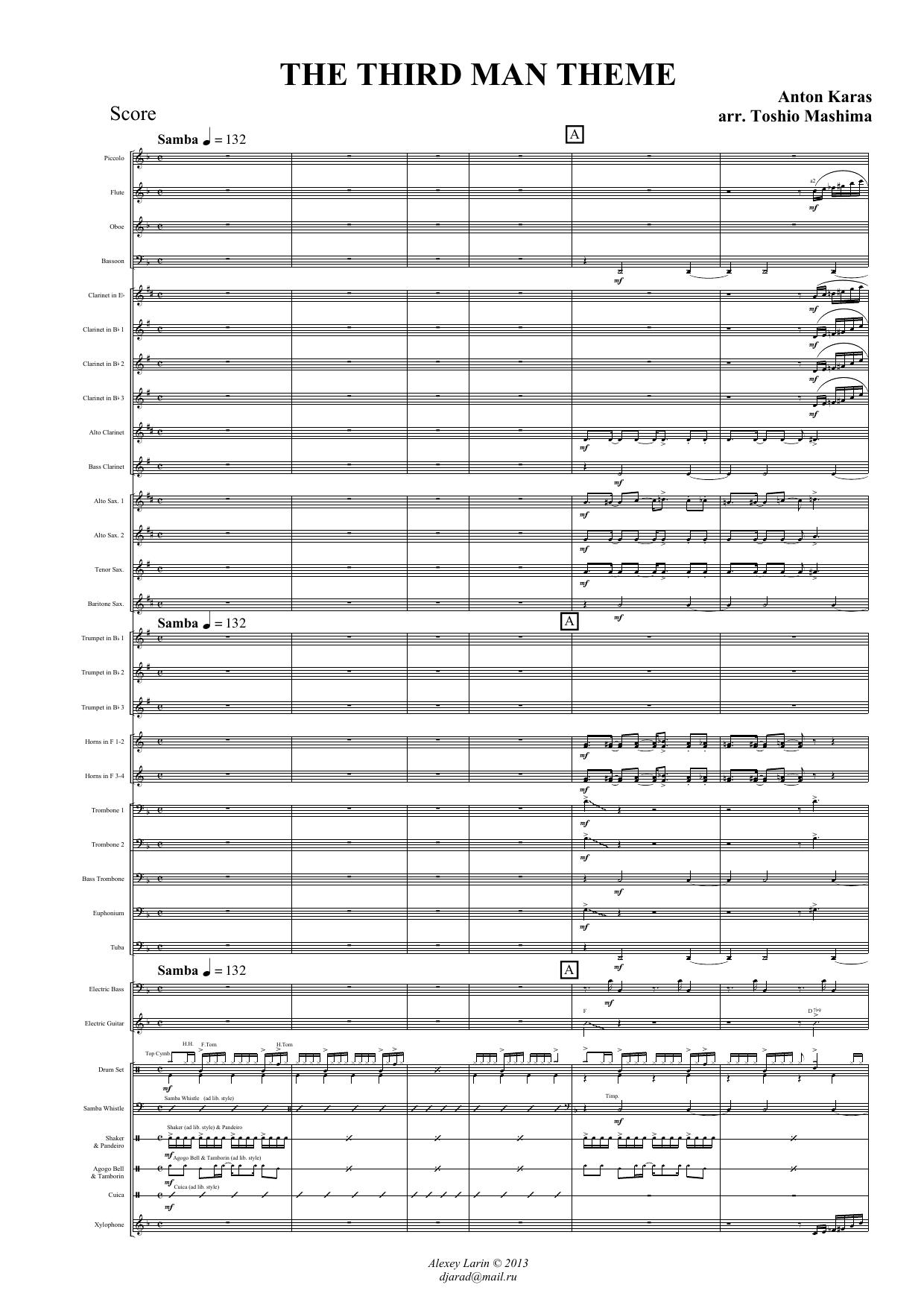
The Third Man Theme (T.Mashima)
Composed by Anton Karas
Arranged by T.Mashima
- Ensemble: Concert Band
- Style: Jazz Standard
- Pages: 107
- Instruments (37): Piccolo, Flute, Oboe, Bassoon, Clarinet in Eb, Clarinet in Bb 1, Clarinet in Bb 2, Clarinet in Bb 3, Alto Clarinet, Bass Clarinet, Alto Saxophone 1, Alto Saxophone 2, Tenor Saxophone, Baritone Saxophone, Trumpet in Bb 1, Trumpet in Bb 2, Trumpet in Bb 3, Horn in F 1-2, Horn in F 3-4, Trombone 1, Trombone 2, Bass Trombone, Euphonium, Tuba, Electric Bass, Electric Guitar, Drum Set, Glockenspiel, Xylophone, Timpani, Samba Whistle, Shaker, Pandeiro, Agogo Bells, Tamborin, Cuica, Suspended Cymbals
- Difficulty: advanced
- Content: Individual Parts
- Format: PDF Download (Instant)
- Price: $22.99
Anton Karas’s iconic melody for Carol Reed’s 1949 film noir classic *The Third Man* forever linked the distinctive, earthy twang of the Austrian zither to post-war Vienna and cinematic intrigue. Originally recorded as a solo zither performance that unexpectedly topped international pop charts, the tune possesses an infectious, melancholic charm bridging Central European folk sensibilities and early mid-century light jazz. Over the decades, the haunting ostinato and mischievous chromatic lines have transitioned seamlessly into the jazz and light concert repertoire, embraced by instrumentalists drawn to its unique modal flavor and instantly recognizable vamp. In this sophisticated concert band setting, T.Mashima refashions the cinematic masterpiece into a vibrant, swinging showpiece that balances nostalgic atmosphere with modern wind band textures. Unfolding at a brisk, buoyant medium-swing tempo in 4/4 time, the arrangement opens with the unmistakable melody introduced playfully in the upper woodwinds before expanding into lush, full-ensemble harmonizations. The harmonic language employs extended tertian structures and clever chromatic passing tones that nod to traditional jazz-standard voicings while keeping the melodic narrative crystal clear. The overall energy shifts deftly between sultry, understated groove sections and sweeping, cinematic climaxes that evoke the misty, gaslit streets of Vienna at midnight. T.Mashima’s signature arranging style shines through in the clever distribution of thematic material across the entire concert band color palette, avoiding static block-scoring in favor of transparent, interactive counterpoint. Trumpets and trombones trade crisp, articulated figures against a rolling rhythmic background laid down by the low brass and percussion, while designated soli passages allow the clarinets and alto saxophones to showcase nimble fingerwork. The arrangement builds toward a dynamic shout chorus featuring roaring brass counter-melodies and punchy percussion accents, briefly modulating to heighten the tension before resolving into a sparkling, high-energy coda. Advanced high school, collegiate, and community concert bands will find this 107-page publication an exceptionally rewarding addition to a pops or light-classical programming rotation. While the rhythmic syncopation requires a solid grasp of swing subdivision, the technical demands are well-balanced across all sections, ensuring every player has an engaging part. Conductor and ensemble alike will appreciate how the meticulous scoring balances massive tutti power with delicate, chamber-like interludes, making it a guaranteed crowd-pleaser that offers genuine musical substance. Achieving an authentic jazz-standard feel in a concert band setting requires strict attention to articulation and stylistic uniformity. The underlying swing eighth-note pattern must remain light and buoyant, avoiding heavy, over-accentuated downbeats; encourage the brass and low reeds to keep their staccato notes short and dry. Directors should pay close attention to the dynamic contrast between the intimate, muted wind passages and the soaring tutti climaxes, ensuring the iconic melody is never masked by the accompaniment. Percussionists should lean into a crisp ride-cymbal swing pattern with a gentle cross-stick or light brush feel on the snare during the quieter verses, opening up for a driving swing groove when the full ensemble enters. Balance in the inner-voice countermelodies is crucial, particularly when passing motives between the saxophones and upper brass. Rehearsals should initially be conducted at a reduced tempo to lock in the intricate chromatic lines and secure clean, uniform articulation across all sections before pushing toward the performance tempo. Q: What instruments and components are included in this publication? A: This comprehensive 107-page publication includes a full conductor score alongside a complete set of standard wind band instrumentation parts, covering all woodwind, brass, and percussion requirements for modern concert bands. Q: What is the difficulty level of this arrangement by T.Mashima? A: This piece is graded as advanced intermediate, making it ideally suited for accomplished high school ensembles, college wind symphonies, and community concert bands with experienced players. Q: What is the musical style and historical background of the piece? A: Based on Anton Karas’s 1949 cinematic theme from *The Third Man*, this arrangement reinterprets the famous melody through the lens of a classic medium-swing jazz standard, blending European folk charm with American swing idioms. Q: What makes this specific arrangement by T.Mashima unique? A: T.Mashima expertly translates a piece originally written for a solo zither into a rich wind band canvas, utilizing transparent woodwind scoring, sophisticated extended harmonies, and a dynamic shout chorus. Q: What is the approximate performance duration and tempo of the work? A: The arrangement is set at a lively medium-swing tempo (approximately quarter note = 120 BPM) and runs for roughly 3.5 to 4 minutes, depending on the chosen pacing and stylistic breadth.
Questions and answers
- What is included in the The Third Man Theme (T.Mashima) PDF?
- The verified current file contains a conductor score and individual parts across 107 pages.
- How many instruments or parts are listed for The Third Man Theme (T.Mashima)?
- The verified instrumentation list contains 37 entries for this Concert Band arrangement.
- Who is credited for The Third Man Theme (T.Mashima)?
- Composer: Anton Karas. Arranger: T.Mashima.
- What difficulty is listed for The Third Man Theme (T.Mashima)?
- The verified difficulty level is advanced.
- What style is listed for The Third Man Theme (T.Mashima)?
- The catalog lists the style as Jazz Standard.
- Can I preview The Third Man Theme (T.Mashima) before buying?
- Yes. The product page provides a preview generated from the current PDF file.
- How is The Third Man Theme (T.Mashima) delivered?
- After successful payment, the digital PDF is made available for download. The displayed price is $22.99.
Musicians Also Search For
The Third Man Theme T.Mashima PDF • The Third Man Theme T.Mashima sheet music • The Third Man Theme arranged by T.Mashima • T.Mashima concert band charts • T.Mashima jazz arrangements PDF • The Third Man Theme Anton Karas sheet music • The Third Man Theme Anton Karas concert band arrangements • Anton Karas concert band charts • The Third Man Theme concert band arrangements • The Third Man Theme concert band PDF download • The Third Man Theme jazz sheet music • concert band sheet music download • The Third Man Theme conductor score PDF • The Third Man Theme individual parts download • The Third Man Theme sheet music PDF • The Third Man Theme Jazz Standard charts • Jazz Standard concert band arrangements • buy The Third Man Theme sheet music • download The Third Man Theme PDF • The Third Man Theme jazz charts • best T.Mashima concert band arrangements • Anton Karas arranged by T.Mashima • The Third Man Theme printable sheet music • concert band repertoire PDF