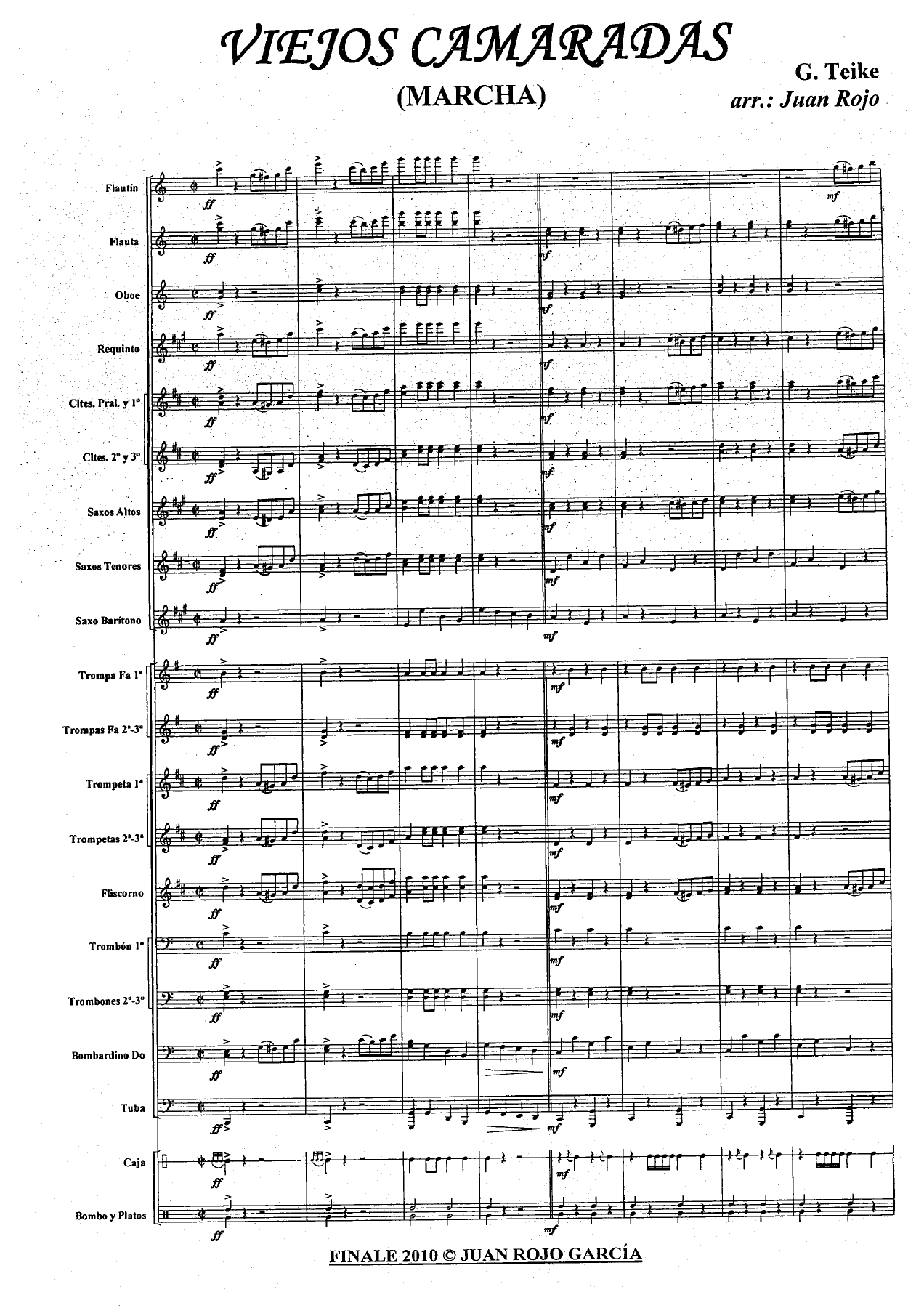
Alte Kameraden (C.Teike)
Composed by Carl Teike
Arranged by C.Teike
- Ensemble: Concert Band
- Style: March
- Pages: 51
- Instruments (30): Flautín, Flauta 1ª, Flauta 2ª, Oboe 1º, Oboe 2º, Requinto, Clarinete Pral., Clarinete 1º, Clarinete 2º, Clarinete 3º, Saxo Alto 1º, Saxo Alto 2º, Saxo Tenor 1º, Saxo Tenor 2º, Saxo Barítono, Fliscorno 1º, Fliscorno 2º, Trompeta 1ª, Trompeta 2ª, Trompeta 3ª, Trompa 1ª Fa, Trompa 2ª Fa, Trompa 3ª Fa, Trombón 1º, Trombón 2º, Trombón 3º, Bombardino 1º Do, Tuba, Bombo y Platos, Caja
- Difficulty: advanced
- Content: Individual Parts
- Format: PDF Download (Instant)
- Price: $22.99
Carl Teike's "Alte Kameraden," composed in 1889, stands as one of the most enduring and recognizable German military marches, transcending its original context to become a global staple of the concert band repertoire. Its title, translating to "Old Comrades," evokes a sense of camaraderie, nostalgia, and steadfastness, themes that resonate universally. While not a jazz standard, its robust melodic lines and clear harmonic structure have made it a favorite for adaptations across various ensembles, including those with a more contemporary or concert band focus. The piece embodies the late 19th-century European march tradition, characterized by strong, memorable melodies, distinct sections, and a powerful, uplifting energy designed for parades, ceremonies, and celebratory performances. Its fame stems from its infectious main theme and its ability to stir a sense of pride and unity, making it a foundational piece in the march genre. This particular arrangement by C.Teike, the original composer, presents "Alte Kameraden" in its quintessential form for concert band, preserving the authentic character and structural integrity of the original work. The musical character is decidedly a majestic, spirited march, typically performed at a brisk *Allegro* or *Alla Marcia* tempo (around 120-130 BPM) in a bright 2/4 or cut-time feel. The primary key is often Eb Major, shifting to Ab Major for the trio section, providing a classic harmonic progression that enhances the march's grandeur. The arrangement features the iconic main theme prominently, often introduced by the brass and woodwinds in unison or octaves, creating a full, resonant sound. The mood is triumphant and resolute, evoking images of military parades and festive gatherings, culminating in a powerful and memorable finale. C.Teike's treatment of his own composition for concert band is masterful, emphasizing clarity, balance, and the inherent power of the ensemble. The arrangement showcases the full spectrum of the concert band, with intricate counter-melodies in the woodwinds complementing the strong brass fanfares. The melody is passed between sections, ensuring engagement for all players, though the trumpets and upper woodwinds often carry the primary melodic statements. There are no featured improvised solos in this traditional march arrangement; instead, the focus is on ensemble precision and dynamic control. Technical challenges include maintaining rhythmic exactitude in fast passages, achieving balanced voicings across the large ensemble, and executing precise articulations characteristic of the march style. The rewarding aspect lies in performing a historically significant and universally beloved piece with its intended power and majesty, creating a cohesive and impactful musical statement. This arrangement is highly suitable for high school, college, community, and even professional concert bands. Its enduring popularity and well-crafted scoring make it an excellent choice for developing ensemble discipline, articulation, and dynamic contrast. For high school and community bands, it offers a challenging yet accessible piece that builds fundamental ensemble skills. College and professional ensembles can refine their precision and musicality, delivering a performance that truly captures the march's historical significance and emotional depth. Its 51 pages indicate a comprehensive score and parts, providing a complete and authoritative rendition of this classic. "Alte Kameraden" demands a precise, energetic performance. The primary technical challenge lies in achieving unified articulation and rhythmic clarity, particularly in the fast eighth-note passages and fanfare-like figures. Conductors should emphasize a crisp, detached articulation for most melodic phrases, avoiding legato unless specifically marked. The tempo should be a consistent *Allegro Alla Marcia*, typically around quarter note = 120-130 BPM, maintaining forward momentum without rushing. Pay close attention to dynamic contrasts, ensuring the *forte* sections are robust and the *piano* sections retain clarity and projection. The trio section in Ab Major requires a slightly broader, more lyrical approach while still maintaining the march feel. Rehearsal tips include isolating brass fanfares for intonation and blend, and woodwind counter-melodies for rhythmic accuracy. Ensure a strong, unified bass line provides a solid foundation throughout. Q: What instruments and parts are included in this arrangement? A: This concert band arrangement includes a full score and individual parts for a standard concert band instrumentation, typically encompassing flutes, oboes, clarinets, bassoons, saxophones, trumpets, horns, trombones, euphonium, tuba, and percussion. Q: What is the difficulty level of this arrangement? A: This arrangement is generally considered to be of medium difficulty, suitable for high school, college, and community concert bands. It presents challenges in articulation, rhythmic precision, and dynamic control, but is accessible to ensembles with solid fundamental skills. Q: What is the musical style and historical context of "Alte Kameraden"? A: "Alte Kameraden" is a classic German military march, composed by Carl Teike in 1889. It represents the late 19th-century European march tradition, characterized by its strong melodic themes, clear structure, and triumphant, patriotic mood. Q: What makes this specific arrangement unique compared to other versions? A: This arrangement is by the original composer, C.Teike, ensuring an authentic and authoritative rendition of the piece for concert band. It faithfully preserves the original melodic and harmonic intent, showcasing the full power and character of the march as envisioned by its creator. Q: What is the typical performance duration and tempo for this piece? A: A typical performance of "Alte Kameraden" lasts approximately 2 minutes and 30 seconds to 3 minutes. It should be performed at a brisk *Allegro Alla Marcia* tempo, generally around quarter note = 120-130 BPM, maintaining a bright and energetic feel.
Questions and answers
- What is included in the Alte Kameraden (C.Teike) PDF?
- The verified current file contains a conductor score and individual parts across 51 pages.
- How many instruments or parts are listed for Alte Kameraden (C.Teike)?
- The verified instrumentation list contains 30 entries for this Concert Band arrangement.
- Who is credited for Alte Kameraden (C.Teike)?
- Composer: Carl Teike. Arranger: C.Teike.
- What difficulty is listed for Alte Kameraden (C.Teike)?
- The verified difficulty level is advanced.
- What style is listed for Alte Kameraden (C.Teike)?
- The catalog lists the style as March.
- Can I preview Alte Kameraden (C.Teike) before buying?
- Yes. The product page provides a preview generated from the current PDF file.
- How is Alte Kameraden (C.Teike) delivered?
- After successful payment, the digital PDF is made available for download. The displayed price is $22.99.
Musicians Also Search For
Alte Kameraden C.Teike PDF • Alte Kameraden C.Teike sheet music • Alte Kameraden arranged by C.Teike • C.Teike concert band charts • C.Teike jazz arrangements PDF • Alte Kameraden Carl Teike sheet music • Alte Kameraden Carl Teike concert band arrangements • Carl Teike concert band charts • Alte Kameraden concert band arrangements • Alte Kameraden concert band PDF download • Alte Kameraden jazz sheet music • concert band sheet music download • Alte Kameraden conductor score PDF • Alte Kameraden individual parts download • Alte Kameraden sheet music PDF • Alte Kameraden March charts • March concert band arrangements • buy Alte Kameraden sheet music • download Alte Kameraden PDF • Alte Kameraden jazz charts • best C.Teike concert band arrangements • Carl Teike arranged by C.Teike • Alte Kameraden printable sheet music • concert band repertoire PDF