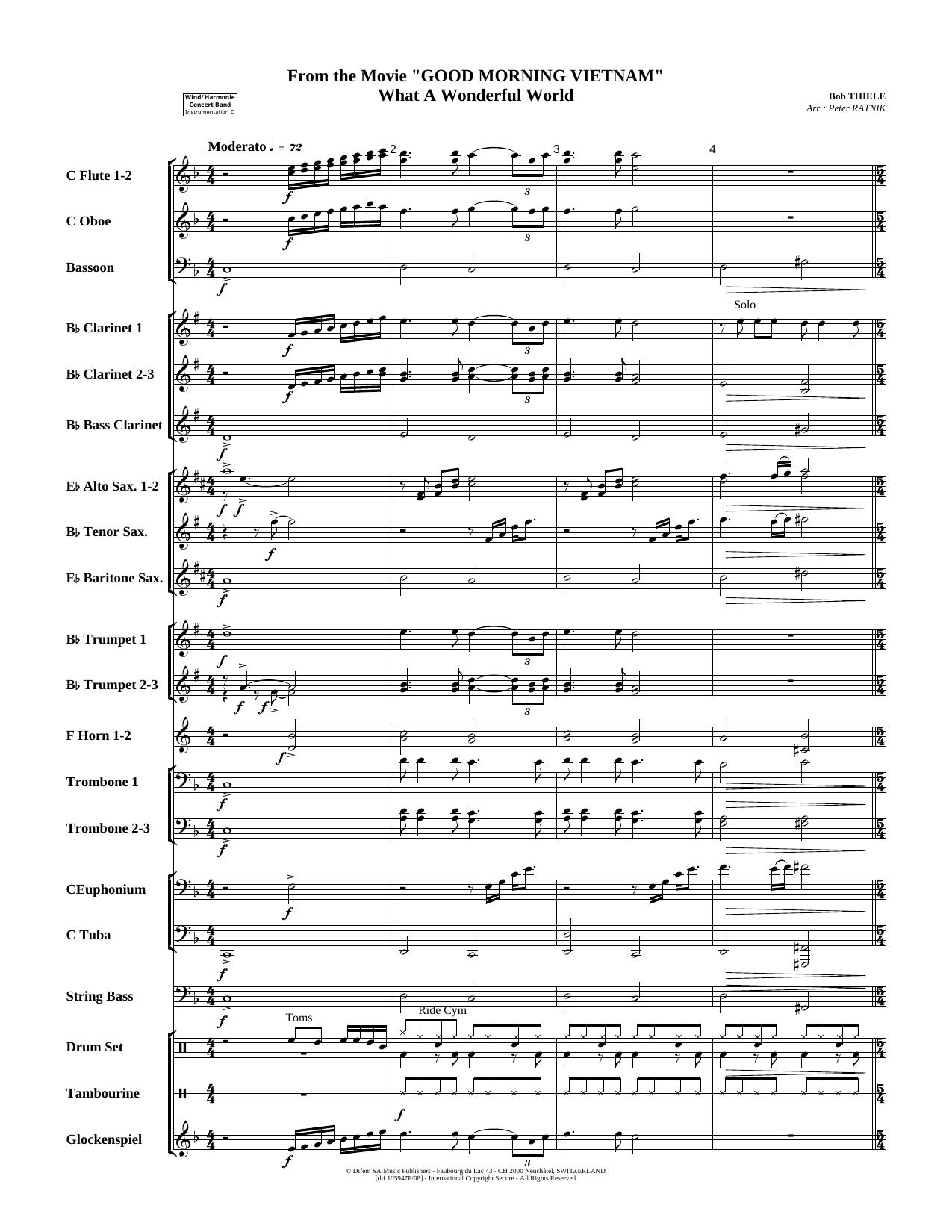
What A Wonderful World (Score & Parts) sheet music preview

What A Wonderful World (Score & Parts)

Composed by Bob Thiele, George David Weiss

Arranged by Score & Parts

  • Ensemble: Concert Band
  • Style: Jazz Standard
  • Pages: 37
  • Difficulty: easy
  • Content: Sheet Music
  • Format: PDF Download (Instant)
  • Price: $22.99

"What A Wonderful World," an enduring anthem of optimism and unity, was originally composed by Bob Thiele and George David Weiss and famously recorded by Louis Armstrong in 1967. Released during a tumultuous period in American history, Armstrong's heartfelt rendition offered a poignant message of hope, instantly cementing the song as a timeless jazz standard and a cultural touchstone. Its simple, evocative melody and profound lyrics have resonated across generations, making it one of the most recognizable and beloved pieces in the popular music canon. While often associated with Armstrong's iconic gravelly voice, its melodic structure and harmonic simplicity lend themselves beautifully to instrumental interpretation, allowing its inherent beauty to shine through an orchestral lens. This concert band arrangement by Score & Parts masterfully translates the song's intimate charm into a rich, full-bodied experience. Eschewing a strict jazz combo feel, the arrangement embraces the grandeur and expressive potential of the concert band, creating a lush soundscape that evokes the original's warmth while adding orchestral depth. The overall feel is a reverent, slow ballad, maintaining the original's reflective tempo (approximately quarter note = 60-66 bpm) and staying primarily in the original key of F major, with judicious modulations to related keys for harmonic interest and emotional lift. The mood is one of profound tranquility and hopeful contemplation, building gently from a delicate opening to a soaring, emotive climax. Score & Parts' distinctive approach to this classic is characterized by its intelligent voicings and dynamic orchestration. The melody is initially introduced by the clarinets and flutes, creating a delicate, ethereal texture, before being passed to the full woodwind section and eventually the brass for a more robust statement. There are no improvised solo sections in this arrangement, ensuring a cohesive and accessible performance for concert bands where traditional jazz soloists may not be readily available. Instead, the arranger focuses on ensemble blend and expressive phrasing, utilizing rich harmonic extensions and carefully crafted counter-melodies within the various sections. A particularly striking feature is the development of the "I see trees of green" motif, which builds through layered instrumentation, culminating in a powerful, yet never overwhelming, full band statement. The arrangement concludes with a return to the initial delicate texture, leaving the audience with a lingering sense of peace and inspiration. This arrangement is ideally suited for high school, college, and community concert bands. Its technical demands are moderate, focusing more on expressive playing, dynamic control, and blend rather than individual virtuosity. Challenging moments include maintaining a consistent slow tempo with precise rhythmic subdivision, achieving balanced voicings in the sustained chordal passages, and executing the subtle dynamic swells and decays that are crucial to the piece's emotional impact. Rewarding to perform, it offers band members the opportunity to connect with a universally cherished melody and to contribute to a collective expression of beauty and hope, making it a perfect addition to any concert program seeking to uplift and inspire. Conductors should prioritize expressive phrasing and dynamic shaping to capture the inherent warmth and optimism of "What A Wonderful World." Maintain a consistent slow ballad tempo (quarter note = 60-66 bpm), emphasizing long, singing lines rather than rhythmic precision alone. Encourage woodwinds to play with a rich, sustained tone, particularly in the opening and closing sections. Brass players should focus on warmth and blend, avoiding harsh attacks, especially in the sustained chordal passages. Pay close attention to the crescendo and diminuendo markings, ensuring a gradual and controlled build to the climactic moments and a gentle, reflective decay. Articulation should generally be legato, with careful attention to releases to avoid abrupt endings. Rehearsal time should be dedicated to achieving seamless transitions between sections and balancing the layered voicings, ensuring the melody always projects clearly without overpowering the accompanying harmonies. Q: What instruments and parts are included in this arrangement? A: This arrangement for concert band includes a full score and individual parts for standard concert band instrumentation, typically encompassing flutes, oboes, clarinets, bassoons, saxophones, trumpets, horns, trombones, euphonium, tuba, and percussion. Q: What is the difficulty level of this arrangement? A: This arrangement is considered to be of moderate difficulty, making it appropriate for high school, college, and community concert bands. It emphasizes musicality, blend, and expressive playing over advanced technical demands. Q: What is the musical style and historical context of "What A Wonderful World" as presented in this arrangement? A: This arrangement presents "What A Wonderful World" as a reflective, slow concert band ballad, honoring its origins as a jazz standard made famous by Louis Armstrong in 1967. It captures the song's timeless message of hope and beauty. Q: What makes this specific arrangement unique compared to other versions? A: This Score & Parts arrangement distinguishes itself by its lush concert band orchestration, intelligent voicings, and focus on ensemble expressiveness rather than improvised solos. It translates the song's intimate charm into a grand, yet warm, orchestral soundscape. Q: What is the approximate performance duration and recommended tempo for this piece? A: The approximate performance duration for this arrangement is around 3-4 minutes. The recommended tempo is a slow ballad, typically around quarter note = 60-66 bpm, to allow for full expressive phrasing and sustain.

Musicians Also Search For

What A Wonderful World Score & Parts PDFWhat A Wonderful World Score & Parts sheet musicWhat A Wonderful World arranged by Score & PartsScore & Parts concert band chartsScore & Parts jazz arrangements PDFWhat A Wonderful World Bob Thiele, George David Weiss sheet musicWhat A Wonderful World Bob Thiele, George David Weiss concert band arrangementBob Thiele, George David Weiss concert band chartsWhat A Wonderful World concert band arrangementWhat A Wonderful World concert band PDF downloadWhat A Wonderful World jazz ensemble sheet musicconcert band sheet music instant downloadWhat A Wonderful World sheet music with partsWhat A Wonderful World Jazz Standard chartJazz Standard concert band arrangementsbuy What A Wonderful World sheet music onlinedownload What A Wonderful World PDFWhat A Wonderful World jazz chartbest Score & Parts concert band arrangementsBob Thiele, George David Weiss songs arranged by Score & PartsWhat A Wonderful World printable sheet musicconcert band repertoire PDF

All arrangements by Score & Parts All Bob Thiele, George David Weiss sheet music