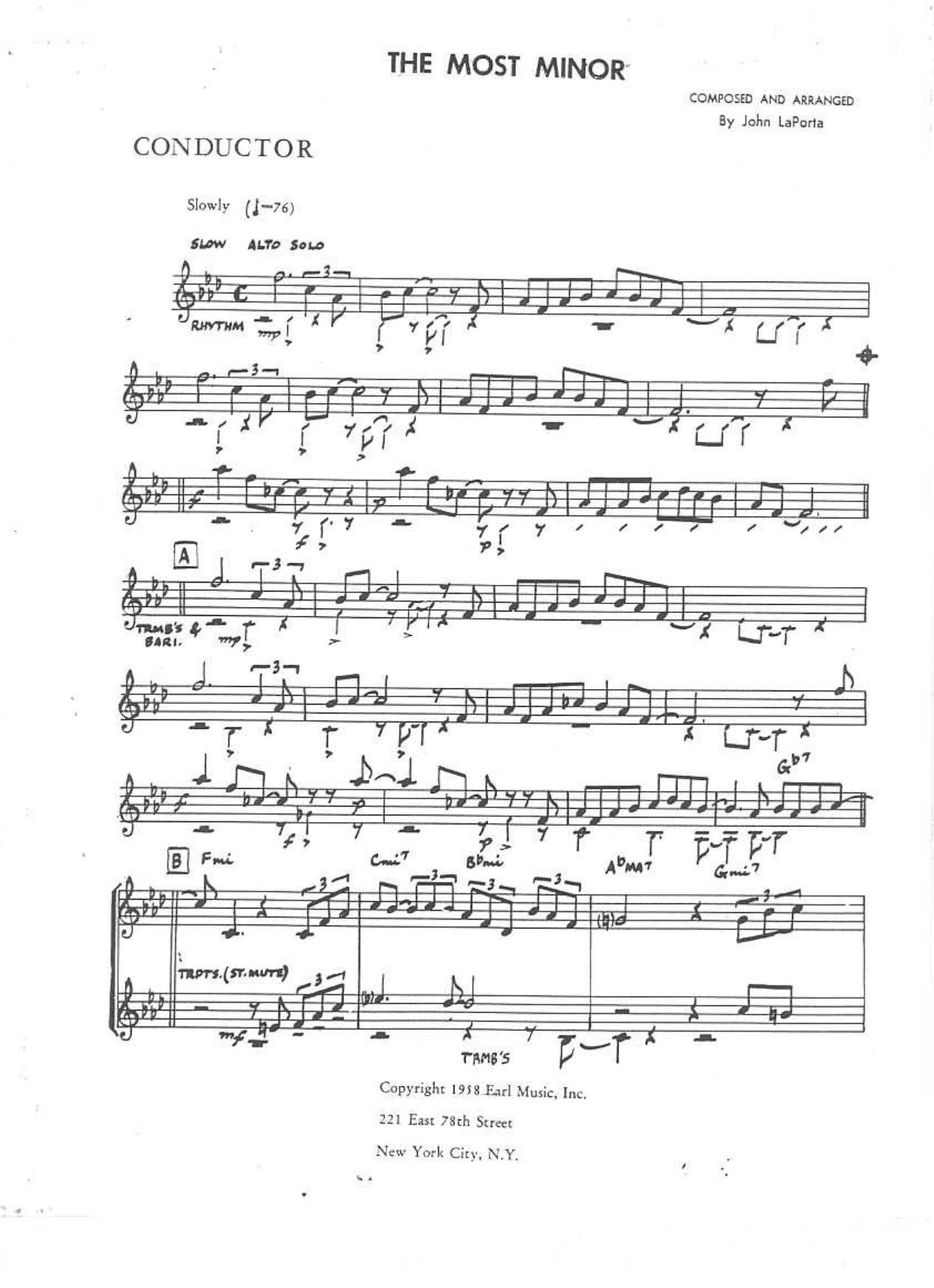
The Most Minor (J.LaPorta)
Composed by John LaPorta
Arranged by J.LaPorta
- Ensemble: Big Band
- Style: Jazz Standard
- Pages: 20
- Instruments (18): Conductor, Alto Sax I, Alto Sax II, Tenor Sax I, Tenor Sax II, Baritone, Trombone I, Trombone II, Trombone III, Trombone IV, Trumpet I, Trumpet II, Trumpet III, Trumpet IV, Piano, Bass, Drums, Guitar
- Difficulty: easy
- Content: Individual Parts
- Format: PDF Download (Instant)
- Price: $24.99
John LaPorta’s contribution to modern jazz pedagogy and composition remains a cornerstone of mid-century American modernism, bridging the gap between bebop innovation and structured big band writing. "The Most Minor" captures the intellectual rigor and soulful accessibility that defined LaPorta's career, reflecting an era when jazz composition began embracing modal explorations and complex harmonic frameworks without losing its fundamental swing groove. As a notable entry in the modern big band canon, this piece stands out for its sophisticated interplay between dense harmonic textures and linear counterpoint, channeling the spirit of progressive jazz workshops and elite collegiate ensembles of the post-war era. Driven by an infectious, medium-tempo swing feel in 4/4 time, the composition balances an edgy, chromatic urbanity with moments of swinging release. The harmonic landscape is heavily anchored in minor tonalities, creating a moody, suspenseful atmosphere that shifts effortlessly between brooding, introspective ensemble passages and high-energy outbursts. The mood is sophisticated and intellectually stimulating, evoking the smoky ambiance of 1950s modernist jazz clubs while maintaining a timeless vitality that commands an audience's undivided attention from the downbeat. In this masterful treatment, J.LaPorta utilizes a transparent orchestration style that avoids thick, turgid block chords in favor of linear independence and crisp sectional dialogue. The arrangement features tightly knit saxophone solis that demand absolute precision and unified articulation, alongside dynamic shout choruses that build tension through clever rhythmic displacement and extended upper-structure harmonies. Rather than relying on bombastic volume, the arrangement achieves its power through brilliant contrast, pitting whispering muted brass against roaring tutti statements and allowing the countermelodies to weave organically through the texture. Melodic duties are distributed democratically across the ensemble, though the saxophone section frequently drives the thematic material, supported by crisp, punctuated brass interjections. Solo opportunities are provided for featured improvisers, framed by meticulously crafted background figures that inspire rather than clutter. Technical challenges center on the execution of intricate chromatic lines, secure intonation within minor-key extended chords, and maintaining a relaxed, driving swing feel at moderate tempos. Advanced high school, collegiate, and professional jazz orchestras will find this chart deeply rewarding, as it offers a masterclass in ensemble balance, stylistic nuance, and sophisticated modern swing phrasing. Achieving success with "The Most Minor" requires meticulous attention to articulation, balance, and stylistic unity within the rhythm section. The tempo should remain locked in a steady, driving medium swing; avoid the temptation to rush during the dense harmonic transitions. The rhythm section is the engine: the bassist should walk a quarter-note line with strong quarter-note articulation, while the drummer maintains a traditional ride cymbal pattern with crisp hi-hat chicks on beats two and four. For the wind sections, the primary technical hurdle lies in executing the chromatic bebop-inflected lines with a light, legato tongue, ensuring that all eighth-note passages swing naturally rather than sounding square. Brass players should pay close attention to dynamic markings during ensemble solis, keeping backgrounds subdued so that the primary melodic voices project clearly without forced tone production. Rehearsal time should be initially dedicated to sectional work on the intricate counterpoint before integrating the full ensemble, ensuring that intonation on minor-seventh and altered dominant chords remains pristine throughout. Q: What instruments and parts are included in this arrangement? A: This complete 17-instrument big band arrangement includes parts for 2 alto saxophones, 2 tenor saxophones, baritone saxophone, standard brass instrumentation, and a full rhythm section, accompanied by a comprehensive 20-page conductor score. Q: What is the difficulty level of this arrangement? A: This piece is best suited for advanced high school, collegiate, and professional jazz orchestras due to its sophisticated chromaticism, intricate ensemble solis, and demand for advanced reading and intonation skills. Q: What is the musical style and historical context of the piece? A: Written in the style of mid-century modern jazz standards, the piece reflects the progressive post-bop era, combining traditional swing grooves with modal and chromatic harmonic explorations pioneered by jazz innovators like John LaPorta. Q: What makes this specific arrangement unique? A: J.LaPorta’s arrangement is distinguished by its transparent orchestration, linear independence among sections, and clever avoidance of thick block-chord writing in favor of dynamic, counterpoint-driven textures. Q: What is the expected performance tempo and duration? A: The arrangement is set to a driving, medium-tempo swing feel in 4/4 time, providing an ideal canvas for extended melodic development and featured improvisational spaces within a standard performance timeframe.
Questions and answers
- What is included in the The Most Minor (J.LaPorta) PDF?
- The verified current file contains a conductor score and individual parts across 20 pages.
- How many instruments or parts are listed for The Most Minor (J.LaPorta)?
- The verified instrumentation list contains 18 entries for this Big Band arrangement.
- Who is credited for The Most Minor (J.LaPorta)?
- Composer: John LaPorta. Arranger: J.LaPorta.
- What difficulty is listed for The Most Minor (J.LaPorta)?
- The verified difficulty level is easy.
- What style is listed for The Most Minor (J.LaPorta)?
- The catalog lists the style as Jazz Standard.
- Can I preview The Most Minor (J.LaPorta) before buying?
- Yes. The product page provides a preview generated from the current PDF file.
- How is The Most Minor (J.LaPorta) delivered?
- After successful payment, the digital PDF is made available for download. The displayed price is $24.99.
Musicians Also Search For
The Most Minor J.LaPorta PDF • The Most Minor J.LaPorta sheet music • The Most Minor arranged by J.LaPorta • J.LaPorta big band charts • J.LaPorta jazz arrangements PDF • The Most Minor John LaPorta sheet music • The Most Minor John LaPorta big band arrangements • John LaPorta big band charts • The Most Minor big band arrangements • The Most Minor big band PDF download • The Most Minor jazz sheet music • big band sheet music download • The Most Minor conductor score PDF • The Most Minor individual parts download • The Most Minor sheet music PDF • The Most Minor Jazz Standard charts • Jazz Standard big band arrangements • buy The Most Minor sheet music • download The Most Minor PDF • The Most Minor jazz charts • best J.LaPorta big band arrangements • John LaPorta arranged by J.LaPorta • The Most Minor printable sheet music • big band repertoire PDF