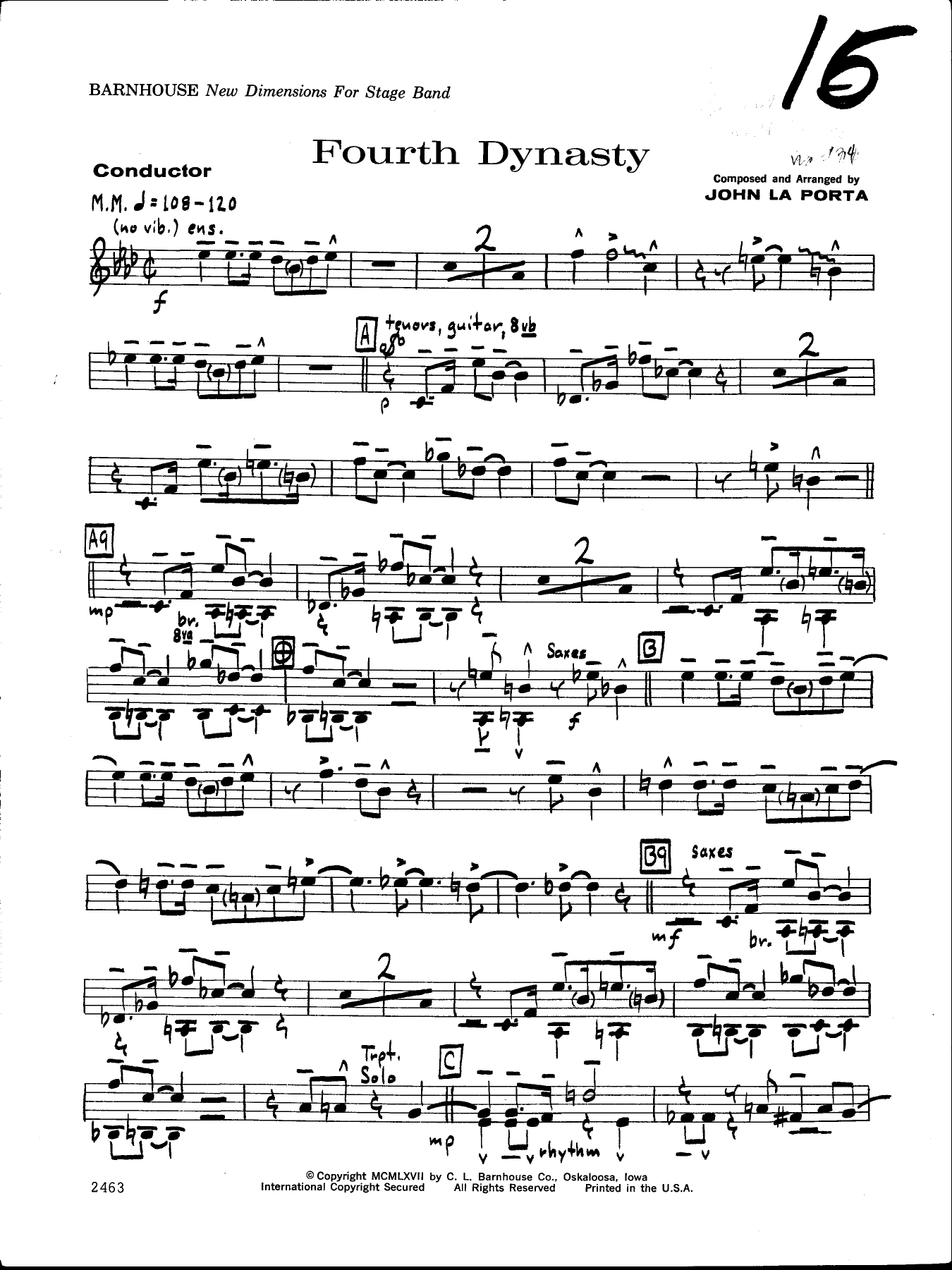
Fourth Dynasty (J.LaPorta) sheet music preview

Fourth Dynasty (J.LaPorta)

Composed by John LaPorta

Arranged by J.LaPorta

  • Ensemble: Big Band
  • Pages: 28
  • Instruments (18): Conductor, 1st Eb Alto Saxophone, 2nd Eb Alto Saxophone, 1st Bb Tenor Saxophone, 2nd Bb Tenor Saxophone, Eb Baritone Saxophone, 1st Bb Trumpet, 2nd Bb Trumpet, 3rd Bb Trumpet, 4th Bb Trumpet, 1st Trombone, 2nd Trombone, 3rd Trombone, 4th Trombone, Bass, Drums, Piano, Guitar
  • Difficulty: medium
  • Content: Individual Parts
  • Format: PDF Download (Instant)
  • Price: $24.99

Modal exploration meets contemporary big band writing in "Fourth Dynasty," an imaginative arrangement by J.LaPorta that breathes fresh life into traditional musical foundations. Drawing inspiration from the modal jazz experiments of the late 1960s and early 1970s—an era pioneered by modal innovators and popularized by adventurous jazz orchestras of the post-bop generation—this composition bridges ancient-sounding folk modalities with modern harmonic sophistication. The piece functions as a captivating journey through shifting tonal centers, avoiding standard ii-V-I progressions in favor of expansive, open-ended scalar frameworks that evoke a sense of ancient mystery combined with urban sophistication. Propelled by an insistent, hypnotic groove, the music shifts fluidly between a driving contemporary straight-eighth feel and expansive, floating rubato passages. The harmonic language is rich with quartal voicings, suspended chords, and subtle chromatic inner-voice movements that create a brooding, high-energy atmosphere. As the arrangement unfolds, the emotional intensity builds from a cool, contemplative opening statement into a thunderous, rhythmically complex climax. The use of space and dynamic contrast is masterful, allowing shimmering textures in the upper woodwinds and brass to give way to heavy, modal vamp sections that demand absolute rhythmic precision from the rhythm section. J.LaPorta approaches the ensemble with an ear toward rich textural variety, utilizing inventive counterpoint and dense, interlocking horn solis that avoid predictable big band clichés. Rather than relying solely on traditional block-voicing, LaPorta treats the eight-instrument ensemble as a chamber jazz orchestra, giving individual voices considerable independence. The arrangement features striking dynamic shifts, sophisticated dynamic layering, and a commanding shout chorus that reworks the primary theme through jagged rhythmic displacement and searing upper-structure triads. The transition points between sections are seamless, driven by sophisticated motivic development that ties the entire chart together. Melodic duties are shared democratically across the ensemble, though the primary thematic material is introduced with striking clarity by the alto and tenor saxophones before the trumpet and trombone enter to widen the harmonic canvas. Improvisational space is carved out thoughtfully, providing featured soloists a modal canvas to stretch their creative wings over a dynamic, evolving accompaniment. Technically, the arrangement demands strong ensemble listening skills, precise articulation in the sax section, and a rhythm section capable of maintaining a relentless, hypnotic pulse while reacting organically to the horns. Advanced high school groups, collegiate ensembles, and professional modern jazz guilds will find this chart deeply rewarding, as it challenges musicians to balance intellectual modal awareness with visceral, high-energy performance. Success with "Fourth Dynasty" hinges on maintaining a relentless, driving pulse while executing the intricate modal shifts with absolute transparency. Conductors should establish a crisp, articulate straight-eighth feel that avoids sounding stiff; the rhythm section must lock in tightly, treating the underlying groove as a living, breathing entity rather than a rigid metronome. The primary technical challenge lies in the execution of tight, fast-moving unison and harmonized lines across the saxophone section, which require meticulous attention to intonation and blended articulation. Dynamic contrast is essential; ensure the ensemble pulls back significantly during the sparse modal vamps so that the eventual crescendo into the shout chorus has maximum impact. Horn players should utilize clean, modern tone qualities with minimal vibrato to preserve the contemporary modal aesthetic. Rehearsal time should be heavily invested in sectionals, isolating the complex metric modulations and ensuring that the rhythm section's vamp layers cleanly beneath the improvised solos without cluttering the harmonic space. Q: What specific instruments and parts are included in this 28-page arrangement? A: This arrangement is scored for an 8-instrument ensemble comprising Alto Saxophone, Tenor Saxophone, Baritone Saxophone, Trumpet, Trombone, and a complete rhythm section framework. Q: What is the official difficulty level of J.LaPorta's "Fourth Dynasty"? A: It is classified as an advanced-intermediate to advanced chart, best suited for skilled high school, collegiate, and professional jazz ensembles comfortable with modal harmony and complex straight-eighth feels. Q: What is the musical style and historical context of this piece? A: Rooted in traditional modal jazz frameworks popularized during the late 1960s and 1970s, the piece blends ancient-sounding scalar melodies with modern post-bop big band harmonies. Q: What makes this specific arrangement by J.LaPorta unique? A: It stands out through its chamber-jazz approach to an 8-piece ensemble, utilizing independent voice-leading, quartal voicings, and a gripping modal shout chorus that avoids standard big band clichés. Q: What is the performance duration and tempo framework of the piece? A: The arrangement runs approximately 5 to 6 minutes and is anchored by a driving, hypnotic tempo feel that balances straight-eighth modal grooves with expansive rubato sections.

Questions and answers

What is included in the Fourth Dynasty (J.LaPorta) PDF?
The verified current file contains a conductor score and individual parts across 28 pages.
How many instruments or parts are listed for Fourth Dynasty (J.LaPorta)?
The verified instrumentation list contains 18 entries for this Big Band arrangement.
Who is credited for Fourth Dynasty (J.LaPorta)?
Composer: John LaPorta. Arranger: J.LaPorta.
What difficulty is listed for Fourth Dynasty (J.LaPorta)?
The verified difficulty level is medium.
Can I preview Fourth Dynasty (J.LaPorta) before buying?
Yes. The product page provides a preview generated from the current PDF file.
How is Fourth Dynasty (J.LaPorta) delivered?
After successful payment, the digital PDF is made available for download. The displayed price is $24.99.

Musicians Also Search For

Fourth Dynasty J.LaPorta PDFFourth Dynasty J.LaPorta sheet musicFourth Dynasty arranged by J.LaPortaJ.LaPorta big band chartsJ.LaPorta jazz arrangements PDFFourth Dynasty John LaPorta sheet musicFourth Dynasty John LaPorta big band arrangementsJohn LaPorta big band chartsFourth Dynasty big band arrangementsFourth Dynasty big band PDF downloadFourth Dynasty jazz sheet musicbig band sheet music downloadFourth Dynasty conductor score PDFFourth Dynasty individual parts downloadFourth Dynasty sheet music PDFbuy Fourth Dynasty sheet musicdownload Fourth Dynasty PDFFourth Dynasty jazz chartsbest J.LaPorta big band arrangementsJohn LaPorta arranged by J.LaPortaFourth Dynasty printable sheet musicbig band repertoire PDF

All arrangements by J.LaPorta All John LaPorta sheet music